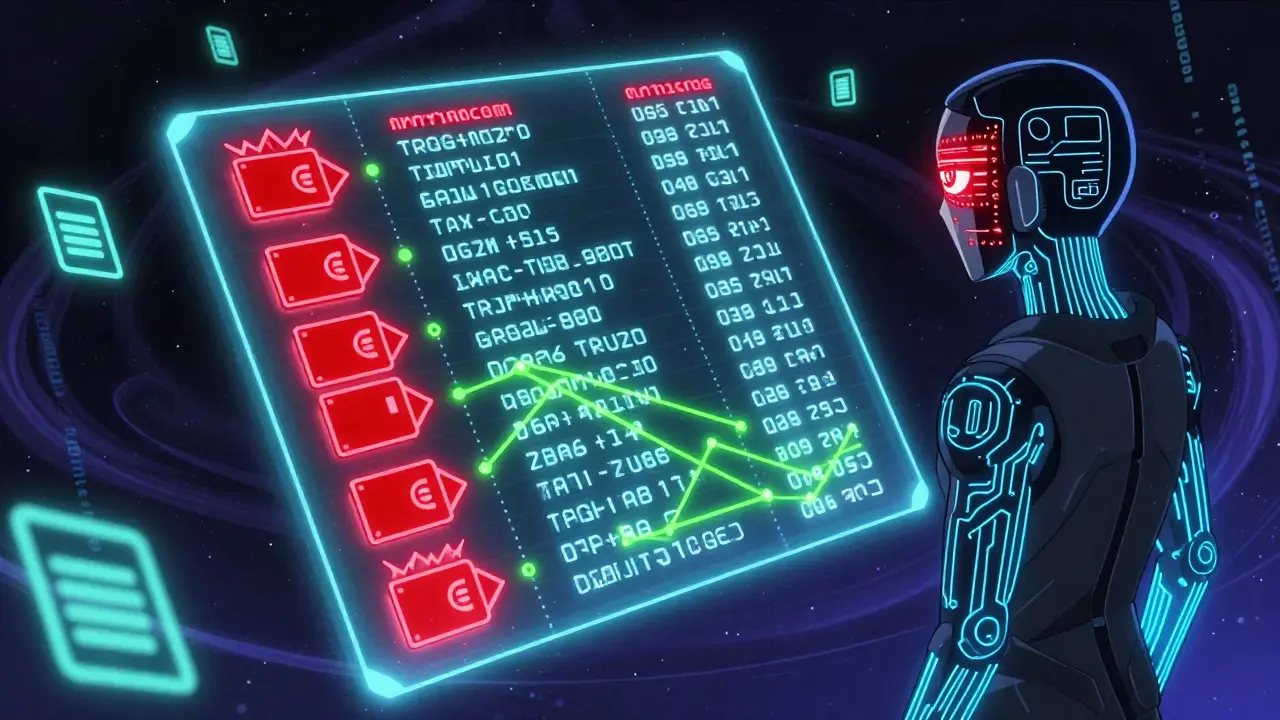
Blockchain was supposed to be the ultimate solution to fraud. Immutable ledgers. Decentralized networks. Transparent transactions. But here’s the truth: blockchain doesn’t stop fraud-it just makes it harder to hide. And that’s where AI comes in.
Scammers aren’t waiting around. They’re using AI themselves to craft smarter scams: fake wallets that mimic real ones, coordinated token swaps that launder millions across chains, and smurfing attacks that drip small amounts to dodge thresholds. Traditional rule-based systems? They’re blind to these patterns. They flag every odd transaction, drowning compliance teams in false alarms. That’s not security-it’s noise.
AI changes everything. It doesn’t just look at one transaction. It watches hundreds of thousands-and learns what normal looks like for every wallet, every address, every behavior. If a wallet that’s been sending 0.02 ETH every Tuesday suddenly sends 5 ETH to a newly created address? AI notices. Not because it was told to. Because it learned that this kind of shift is almost always a red flag.
How AI Sees Blockchain Transactions
Think of blockchain as a public ledger that never forgets. Every transaction is recorded forever. That’s powerful-but without context, it’s just data. AI turns that data into insight.
Machine learning models like XGBoost and Random Forest are trained on millions of past transactions. They don’t just look at amounts or timestamps. They analyze:
- How often a wallet interacts with other addresses
- Whether funds move quickly between multiple wallets (a classic money laundering tactic)
- If a wallet was created the same day as a scam campaign went live
- Whether transaction patterns match known scam signatures across Bitcoin, Ethereum, Solana, and other chains
These models don’t rely on fixed rules. They adapt. If a new scam emerges-say, fake DeFi yield farms that vanish after collecting deposits-AI learns from the first few victims and flags similar patterns before more people get hurt.
The Three Layers of Fraud Detection
Modern AI systems don’t just look at on-chain data. They fuse three layers to build a full picture:
- On-chain data: Transaction graphs, wallet clustering, smart contract behavior. For example, if 12 new wallets all send ETH to the same contract within 90 seconds, that’s not coincidence-it’s a bot-driven scam.
- Off-chain intelligence: Exchange records, bank reports, sanctions lists, leaked hacker infrastructure. If a wallet is linked to a known darknet market or a flagged fiat gateway, AI adds that risk score instantly.
- Community signals: Real-time reports from users who spotted phishing links, fake Twitter accounts, or scammy Discord admins. These aren’t just tips-they’re live threat feeds.
Put together, this creates a risk score for every address. A wallet might look clean on-chain. But if it’s connected to a flagged exchange, has a history of interacting with known scam contracts, and was created after a recent phishing campaign, AI flags it as high-risk-even if no transaction has happened yet.
Real-Time Prevention, Not Just Post-Facto Tracking
Before AI, fraud detection was like cleaning up after a flood. You’d see the damage, then trace where the water came from. Now, AI stops the flood before it starts.
Crypto exchanges use AI to:
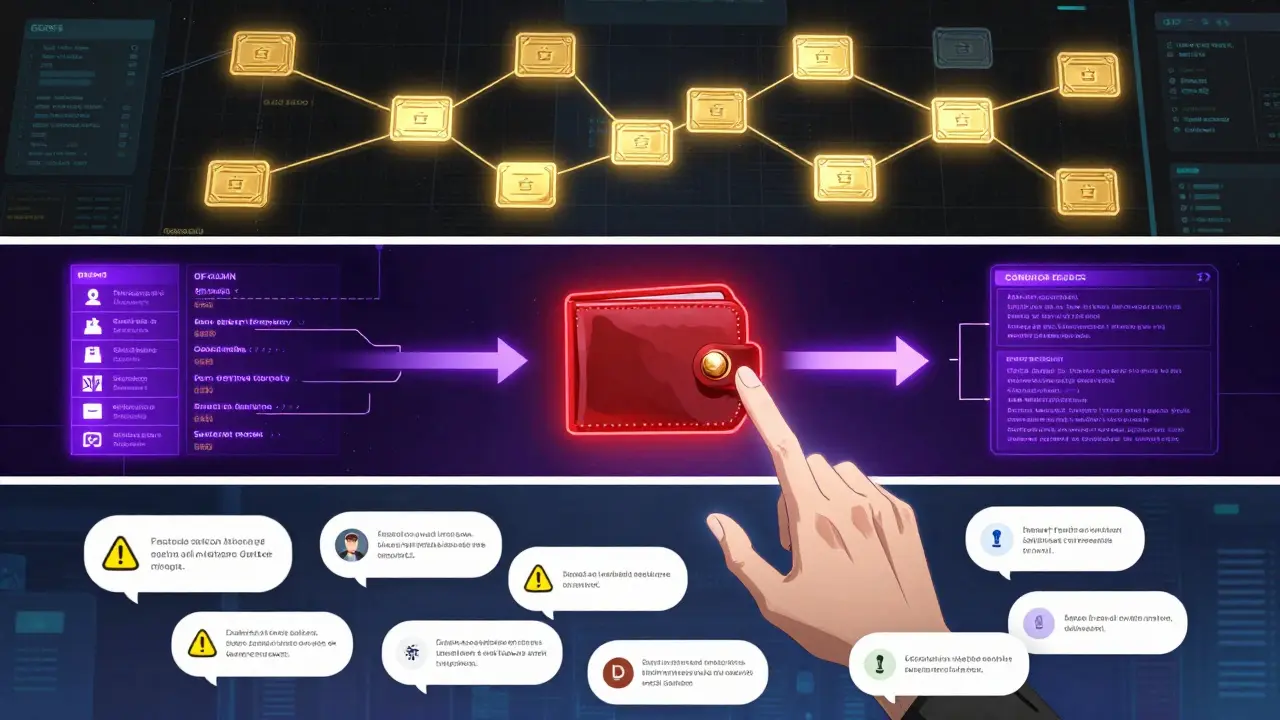
- Block withdrawals to high-risk addresses before funds leave
- Pause transfers from accounts showing sudden behavioral shifts
- Send instant warnings to users: “You’re about to send funds to a wallet linked to $2.3M in scams.”
In 2025, one major exchange stopped over $87 million in fraudulent transfers before they were completed-using AI-driven real-time blocking. That’s not luck. That’s pattern recognition at scale.
Law enforcement agencies now get live alerts when a scam network is forming. They can trace how funds move from one chain to another, identify cash-out points, and even freeze assets before they’re converted to fiat. This wasn’t possible five years ago.
Why AI Beats Old Rule-Based Systems
Old systems used rules like: “Block any transaction over $10,000.” Or “Flag transfers to unknown addresses.”
Here’s the problem: legitimate users get blocked. A small business sending regular payments to vendors? Flagged. A crypto investor moving funds between wallets? Flagged. A miner paying gas fees? Flagged.
These systems generated 90% false positives. That meant compliance teams spent 80% of their time chasing ghosts.
AI fixes this. It doesn’t just look at the transaction. It looks at the context. Is this the same user who’s made 200 small transactions over the last year? Yes? Then a $5,000 transfer isn’t suspicious-it’s just bigger than usual. But if that same user suddenly starts sending micro-transactions to 50 new wallets? That’s smurfing. And AI spots it.
AI reduces false positives by 70% or more. That means fewer frustrated users. Fewer manual reviews. And more time to catch real threats.
How Smart Contracts Are Being Secured
Smart contracts are supposed to be self-executing and trustless. But if they’re poorly coded, they’re open doors for hackers.
AI tools now scan smart contracts before they go live. They look for:
- Reentrancy bugs (where a hacker can drain funds by calling the contract repeatedly)
- Unprotected functions that let anyone call critical actions
- Logic flaws in token transfer rules
One study showed AI could detect 92% of known vulnerabilities in DeFi contracts before deployment-something manual audits missed half the time. These systems don’t just find bugs. They predict how an attacker might exploit them, based on past hacks.

The Arms Race: Scammers vs. AI
Scammers aren’t sitting still. They’re using AI to automate phishing, generate deepfake voice scams, and create wallets that mimic real user behavior. Some now use generative AI to simulate transaction patterns that fool basic anomaly detectors.
That’s why AI systems must evolve too. They now use behavioral biometrics: not just what you send, but how you send it. Timing. Device fingerprint. Location patterns. Even the way you type in a wallet password (yes, some systems track that).
If a user’s wallet is accessed from a new device at 3 a.m., with a different IP and typing speed, AI raises the alarm-even if the transaction itself looks normal.
This is the future: not just detecting fraud, but predicting it before it happens.
What’s Next?
AI for blockchain security is still young-but growing fast. In 2026, we’ll see:
- AI models trained on cross-chain data to detect scams that jump between Ethereum, Solana, and Polygon
- Decentralized AI networks where multiple nodes validate fraud signals without relying on one company
- Wallets that auto-protect users by blocking risky interactions before they’re confirmed
The goal isn’t to replace blockchain. It’s to make it safer. Blockchain gives us trust. AI gives us vigilance.
Together, they’re not just preventing fraud. They’re rebuilding trust in digital finance-one smart detection at a time.
Can AI completely eliminate fraud on blockchain?
No-AI can’t eliminate fraud entirely. But it can stop over 90% of known scams before they succeed. Fraudsters will always adapt, so detection must evolve too. AI’s strength is speed and scale: it catches patterns humans can’t see in real time. The goal isn’t perfection-it’s making fraud too costly and too risky to attempt.
Do I need AI if I use a hardware wallet?
Hardware wallets protect your private keys, but they don’t stop you from sending funds to a scam address. AI steps in where you’re vulnerable: at the point of transaction. If you try to send ETH to a known scam wallet, your exchange or wallet app can warn you-even if you’re using a Ledger or Trezor. AI protects you from yourself.
How does AI handle privacy on public blockchains?
AI doesn’t need to see your identity. It analyzes transaction patterns-addresses, timing, amounts, connections-without knowing who owns them. Privacy-focused blockchains like Zcash or Monero are harder to monitor, but even they can be analyzed for behavioral anomalies. AI focuses on behavior, not identity.
Is AI-powered fraud detection only for big exchanges?
No. Smaller platforms can use API-based blockchain intelligence tools that cost less than $500/month. These tools give you the same detection power as Coinbase or Binance, without needing to build your own AI. Many startups now offer plug-and-play fraud detection for DeFi apps and wallet services.
Can AI be tricked by sophisticated scammers?
Yes, but it’s getting harder. Early AI models were fooled by simple mimicry. Modern systems use ensemble learning-combining dozens of models that each look at different signals. One model might catch timing anomalies. Another might detect wallet clustering. A third might flag off-chain links. To fool them all, a scammer would need to replicate every behavior perfectly-and even then, the system learns from each attempt.
Elijah Young
February 14, 2026 AT 14:19AI is changing the game, no doubt. But I’ve seen too many systems that flag legitimate transfers just because they’re ‘unusual.’ The real win here is reducing false positives-finally, compliance teams can focus on real threats instead of panic-cleaning their inboxes.
Still, I worry about over-reliance. What happens when the model gets lazy? Or when the training data gets skewed? We need human oversight, not just automation.
Beth Trittschuh
February 15, 2026 AT 01:49It’s wild to think that we’re now teaching machines to read the silent language of money… the rhythm of transactions, the hesitation in micro-transfers, the ghost of a wallet that never quite fits in.
AI doesn’t just detect fraud. It senses loneliness in a wallet that’s been abandoned for months, then suddenly wakes up at 3 a.m. with a new purpose.
🫶
Benjamin Andrew
February 15, 2026 AT 23:24This entire article is a glorified marketing whitepaper for AI vendors. You’re telling me that a model trained on historical data can predict future behavior better than a human analyst? Please. The moment you automate risk assessment, you create systemic blind spots. Scammers don’t need to outsmart AI-they just need to outlast its training cycle.
Also, where’s the peer-reviewed study backing the 90% fraud reduction claim? I’m not impressed by anecdotal exchange stats.
Joe Osowski
February 16, 2026 AT 06:24AI? Yeah, right. Meanwhile, real Americans are getting scammed because some Silicon Valley algorithm decided their $300 transfer to their cousin’s wallet was ‘suspicious.’
And now we’re supposed to trust machines that don’t even know what a Thanksgiving dinner is? This is why crypto is doomed. You’re replacing trust with code… and code breaks.
Jeremy Lim
February 17, 2026 AT 12:26So… AI is just a fancy rule engine with a neural net wrapper? Cool. Cool. Cool. And yet, it still can’t tell the difference between a miner paying gas and a wash trader. So we’re back to square one…
Also, why are we even talking about this? Isn’t blockchain supposed to be trustless? Now we need AI to trust the blockchain? Huh.
...I’m confused.
John Doyle
February 19, 2026 AT 03:56Yessssss this is exactly what we needed!
I used to lose sleep wondering if I’d accidentally sent ETH to a scammer. Now my wallet just says ‘Hold up-this address has been flagged in 12 other scams.’ I pause. I check. I’m safe.
AI isn’t perfect, but it’s the first thing that actually feels like a safety net instead of a trap. Thank you to everyone building this.
🙌
Grace Mugambi
February 19, 2026 AT 15:10There’s a deeper question here: if we’re using AI to detect behavior anomalies, are we also training people to behave more predictably? Are we slowly erasing the messy, human patterns of finance just to make machines happy?
What happens when every wallet learns to mimic ‘normal’ behavior to avoid flags? Do we lose the freedom to transact oddly? To be spontaneous? To be human?
Not saying we shouldn’t use AI. Just asking: at what cost?
Crystal McCoun
February 20, 2026 AT 18:01One thing I’ve learned from working with blockchain security teams: AI doesn’t replace intuition-it amplifies it.
When a compliance analyst sees a pattern flagged by AI, they don’t just accept it. They dig. They cross-reference. They call the user. That human-AI loop is what makes this work.
And yes, it works for small platforms too. I’ve helped three DeFi startups set up API-based detection for under $500/month. It’s not magic. It’s just smart tooling.
You don’t need a PhD. You just need to care.
Donna Patters
February 21, 2026 AT 18:54How quaint. You believe AI can solve what human greed cannot?
Let me be clear: fraud is not a technical problem. It is a moral vacuum. No algorithm can fill that. No model can restore integrity.
You are not securing blockchain. You are merely decorating a house built on sand-with machine learning wallpaper.
And for that, I am profoundly disappointed.
Michelle Cochran
February 22, 2026 AT 05:02AI is just the latest cult of efficiency. We used to have humans reviewing transactions. Now we have black boxes making life-or-death financial calls without accountability.
And you call this progress?
Who audits the auditors? Who trains the trainers? Who is responsible when the AI misfires and freezes someone’s life savings?
This isn’t innovation. It’s outsourcing ethics to a neural network.
monique mannino
February 22, 2026 AT 05:52I love how this tech helps people like my cousin in Manila who sends remittances home. She never knew what a smart contract was… but now her app says, ‘Hey, this address is sketchy.’ And she stops.
That’s power.
Not because it’s fancy. But because it’s kind.
❤️
Peggi shabaaz
February 24, 2026 AT 03:48cool post
i like how ai just quietly works in the background like a friend who notices you’re about to make a dumb move
no drama
just a nudge
that’s all i need
Holly Perkins
February 25, 2026 AT 14:09ai is so cool but i think it still makes too many mistkaes like flagging legit wallets and i just dont trust it 100%
also why do all the exchangse look the same now
Ben Pintilie
February 27, 2026 AT 05:15AI? More like AI-ntelligent. 😏
Still, I’d rather have my hardware wallet and a prayer than some algorithm deciding my money’s fate.
Sakshi Arora
February 27, 2026 AT 19:08in india we see so many fake crypto apps now
ai helps but people still click links
education matters more than tech
bala murali
February 28, 2026 AT 21:49From a compliance standpoint, the convergence of on-chain behavioral analytics with off-chain KYC/AML signals creates a multidimensional risk surface that significantly elevates the fidelity of anomaly detection.
Moreover, the integration of federated learning paradigms enables distributed model training without centralizing sensitive transaction metadata, preserving both efficacy and privacy-preserving compliance.
Essentially, this architecture mitigates single-point-of-failure vulnerabilities inherent in legacy rule-based frameworks.