Algeria Energy Calculator: Crypto Mining Impact
Energy Impact Calculator
Algeria's power grid struggles at 95-100% capacity during summer. See how much electricity crypto mining consumes compared to household use.
Energy Consumption Breakdown
Algeria has 22GW solar potential. Current mining operations use 15-20MW (0.07-0.09% of capacity).
On July 24, 2025, Algeria made one of the strictest cryptocurrency moves in the world. Law No. 25-10 didn’t just restrict trading or exchanges-it made cryptocurrency mining illegal, along with holding, buying, selling, or even promoting digital coins. The government didn’t just slap on fines. It threatened jail time. And the reason? Not just fear of fraud or money laundering. It was about power.
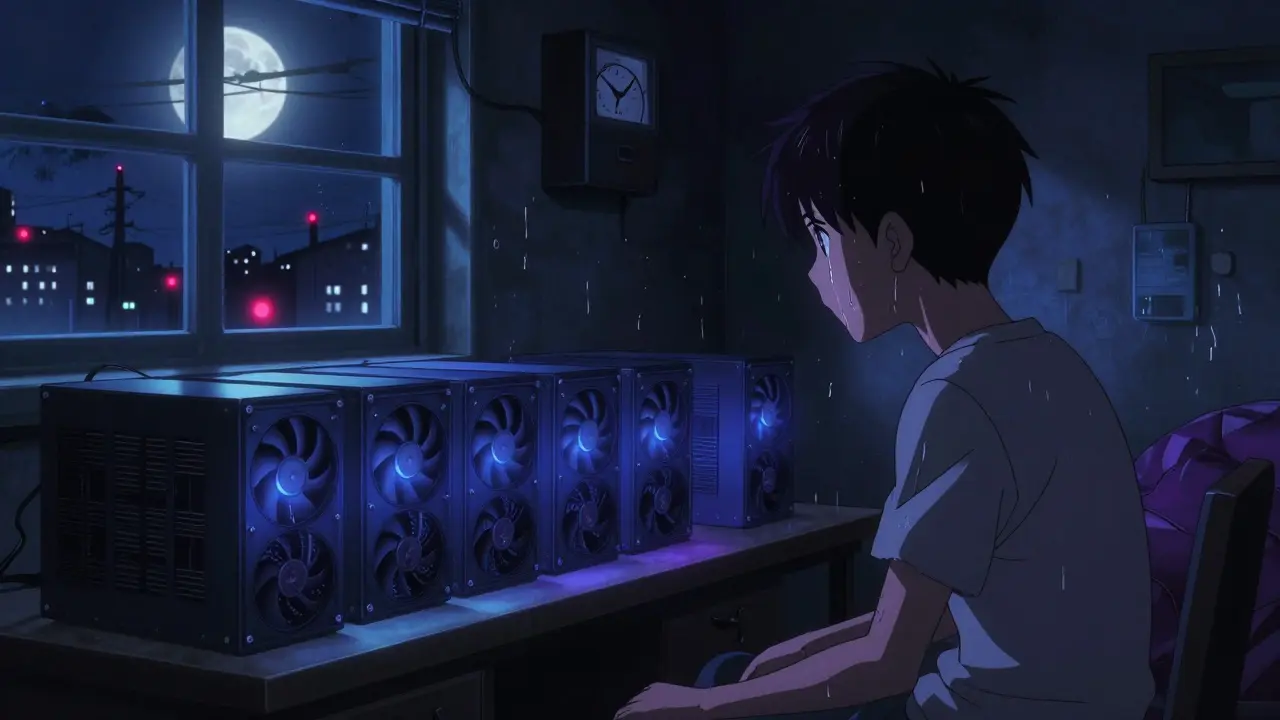
Algeria’s electricity grid is stretched thin. During summer, when temperatures hit 40°C and air conditioners run nonstop, the grid hits 95-100% capacity. That’s not a glitch-it’s the norm. And in 2024, authorities found underground mining operations siphoning off 15-20 megawatts of electricity. That’s enough to power 15,000 homes. For a country where residential electricity costs just $0.035 per kWh-far below the global average of $0.14-it’s no surprise that miners saw an opportunity. But the government saw a crisis.
The law doesn’t care if you’re running one GPU in your bedroom or a warehouse full of ASIC rigs. If you’re using electricity to mine Bitcoin, Ethereum, or any other crypto, you’re breaking the law. Authorities can seize your equipment without warning. And if you’re caught? You could spend up to a year in prison and pay fines between 200,000 and 1,000,000 Algerian dinars-roughly $1,500 to $7,700. Repeat offenders? Double the penalty.
What’s worse, the ban isn’t just about mining. It covers everything. Holding Bitcoin in a wallet? Illegal. Sharing a link to a crypto exchange on social media? Illegal. Even using a VPN to access foreign platforms is now outlawed. The government didn’t just block access-it tried to erase the entire ecosystem.
This isn’t just about saving power. It’s about control. Algeria’s central bank has long warned that crypto could destabilize the financial system. But experts like Dr. Leila Bencharif from Algiers University argue the ban misses the point. Algeria has over 22 gigawatts of solar energy potential. Instead of banning mining, why not use it? Imagine running mining rigs in the Sahara with solar panels, turning excess energy into economic value instead of wasting it.
Other countries in the region took different paths. The UAE, Saudi Arabia, and Bahrain created clear rules, licensed operators, and attracted billions in investment. Tunisia allows licensed mining. Egypt bans trading but lets people hold crypto. Algeria chose to outlaw it all. The result? A brain drain. Around 37% of Algerian blockchain developers have left since 2023, moving to Tunisia, Morocco, or beyond. Startups that could’ve created jobs, tech hubs, and innovation are now operating in other countries.
Enforcement has been aggressive. The government spent $9.2 million in 2025 just to train cyber units in the National Gendarmerie. They monitor power usage patterns-any facility drawing 30-50% more than expected becomes a target. In Oran, a university student lost seven mining rigs after a surprise raid. On Reddit, users report shutting down profitable operations because the risk isn’t worth it. One miner made $350 a month from Ethereum. Now he’s unemployed-and scared.
But not everyone is upset. Traditional bankers and government workers say the ban protects ordinary people from scams and speculative bubbles. A Socialbakers analysis of 1,200 social media posts showed only 28% supported the ban. The rest? They’re angry. And frustrated. Why ban proof-of-work mining but ignore proof-of-stake? Ethereum stopped using energy-hungry mining in 2022. Why treat them the same?
There’s no legal workaround. No gray area. No grandfathering. If you own crypto, you’re breaking the law. If you mined last year, your hardware is now contraband. Even talking about blockchain in a university lecture is risky-some professors have started avoiding the topic altogether.
Meanwhile, the global picture keeps shifting. In 2025, 119 countries have some form of crypto regulation. Algeria is one of only two major economies in the MENA region still banning it outright-alongside Egypt. But Egypt doesn’t jail people for holding Bitcoin. Algeria does.
There’s a chance this won’t last forever. The Global Crypto Alliance found that 68% of crypto bans implemented between 2020 and 2025 were rolled back within three years. Why? Because economies need innovation. Because people find ways around bans. Because energy solutions evolve.
Algeria’s own government passed Law No. 25-12 in August 2025-regulating traditional mining of metals like gold and copper. That’s a hint. They’re not against mining. They’re against uncontrolled mining. Maybe one day, they’ll allow crypto mining-but only if it runs on solar, only if it’s licensed, only if it doesn’t drain the grid.
For now, the message is clear: in Algeria, your computer can’t mine crypto. Your phone can’t trade it. Your voice can’t promote it. And if you try? You risk everything.
But history shows bans rarely kill technology. They just drive it underground-or overseas.
Vincent Cameron
December 5, 2025 AT 22:52It's not about crypto. It's about control. When a government fears its people having access to decentralized systems, it's not because they're worried about power grids-it's because they're worried about losing power. Period.
History repeats: printing presses were banned, radio was feared, the internet was censored. Every time, the tech outlived the ban. Algeria's just early in the cycle.
They think banning Bitcoin will stop innovation. But innovation doesn't care about borders. It just moves. And it's already moving-to Tunisia, to Morocco, to Dubai.
What's tragic is that this isn't even a smart energy policy. It's a symbolic gesture dressed up as pragmatism. They're punishing the poor kid with a GPU in his bedroom while ignoring the state-owned power plants that waste 40% of their output.
And yet, no one talks about the fact that solar potential here is insane. The Sahara could power Europe. Instead, they're jailbreaking teenagers for mining ETH.
They could've taxed mining. Regulated it. Made it pay for grid upgrades. But no-better to be the hero of a crackdown than the architect of a solution.
One day, they'll look back and realize they didn't stop crypto. They just exported their future.
Noriko Robinson
December 7, 2025 AT 10:04I get why they did it. Electricity is a basic human need, and when people are struggling to cool their homes, mining rigs running 24/7 feels like a betrayal. But banning it all? That feels like burning down the house to kill a cockroach.
There’s got to be a middle ground. Maybe license miners who use solar. Maybe tax the profits to fund grid upgrades. But outlawing wallets and VPNs? That’s just fear talking.
Yzak victor
December 8, 2025 AT 22:02My cousin in Algiers told me his roommate got raided last month. Seven GPUs, all seized. No warning. No court. Just cops showing up, unplug everything, and walk out.
He’s a comp sci student. Was making $300/month. Now he’s working at a call center for $200. And he’s terrified to even Google ‘blockchain’.
That’s not saving energy. That’s crushing dreams.
Josh Rivera
December 9, 2025 AT 19:08Oh wow, Algeria finally grew a spine. Let the crypto bros run their ASICs on taxpayer-funded electricity while grandmas can’t afford AC? Groundbreaking.
And now we’re supposed to feel bad for them? Sorry, I don’t cry over people who thought ‘mining Bitcoin’ was a side hustle and not a felony.
Next time, maybe don’t steal power from a country that already has rolling blackouts. Just a thought.
Neal Schechter
December 9, 2025 AT 19:27Most people don’t realize Algeria has one of the highest solar irradiance levels in the world. The Sahara isn’t just sand-it’s a power plant waiting to happen.
Imagine crypto mining running on solar farms in the desert, with excess energy feeding back into the grid. That’s not just sustainable-it’s brilliant.
Instead, they chose to ban it. And now the engineers who could’ve built that future are in Berlin or Toronto.
It’s not just a policy failure. It’s a generational loss.
Madison Agado
December 10, 2025 AT 07:30There’s a difference between regulating something and erasing it.
Algeria didn’t just regulate mining-they outlawed thought. If you talk about crypto, you’re a criminal. If you hold it, you’re guilty. If you use a VPN, you’re breaking the law.
This isn’t about energy. It’s about silence. And that’s the scariest part.
Tisha Berg
December 10, 2025 AT 08:31It’s sad. People just want to make money. And if they’re using their own electricity, why not? But when the whole country is struggling, it’s hard to say ‘mine away’.
Maybe the answer isn’t banning it. Maybe it’s teaching people how to do it right. With solar. With limits. With responsibility.
Roseline Stephen
December 10, 2025 AT 21:58I’ve seen this before. In 2018, my uncle in Venezuela tried mining Bitcoin to survive hyperinflation. They cracked down hard too. Said it was ‘economic sabotage’. He lost his rig. Lost his hope.
People don’t mine crypto because they’re greedy. They do it because the system failed them.
Algeria’s not punishing criminals. They’re punishing the desperate.
nicholas forbes
December 12, 2025 AT 16:36They’re right to ban it. This isn’t just about power-it’s about sovereignty. Crypto is a Western tool to destabilize emerging economies. Algeria’s protecting its people from financial colonialism.
Let the rich countries play with their digital toys. We’ve got real problems to solve.
Kenneth Ljungström
December 13, 2025 AT 10:45Algeria’s move is brutal, but I get it. Imagine your AC dying because some guy in Oran is running 20 rigs in his garage.
Still… I wish they’d gone the UAE route. License it. Tax it. Use it to fund renewables.
Instead of crushing it, they could’ve turned it into a national asset. Now they’re just losing talent. And money. And time.
So much potential wasted. 😔
Cristal Consulting
December 13, 2025 AT 12:27Miners aren’t villains. They’re people trying to survive in a broken system.
The real villain? The lack of vision.
Algeria has solar. It has youth. It has tech talent.
Instead of banning, they should’ve built. And now? The future left without them.
Sandra Lee Beagan
December 14, 2025 AT 17:41The energy argument is valid, but the scope of the ban is absurd. Holding crypto? Promoting it? Using a VPN? That’s not energy policy-that’s digital authoritarianism.
And the irony? The same government that bans crypto mining is investing in AI surveillance systems. They’re not scared of energy waste. They’re scared of decentralized networks.
They want control, not conservation.
Nina Meretoile
December 15, 2025 AT 17:48Proof-of-stake doesn’t use energy. Ethereum switched in 2022. So why ban everything?
This isn’t about mining. It’s about ignorance.
They’re treating blockchain like a virus instead of a tool. And tools can be used for good or bad. But banning them? That’s the lazy answer.
Meanwhile, the world’s building. Algeria’s burying its head in the sand.
Elizabeth Miranda
December 16, 2025 AT 09:49They’re not banning crypto because it’s dangerous.
They’re banning it because it’s unstoppable.
And that terrifies them more than any blackout ever could.
Chloe Hayslett
December 17, 2025 AT 07:09Typical Westerners crying about ‘freedom’ while their own country runs on crypto-powered grids. Algeria’s doing what any responsible nation should do-protect its citizens from financial chaos.
Maybe if you spent less time mining and more time fixing your own broken economy, you’d understand.
Jonathan Sundqvist
December 17, 2025 AT 22:48My uncle’s a power engineer in Algiers. He says the grid’s been on life support since 2020. Mining rigs? They’re like cancer cells. You don’t negotiate with cancer.
Yeah, it’s harsh. But sometimes you gotta cut the limb to save the body.
Thomas Downey
December 19, 2025 AT 21:41It is with profound disappointment that I observe the tragic confluence of technological naiveté and moral myopia that has led to Algeria’s draconian measures. To criminalize the very notion of decentralized value exchange is not merely regressive-it is an affront to the Enlightenment principles upon which modern governance ought to be founded.
One cannot suppress innovation through force without simultaneously suppressing the intellectual spirit of a people. This is not policy. It is cultural suicide.
Annette LeRoux
December 21, 2025 AT 07:25Imagine if instead of banning mining, they turned the Sahara into the world’s first solar-powered crypto hub.
Algeria could’ve been the Switzerland of blockchain. Instead, they chose to be the jailer.
History won’t remember them for saving energy.
It’ll remember them for missing the future.
Jerry Perisho
December 22, 2025 AT 20:01Manish Yadav
December 24, 2025 AT 12:15Algeria did the right thing. Crypto is a scam. It’s digital gambling disguised as tech. Why let people lose everything? Why let them steal electricity? We don’t allow casinos in homes. Why allow crypto rigs?
My brother lost $10,000 trying to mine. Now he’s broke. Algeria saved him.
Stop romanticizing criminals.