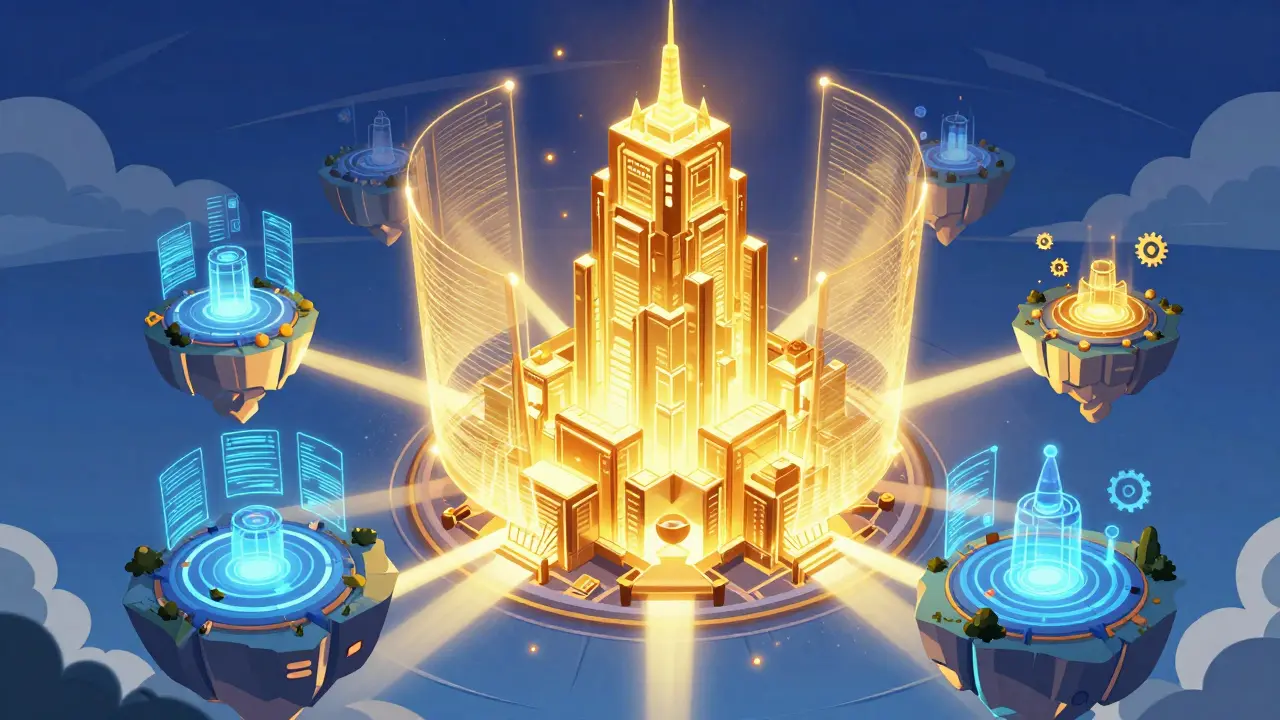
Most people think of a decentralized exchange as a standalone app like Uniswap where you swap tokens and leave. But Ardor DEX is a built-in trading functionality integrated directly into the Ardor blockchain ecosystem Ardadex . Instead of being a separate layer, it's a native feature of the network's architecture. This raises a big question: does having an exchange baked into the blockchain actually make trading better, or is it just a niche feature for a small group of enthusiasts?
The Secret Sauce: Parent-Child Chain Architecture
To understand how Ardor DEX works, you have to understand the Ardor blockchain is a platform using a unique multi-chain structure where a main parent chain provides security for multiple independent child chains . Imagine a massive security firm (the parent chain) protecting a dozen different small businesses (the child chains). The small businesses handle their own daily operations and customers, but they don't have to worry about hiring their own guards because the big firm covers them all.
In the context of trading, this means the exchange functionality can live on a specialized child chain. This separates the heavy lifting of transaction processing from the core security of the network. While a standard Ardor DEX review might focus on speed, the real value here is efficiency. Validators secure multiple child chains at once, which is a huge advantage over single-chain DEXs that have to rebuild their security model every time they launch a new feature.
Trading Experience and the Ardor Wallet
You won't find a flashy web portal that looks like a Wall Street terminal here. Instead, most users interact with the exchange via the Ardor Wallet is the primary gateway for users to manage ARDR tokens and perform instant cryptocurrency swaps . This integration allows for "instant swaps," meaning you can trade one coin for another without ever leaving your wallet. It removes the need to connect your wallet to a third-party website, which is often where phishing scams happen.
For the average person, the setup is pretty straightforward. The wallet has a solid reputation, maintaining a 4.8 out of 5.0 rating on Google Play. However, there is a catch: you need to hold ARDR is the native cryptocurrency of the Ardor network used to pay for transaction fees to move anything. If you're coming from outside the ecosystem, this adds a step to your process-you can't just drop in some USDT and start trading; you need the native fuel first.
| Feature | Ardor DEX | Uniswap (v3) | PancakeSwap |
|---|---|---|---|
| Structure | Integrated Multi-Chain | Standalone App | Standalone App |
| Security Model | Parent-Child PoS | Ethereum Mainnet | BNB Chain PoSA |
| Daily Volume | Niche/Low | Very High ($1.7B+) | High ($890M+) |
| User Interface | Wallet-Centric | Web-Centric | Web-Centric |

The Trade-Offs: Security vs. Liquidity
Here is the reality: Ardor DEX is a fortress, but it's a fortress in a quiet neighborhood. Because it's so tightly integrated into the Proof-of-Stake is a consensus mechanism where validators are chosen based on the number of coins they hold system of the parent chain, the security is top-notch. You aren't dealing with the volatile "rug pull" risks often found in new, standalone DeFi projects.
But security doesn't equal liquidity. If you're trying to move millions of dollars in a single trade, Ardor DEX will struggle. Compare it to platforms like dYdX, which handles billions in daily volume. Because Ardor has a smaller user base, you might experience more "slippage" (the difference between the expected price and the actual price) on larger trades. It's a great tool for the Ardor community, but it's not where high-frequency traders go to make their bones.

Performance and Practicality
How does it actually feel to use? The blockchain processes transactions with a finality time of about one minute. To put that in perspective, it's way faster than Bitcoin, which takes about 10 minutes to confirm a block, but it's a snail compared to Solana, which does it in milliseconds. For a peer-to-peer swap, one minute is perfectly acceptable, but it's not "instant" in the way a centralized exchange like Binance feels.
One common pitfall for new users is the multi-chain complexity. Since different child chains can support different token standards, you have to make sure you're interacting with the right chain for the token you want. It's not a dealbreaker, but it means there's a slightly steeper learning curve than just clicking "Swap" on a simple interface.
Is It Right For You?
Ardor DEX isn't trying to kill Uniswap. It's designed for people who want a cohesive ecosystem where their wallet and their exchange are the same thing. If you're already holding ARDR and want a secure, low-fee way to swap assets without worrying about third-party site security, this is a win.
However, if you are a "degen" trader looking for the latest meme coins with massive liquidity and lightning-fast execution, you'll find this platform too slow and too quiet. It's a specialized tool for a specific job-integrated multi-chain management-rather than a general-purpose trading hub.
What is the main difference between Ardor DEX and other DEXs?
The biggest difference is the architecture. While most DEXs are applications built on top of a blockchain, Ardor DEX is integrated into the blockchain's parent-child chain structure. This allows it to share security from the parent chain while processing trades on a child chain.
Do I need ARDR tokens to use the exchange?
Yes. Since the exchange operates on the Ardor network, you must have ARDR tokens to cover the transaction fees for any swaps or transfers you make.
Is Ardor DEX secure?
Generally, yes. It leverages the Proof-of-Stake security of the Ardor parent chain, which reduces the risks associated with standalone smart contract vulnerabilities found in many other DeFi platforms.
How fast are the transactions on Ardor DEX?
Transactions typically reach finality in about one minute. This is significantly faster than Bitcoin but slower than high-performance networks like Solana.
Where can I trade using Ardor DEX?
The most common way to access the exchange is through the Ardor Wallet, which integrates the DEX functionality directly into the user interface for seamless swapping.
Iestyn Lloyd
April 28, 2026 AT 13:30The parent-child chain setup is actually quite elegant from a technical perspective. By offloading the trading logic to a child chain, they prevent the main network from getting bogged down by high-frequency swap requests, which is a common bottleneck for many early-stage blockchains.
debra hoskins
April 29, 2026 AT 15:37Total snooze-fest. Who actually wants a DEX that's basically a ghost town in a fancy fortress? I'd rather risk a rug pull on a flashy site than stare at a wallet interface from 2012.
Ryan Nakielny
May 1, 2026 AT 13:38Oh sure, a one-minute finality time is just lightning fast. I can barely brew a cup of tea before my transaction actually clears. Truly the pinnacle of efficiency right here.
Noel Mandotah
May 3, 2026 AT 11:30Slippage on a low-volume DEX is a joke. Groundbreaking stuff.
Rushell Perry
May 5, 2026 AT 07:45the native fuel requirement is the only real hurdle for newcomers. once you get some ardr in your wallet the experience is actually pretty smooth
Nitin Gupta
May 5, 2026 AT 08:15I agree that the security model is the strongest point here. For those who prefer long-term stability over quick gains, the integrated nature of Ardor DEX provides a much-needed peace of mind.
its me
May 5, 2026 AT 13:18We must ask ourselves if the pursuit of security has led us to a sterile environment where innovation dies. It's almost as if the developers forgot that trading is an emotional, human experience and not just a series of secure packets.
Livvy Cooper
May 6, 2026 AT 19:46Too complex. Why do I need child chains just to trade some coins? It's just overcomplicated for no reason.
Pramendra Singh
May 6, 2026 AT 20:09It is wonderful to see different architectural approaches to DeFi. While it might not be for everyone, it offers a safe harbor for those of us who value stability.
Sri Astuti
May 8, 2026 AT 14:00The liquidity problem is absolutely glaring and honestly it's kind of pathetic that people act like this is a viable alternative to Uniswap when you can't even execute a decent size trade without the price moving against you by a mile 🙄 plus the UI is basically nonexistent compared to modern standards which makes the whole "integrated" argument feel like a excuse for lazy design!
Rain Richardsson
May 9, 2026 AT 18:49Wait, so the wallet is the exchange?
Michael Repak
May 10, 2026 AT 08:54That's a great point!! It really simplifies the workflow once you're set up!!!
Amanda Macy
May 12, 2026 AT 04:42The distinction between a standalone application and a native feature speaks to a deeper philosophy of how a network should be governed. By baking the exchange into the protocol, Ardor creates a symbiotic relationship between the token and its utility, rather than treating the DEX as a third-party parasite.
Elle Kharitou
May 14, 2026 AT 01:09I absolutely love how this approach treats the user as part of a larger ecosystem rather than just a customer of a service 🌸 it reminds me of the early days of community-driven tech where the goal was sustainability and shared security over raw, aggressive profit 🌿 by integrating the exchange, they've created a digital sanctuary that protects the smaller players from the chaotic winds of the broader market, and while the speed isn't top-tier, the peace of mind is a currency all its own 💖✨
Ipsita Seal
May 14, 2026 AT 06:40Another review of a dead project. Whatever.
Kara Spadone
May 15, 2026 AT 18:23Typical. People obsess over "speed" and "liquidity" without realizing they are just chasing ghosts in the machine 🙄 the real enlightenment comes from understanding the architecture, not the ticker symbol.
Arun Prabhu
May 16, 2026 AT 13:37The sheer audacity of comparing this quaint little playground to the titans of industry is almost poetic. It's a boutique experience for the technologically stagnant.
edie rosa
May 17, 2026 AT 16:43It's honestly depressing that some people think "security" justifies a lack of basic usability. If you can't make it user-friendly, you're just gatekeeping technology from the masses under the guise of safety.
April D Thompson
May 19, 2026 AT 14:15Listen, we've all been there with the steep learning curves! Just take a breath and realize that the a-ha moment comes once you get the ARDR fuel. It's a journey of discovery, not a race to the bottom! 🚀
AP Fisher
May 21, 2026 AT 11:04I just want to know if it is safe for a beginner.