AtomicDEX Fee Calculator
Calculate Your AtomicDEX Trading Fee
AtomicDEX charges 0.15% for takers and 0% for makers. Enter your trade amount to see your exact fee.
Taker: Takes liquidity from the order book (0.15% fee)
Maker: Adds liquidity to the order book (0% fee)
If you're searching for BarterDEX right now, you'll find it's no longer around. The platform evolved into AtomicDEX in 2019, and that's what we're reviewing today. Many people still search for BarterDEX, but the name changed as part of Komodo Platform's upgrade to a more robust decentralized exchange. This article covers AtomicDEX's features, pros, cons, and who should use it.
AtomicDEX is a decentralized exchange built on Komodo Platform that evolved from BarterDEX in 2019. It uses atomic swap technology to enable direct peer-to-peer trading between different cryptocurrencies without intermediaries. This means your private keys stay on your device, and no third party holds your funds.History of BarterDEX and AtomicDEX
BarterDEX started as EasyDEX in 2016, then rebranded to BarterDEX in July 2017. In July 2019, Komodo Platform rebranded it to AtomicDEX. This wasn't just a name change-it included major technical improvements to solve real-world problems like liquidity and cross-chain trading. The original BarterDEX platform is now inactive, so any current information about it refers to AtomicDEX.
Key Features of AtomicDEX
AtomicDEX stands out for its non-custodial nature. Unlike exchanges like Binance or Coinbase where you hand over your coins, AtomicDEX keeps your private keys on your own device. This eliminates the risk of exchange hacks or theft.
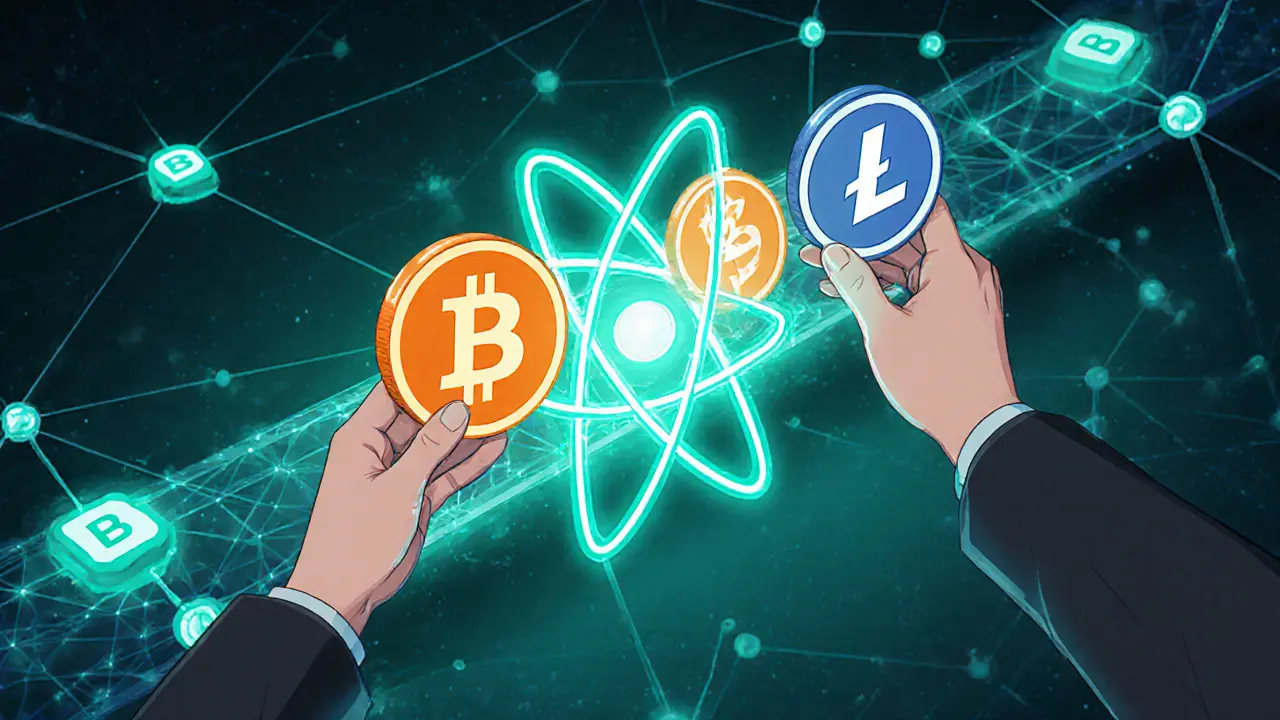
It uses atomic swap technology for cross-chain trading. This means you can trade Bitcoin for Litecoin directly, without needing a middleman. Atomic swaps work by locking funds in smart contracts until both sides complete the trade. If something goes wrong, the funds return to the original owner.
The exchange supports nearly 99% of all cryptocurrencies. According to Komodo Platform's official website, AtomicDEX can trade almost any coin that uses a compatible blockchain. This includes Bitcoin, Ethereum, Litecoin, and many others. Most other decentralized exchanges only support tokens on their own blockchain, like Uniswap for Ethereum tokens.
Liquidity Nodes are a unique feature of AtomicDEX. They work by automatically buying and selling assets in the order book to maintain stable prices. This solves the liquidity problem that plagues most decentralized exchanges, where low trading volume can lead to slippage and failed trades. According to Coin Bureau's 2023 review, Liquidity Nodes have been crucial in making AtomicDEX viable for regular trading.
Fees are competitive. AtomicDEX charges 0.15% for takers (those who take liquidity from the order book) and 0% for makers (those who add liquidity). This is lower than the industry average of around 0.25% for decentralized exchanges. Centralized exchanges like Binance charge between 0.1% and 0.4% depending on trading volume.
Komodo Platform also offers Jumblr, a privacy tool that anonymizes transactions for a 0.3% fee in KMD tokens. While Jumblr isn't part of AtomicDEX itself, it's part of the broader Komodo ecosystem and can be used alongside AtomicDEX for enhanced privacy.
AtomicDEX doesn't require KYC (Know Your Customer) checks. You don't need to submit ID documents to trade. This is great for privacy but means you can't deposit fiat currency like USD. You need to already have cryptocurrency to use AtomicDEX.
Pros and Cons of AtomicDEX
Pros:
- Complete control of your funds-no third party holds your assets.
- Wide cryptocurrency support across different blockchains.
- No KYC required, so your identity stays private.
- Lower fees compared to many centralized exchanges.
- Atomic swaps reduce counterparty risk during trades.
Cons:
- Steep learning curve-requires technical knowledge to set up and use.
- No fiat on-ramps-you can't buy crypto with USD or other fiat currencies directly.
- Slower transaction speeds for high-frequency trading compared to centralized exchanges.
- Limited customer support; mostly community-driven help.
AtomicDEX vs Other Exchanges
How does AtomicDEX stack up against other popular options? Here's a quick comparison:
| Feature | AtomicDEX | Centralized (e.g., Binance) | AMM DEX (e.g., Uniswap) |
|---|---|---|---|
| Custody | Non-custodial (user controls keys) | Custodial (exchange holds keys) | Non-custodial (but liquidity pools) |
| Supported Coins | 99% of all cryptocurrencies | 200-350+ coins | Primarily ERC-20 tokens |
| Fees | 0.15% taker, 0% maker | 0.1%-0.4% (varies) | 0.3%+ (swap fees + gas) |
| KYC Required | No | Yes | No |
| Fiat Support | No | Yes | No |
| Best For | Cross-chain trading, privacy-focused users | Beginners, high-volume traders | Ethereum-based tokens, liquidity pools |
Who Should Use AtomicDEX?
AtomicDEX is ideal for experienced crypto users who value privacy and control. If you're comfortable with technical setups and want to trade across multiple blockchains without KYC, AtomicDEX is a great choice. It's also perfect for those who want to avoid centralized exchanges due to trust issues.
However, if you're a beginner or need to buy crypto with USD, AtomicDEX isn't for you. You'll need to use a centralized exchange like Binance or Coinbase first to get your initial cryptocurrency, then move it to AtomicDEX for cross-chain trading.

How to Get Started with AtomicDEX
Here's how to set up AtomicDEX:
- Download the Komodo Wallet from the official Komodo Platform website. It's available for Windows, macOS, Linux, Android, and iOS.
- Install the wallet and create a new wallet. Write down your seed phrase and store it securely. This is crucial-losing it means losing access to your funds.
- Once the wallet is set up, navigate to the AtomicDEX section within the app.
- Use the atomic swap feature to trade between cryptocurrencies. Select the coins you want to trade, enter the amount, and follow the prompts.
- Confirm the trade details and complete the swap. The process may take a few minutes depending on network conditions.
Keep in mind that AtomicDEX requires some technical knowledge. If you're new to this, watch tutorial videos or join the Komodo community on Discord for help. The learning curve is steep, but once you get the hang of it, the process becomes smoother.
What's Next for AtomicDEX?
Komodo Platform has plans to improve AtomicDEX further. According to Coin Bureau's 2023 review, the roadmap includes better mobile app functionality, deeper integration with Ethereum layer-2 solutions, and possibly adding fiat on-ramps in the future.
Industry analysts from Delphi Digital's 2024 DeFi report predict that atomic swap technology will grow in popularity, capturing 5-7% of total DEX volume by 2026. This growth is driven by increasing demand for cross-chain interoperability as more blockchains emerge.
However, challenges remain. Messari's 2025 DeFi Outlook report notes that "user experience barriers remain significant" for non-technical users. So while AtomicDEX is powerful, it's still not for everyone.
Frequently Asked Questions
Is BarterDEX still available?
No, BarterDEX was rebranded to AtomicDEX in July 2019. The original BarterDEX platform is no longer active, and all development has moved to AtomicDEX. If you're looking for the current version, search for AtomicDEX instead.
Can I trade fiat currency on AtomicDEX?
No, AtomicDEX does not support fiat currency deposits or withdrawals. You need to already have cryptocurrency to use AtomicDEX. To buy crypto with USD or other fiat, you'll need to use a centralized exchange like Binance or Coinbase first, then transfer your coins to AtomicDEX for trading.
How does AtomicDEX compare to Uniswap?
AtomicDEX and Uniswap are both decentralized exchanges, but they work differently. Uniswap is an AMM (Automated Market Maker) DEX that uses liquidity pools on the Ethereum blockchain, so it mainly supports ERC-20 tokens. AtomicDEX uses atomic swap technology to trade across multiple blockchains, supporting nearly all cryptocurrencies. AtomicDEX also doesn't require liquidity providers, reducing impermanent loss risks, but has a steeper learning curve.
Is AtomicDEX safe to use?
Yes, AtomicDEX is designed to be safe. Since it's non-custodial, your private keys never leave your device. This eliminates the risk of exchange hacks. However, you're responsible for securing your seed phrase. If you lose it, you lose access to your funds. Always follow best practices for wallet security.
What are the fees for AtomicDEX?
AtomicDEX charges a 0.15% fee for takers (those who take liquidity from the order book) and 0% for makers (those who add liquidity). This is lower than many centralized exchanges and other DEXs. Additionally, you'll pay standard network fees for blockchain transactions, which vary depending on network congestion.
Does AtomicDEX require KYC?
No, AtomicDEX does not require any KYC (Know Your Customer) verification. You can trade without submitting personal information, which is great for privacy. However, this also means you can't deposit fiat currency directly.
Jenna Em
October 22, 2025 AT 01:51AtomicDEX promises total control over your coins, but that also means you’re left alone when something goes wrong. The idea of keeping your private keys on a phone feels risky if you ever lose the device. I can’t shake the feeling that the whole “no‑custody” narrative is a way to shift responsibility onto users. If you’re not a tech‑savvy person, you might end up with funds you can’t recover. In a world where hacks happen daily, trusting your own hardware is a gamble.
Stephen Rees
November 1, 2025 AT 13:26When we speak of sovereignty in the digital realm, we often ignore the invisible hand that still guides the market. Decentralized exchanges like AtomicDEX claim freedom, yet the code itself is authored by a handful of developers whose motives remain opaque. One could argue that true liberty is an illusion, a comforting story told to mask the underlying dependencies we cannot see. The very act of swapping tokens becomes a ritual, a reminder of how little control we truly possess. Perhaps the real question is not “who holds the keys?” but “who writes the rules?”
Katheline Coleman
November 11, 2025 AT 23:26Dear community, I would like to extend my gratitude for the comprehensive overview provided herein. The delineation of AtomicDEX’s architectural components, particularly the implementation of atomic swap protocols, is both elucidating and precise. It is noteworthy that the platform’s non‑custodial nature mitigates certain systemic risks traditionally associated with centralized entities. Nonetheless, the exposition could benefit from an expanded discussion regarding the inherent latency introduced by cross‑chain consensus mechanisms. I look forward to further scholarly dialogue on this salient topic.
Amy Kember
November 22, 2025 AT 09:26AtomicDEX looks cool but it’s a steep hill to climb it demands patience and a bit of tech know‑how
Evan Holmes
December 2, 2025 AT 19:26Looks like another overhyped DEX.
Isabelle Filion
December 13, 2025 AT 05:26Ah, AtomicDEX – the culmination of every Bitcoin‑centric idealist’s daydream, wrapped in a veneer of “cutting‑edge” technology. One can almost hear the sigh of relief as the platform promises “zero fees for makers,” as if the market itself has finally aligned with fiscal utopia. Yet, beneath the polished brochure lies the same old complexity that repels the average user, a reminder that sophistication often masquerades as exclusivity. In short, it’s a brilliant illusion for those who enjoy navigating labyrinthine interfaces while pretending they’re pioneers.
Anna Kammerer
December 23, 2025 AT 15:26While the sarcasm is appreciated, it’s worth noting that the “zero maker fee” isn’t just PR fluff – it can genuinely reduce costs for high‑volume traders who provide liquidity. The real hurdle, however, remains the user experience; the UI could benefit from clearer onboarding tutorials. If the community pools resources to produce step‑by‑step guides, the barrier could lower significantly. So, beneath the bravado, there’s room for practical improvement.
Mike GLENN
January 3, 2026 AT 01:26AtomicDEX’s approach to cross‑chain swaps certainly marks a pivotal advancement in the decentralized finance ecosystem, and it warrants a thorough examination of its operational intricacies. First, the utilization of atomic swap contracts ensures that both parties in a transaction are protected against counterparty default, a safety net that traditional exchanges lack entirely. Second, the inclusion of Liquidity Nodes attempts to address the pervasive issue of thin order books, which historically have plagued DEX platforms with high slippage. Third, the fee structure-0.15% for takers and zero for makers-creates a tangible incentive for users to contribute liquidity, thereby fostering a more resilient market environment. Fourth, the non‑custodial nature of the platform aligns with the broader philosophical tenets of self‑sovereignty, empowering users to retain full control over their private keys. Fifth, the integration of the Jumblr privacy tool, albeit separate, enriches the ecosystem by offering optional anonymity for those concerned with transaction traceability. Sixth, the absence of KYC requirements lowers entry barriers for privacy‑focused individuals, though it simultaneously constrains fiat on‑ramps, limiting accessibility for newcomers. Seventh, the reliance on user‑managed seed phrases introduces a critical point of failure; anyone who mishandles this information risks irrevocable loss of assets. Eighth, the platform’s current performance metrics indicate slower transaction speeds compared to centralized counterparts, a trade‑off that may be acceptable for users prioritizing security over speed. Ninth, community support, while enthusiastic, remains largely volunteer‑driven, suggesting that users should be prepared for potential response delays. Tenth, the roadmap outlined by Komodo Platform hints at future enhancements, such as Layer‑2 integrations, which could alleviate some of the existing latency concerns. Eleventh, the growing interest from DeFi analysts signals a positive market perception, yet caution remains advisable given the evolving regulatory landscape. Twelfth, developers looking to build on AtomicDEX should familiarize themselves with the underlying smart contract logic to avoid inadvertent vulnerabilities. Thirteenth, the platform’s cross‑chain compatibility, supporting roughly 99% of cryptocurrencies, positions it as a versatile hub for diversified trading strategies. Fourteenth, while the learning curve is undeniably steep, comprehensive educational resources and community forums can bridge this knowledge gap. Finally, the overall trajectory of AtomicDEX suggests that, despite its challenges, it embodies a significant step toward truly decentralized, interoperable finance.
BRIAN NDUNG'U
January 13, 2026 AT 11:26Esteemed traders, I commend the relentless pursuit of autonomy embodied by AtomicDEX. The platform’s dedication to minimizing fees while preserving security exemplifies a commendable vision. May you harness these tools wisely, contributing to a robust and inclusive decentralized marketplace.
Donnie Bolena
January 23, 2026 AT 21:26Wow!!! AtomicDEX looks like a game‑changer!!! The idea of swapping across chains without a middleman is just mind‑blowing!!! And those 0% maker fees? Absolutely fantastic!!! Can't wait to see how the community embraces this innovation!!!
Elizabeth Chatwood
February 3, 2026 AT 07:26yeah its wild but tho the ui still feels kinda rough ive seen better fr
Tom Grimes
February 13, 2026 AT 17:26Honestly, I feel a pang of sadness every time I think about how many people get lost in the maze of AtomicDEX’s setup. It’s like watching a friend stumble through a dark hallway, calling out for help that never arrives because the lights are dim and the instructions are written in some cryptic code. The whole “no KYC” promise sounds appealing, yet it also feels like a trap set by the developers to lure the naïve into a self‑imposed isolation, away from any safety net. I’m not saying the platform is malicious, but the emotional toll on a user who forgets their seed phrase – it’s heartbreaking. When you see stories of lost fortunes because a single typo erased a wallet, you can’t help but wonder if the convenience is worth the perpetual anxiety that follows every transaction. The liquidity nodes are a neat concept, but they also add another layer of complexity that can easily overwhelm someone who just wants to exchange a few tokens without diving into a tech‑savvy rabbit hole. In the end, the promise of total control may just be another way of saying you’re entirely on your own – and that solitude can be both empowering and terrifying.
Paul Barnes
February 24, 2026 AT 03:26Control is an illusion; the code decides everything.
John Lee
March 6, 2026 AT 13:26AtomicDEX paints a vibrant picture of a future where every blockchain can chat with each other like old friends at a bustling market. The eclectic mix of coins it supports feels like a grand orchestra, each instrument playing its unique tune while harmonizing with the rest. I appreciate the ambition, though I also recognize the practical challenges that come with such a sprawling ecosystem. Still, the prospect of swapping Bitcoin for a niche token without a middleman sparks a delightful sense of possibility. Let’s keep the conversation flowing and see how the platform evolves.
Jireh Edemeka
March 16, 2026 AT 23:26Ah, the ever‑optimistic vision of a borderless DEX-how refreshing. One can only hope that the next update finally smooths out those UI quirks that have been mentioned ad nauseam.