
Bex Swap Slippage Calculator
Estimate your expected trade slippage across different DEX platforms based on the article's data about Bex performance.
Trade Amount
Estimated Slippage Comparison
Based on data from the article and typical platform performance:
| DEX | Slippage | Key Advantage |
|---|---|---|
| Bex (Berachain) | 0.30% | Proof-of-Liquidity model with deep BERA/HONEY liquidity |
| Uniswap (Ethereum) | 2.50% | Large market capitalization |
| PancakeSwap (BSC) | 1.80% | Low transaction fees |
| Raydium (Solana) | 0.80% | Fast transaction finality |
When you hear "Bex" in crypto, you’re not talking about a centralized exchange like Binance or Coinbase. You’re talking about Bex, the native decentralized exchange on Berachain - a new blockchain built to fix one of DeFi’s biggest headaches: liquidity fragmentation. If you’ve ever swapped tokens on Uniswap and watched your trade slip 5% because the pool was too thin, you already know why Bex matters. It’s not just another DEX. It’s a different approach to how liquidity works - and that’s worth understanding before you put money in.
What Is Bex and How Does It Work?
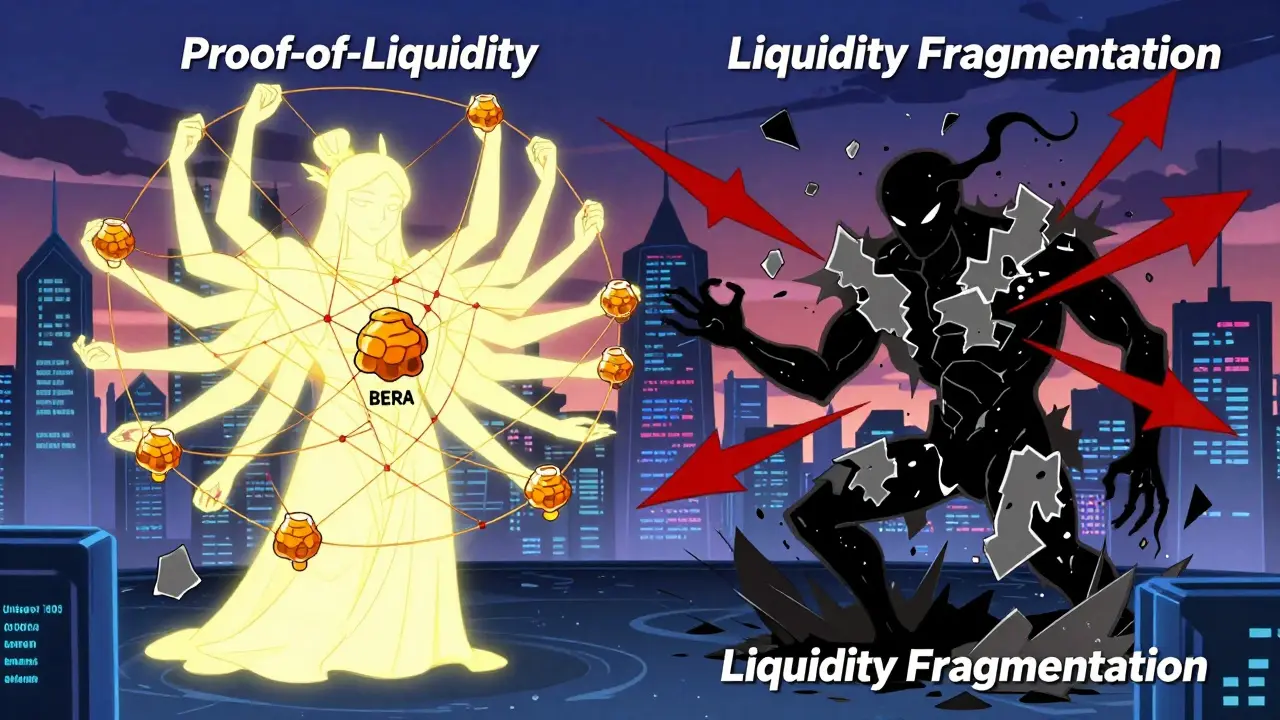
Bex is the trading platform built into the Berachain blockchain. Unlike Uniswap or PancakeSwap, which rely on users depositing tokens into pools, Bex uses something called Proof-of-Liquidity (PoL). This isn’t just a marketing term. It’s a consensus mechanism that rewards validators not just for securing the network, but for actively helping DeFi protocols attract deposits. Think of it like this: instead of waiting for users to bring liquidity to the DEX, the network itself pulls liquidity in - and pays validators to make sure it sticks. This system runs on Berachain’s tri-token economy:- BERA - the gas token. You need it to pay for trades and transactions.
- HONEY - a stablecoin pegged to $1. Used as a base pair for most trades.
- BGT - the governance token. Lets you vote on upgrades and fee changes.
Why Bex Stands Out (Technically)
Berachain isn’t trying to be Ethereum 2.0. It’s trying to be something better for traders: faster, cheaper, and more liquid. Here’s how it delivers:- Block time: 2 seconds. Transactions confirm almost instantly. No more waiting 15 seconds for a swap to go through.
- EVM-compatible. If you’ve used MetaMask on Ethereum, you can use it here. Just add Berachain’s RPC to your wallet and you’re good to go.
- Cosmos IBC built-in. Unlike most DEXs that need bridges to move assets from other chains, Bex can receive tokens directly from Cosmos, Avalanche, Polygon, and others - no third-party bridge required.
- $22M daily volume. As of December 2025, Bex handles over $121 million in weekly trading volume. That’s not Uniswap-level yet, but it’s growing fast - up from $35 million weekly in August.
Where Bex Falls Short
Let’s be real: Bex isn’t perfect. It’s still young. And that shows.- Too new to trust. Berachain’s mainnet launched in February 2025. Within weeks, users reported crashes, failed transactions, and liquidity withdrawals that took days to settle. The team called it a "soft launch," but many lost money. It’s recovered since, but the memory lingers.
- Centralized governance risk. There’s a nine-member council that can pause harmful governance votes. Some see this as a safety net. Others see it as a backdoor for control. If the council decides to block a proposal, users have no recourse.
- Low TVL compared to giants. Uniswap has over $12 billion locked. Bex has $1.2 billion. That’s a big gap. Most of Bex’s liquidity comes from HONEY, not from external assets. That’s good for stability, but limits its appeal for traders who want to swap obscure tokens.
- Hard to onboard beginners. Setting up your wallet, bridging ETH to BERA, understanding the three-token system - it’s not intuitive. Trustpilot reviews from December 2025 mention users getting stuck for hours trying to connect their MetaMask. The official docs are thorough, but they assume you already know what an RPC endpoint is.
How It Compares to the Competition
| Feature | Bex (Berachain) | Uniswap (Ethereum) | PancakeSwap (BSC) | Raydium (Solana) |
|---|---|---|---|---|
| Block Time | 2 seconds | 12-15 seconds | 3 seconds | 0.4 seconds |
| Transaction Fees | $0.01-$0.05 | $1-$10 | $0.05-$0.20 | $0.001-$0.01 |
| Liquidity Model | Proof-of-Liquidity (protocol-driven) | AMM (user-driven) | AMM (user-driven) | AMM + liquidity mining |
| Cross-Chain Native | Yes (Cosmos IBC) | No (needs bridges) | No (needs bridges) | Partial (via Wormhole) |
| Weekly Volume | $121M | $28.7B | $4.1B | $1.9B |
| Best For | Traders wanting deep liquidity on BERA/HONEY, low fees, cross-chain access | Large, stable pools, ERC-20 tokens | BNB ecosystem, low-cost swaps | Speed, Solana-native tokens |
Who Should Use Bex?
Bex isn’t for everyone. If you’re just buying Bitcoin or Ethereum and holding, skip it. But if you fit one of these profiles, it’s worth your time:- DeFi power users who are tired of high Ethereum fees and fragmented liquidity.
- Stakers and yield farmers looking for high APYs - some BERA/HONEY pools are offering 60-70% annual returns as of December 2025.
- Early adopters who believe in Berachain’s vision and want to be part of its growth.
- Cross-chain traders who regularly move assets between Cosmos, Ethereum, and Polygon and want fewer bridges to manage.

How to Get Started
Here’s a simple step-by-step to start trading on Bex:- Install MetaMask (or another EVM wallet).
- Add the Berachain network manually:
- Network Name: Berachain Testnet (or Mainnet)
- New RPC URL: https://rpc.bera.chain
- Chain ID: 80084
- Currency Symbol: BERA
- Block Explorer URL: https://testnet.berascan.com
- Bridge ETH or other assets to Berachain using the official bridge (berachain.com/bridge).
- Once BERA is in your wallet, go to app.bex.berachain.com.
- Connect your wallet and start trading.
The Bottom Line
Bex isn’t the biggest DEX. It’s not the safest. But it’s one of the most interesting. It’s betting everything on Proof-of-Liquidity - a radical idea that could either redefine how DeFi attracts capital, or collapse under its own complexity. As of December 2025, it’s working - but barely. Volume is rising. User numbers are up 300% since August. Liquidity is deeper than most new chains. And the team has shown they can fix problems fast. If you’re comfortable with risk and want to be ahead of the curve, Bex is worth exploring. Start small. Test the waters. But don’t put your life savings in until you’ve seen it handle a market crash.Frequently Asked Questions
Is Bex safe to use?
Bex runs on Berachain, which has been live since February 2025. After early instability, the network has been stable since August 2025 following major protocol upgrades. No major exploits have occurred since then. However, as with any new blockchain, there’s always risk. Always use small amounts to test, and never store large sums on the platform.
Can I stake BERA on Bex?
You can’t stake BERA directly on Bex. But you can provide liquidity to BERA/HONEY pools on the exchange and earn BGT and BERA rewards. For direct staking, you can use the official Berachain staking portal or stake via centralized exchanges like Binance or Bitget.
What’s the difference between BERA and HONEY?
BERA is the native token used to pay for gas and transaction fees on Berachain. HONEY is a stablecoin pegged to $1, used primarily as a trading pair on Bex. You need BERA to swap tokens, and HONEY is what you swap them against - like USDT on Uniswap.
How do I get HONEY on Bex?
You can mint HONEY by depositing USDC or other stablecoins into the official HONEY minting contract. Alternatively, you can swap BERA for HONEY directly on Bex. The easiest way is to bridge USDC from Ethereum or Polygon to Berachain, then convert it to HONEY on the minting page.
Is Bex available on mobile?
There’s no official Bex mobile app. But you can access it through MetaMask or Trust Wallet on your phone. Just open the app, switch to the Berachain network, and go to app.bex.berachain.com in your mobile browser. It works fine, but the interface is optimized for desktop.
What’s the future of Bex?
The Berachain team is working on improved liquidity routing, deeper integration with other stablecoins, and cross-chain messaging upgrades. If they can maintain growth and attract more institutional liquidity, Bex could become a major player in the next 12-18 months. But if user growth stalls or the PoL model fails to deliver consistent rewards, it could fade into obscurity like many other new chains.
Krista Hewes
December 8, 2025 AT 00:43Elizabeth Miranda
December 9, 2025 AT 20:18Chloe Hayslett
December 10, 2025 AT 09:32Noriko Robinson
December 10, 2025 AT 15:32Mairead Stiùbhart
December 10, 2025 AT 23:48ronald dayrit
December 11, 2025 AT 05:27Neal Schechter
December 13, 2025 AT 00:54Tisha Berg
December 14, 2025 AT 01:24Billye Nipper
December 14, 2025 AT 09:19Roseline Stephen
December 15, 2025 AT 08:00Jon Visotzky
December 15, 2025 AT 19:07Isha Kaur
December 17, 2025 AT 03:49Glenn Jones
December 17, 2025 AT 04:46Tara Marshall
December 18, 2025 AT 18:33Joe West
December 20, 2025 AT 04:54Lore Vanvliet
December 22, 2025 AT 02:27Frank Cronin
December 24, 2025 AT 01:56miriam gionfriddo
December 24, 2025 AT 23:17Nicole Parker
December 25, 2025 AT 09:32Brooke Schmalbach
December 26, 2025 AT 04:32Cristal Consulting
December 26, 2025 AT 12:42