
If you're looking for a crypto exchange that works well in Georgia, BitBegin might catch your eye. But if you're outside the country, or you trade more than just Bitcoin and Ethereum, you’ll want to know what you're really getting into. BitBegin isn't Binance. It isn't Coinbase. It’s something smaller, regional, and oddly specific - and that’s both its strength and its biggest weakness.
What Is BitBegin Exactly?
BitBegin is a centralized cryptocurrency exchange registered in Georgia. It’s not a sketchy offshore platform - it’s officially recognized by the Georgian government. That matters. In a world full of crypto exchanges that vanish overnight, having government backing gives it a level of legitimacy most small players don’t have. It launched with a clear goal: make crypto trading easy for people in Georgia who want to use their local currency, the Georgian Lari (GEL). It’s not just a spot trading platform. BitBegin also offers derivatives trading, an NFT marketplace, staking, and its own native token, BRIT. The platform markets itself as a full Web3.0 ecosystem, but in practice, most users only ever use the trading part. The other features exist, but they’re not widely used - at least not outside Georgia.Trading Pairs and Cryptocurrencies Available
BitBegin supports around 32 to 50 cryptocurrencies. That’s not a lot. For comparison, Binance offers over 350, and even Kraken has more than 200. On BitBegin, you’ll find the usual suspects: BTC, ETH, SOL, TRX, LTC, and ADA. There are also some lesser-known coins like NEVA and ADON, which might appeal to traders looking for niche assets. But if you’re into newer tokens from Solana, Ethereum Layer 2s, or DeFi projects, you’re going to be disappointed. The exchange offers 38 spot trading pairs. That’s enough for basic trading, but it’s not designed for advanced traders who need deep liquidity or complex order types. You won’t find margin trading with high leverage, nor will you find perpetual futures with low fees like you’d see on Bybit or OKX. BitBegin keeps things simple - and that’s fine if you’re just buying and holding.Fees: Transparent, But Not Always Cheap
One area where BitBegin actually shines is fee transparency. The base trading fee is 0.1% for both makers and takers. That’s standard, nothing special. But unlike some exchanges that hide fees in fine print, BitBegin lists them clearly on its website. No surprise charges. Deposits are free - whether you’re sending crypto or using bank transfers in GEL, USD, or EUR. That’s good. But withdrawals? That’s where it gets painful. Bitcoin withdrawals cost 0.0015 BTC - that’s roughly $100 at current prices. USDT withdrawals on the TRC20 network cost 5 USDT. That’s higher than most global exchanges. On Kraken, you can withdraw USDT for under 1 USDT. On Binance, it’s often free for certain networks. If you’re a frequent trader or someone who moves funds often, these withdrawal fees will eat into your profits fast. And there’s no way around them. BitBegin doesn’t offer lower fees for high-volume traders or BRIT token holders. No discounts. No loyalty program.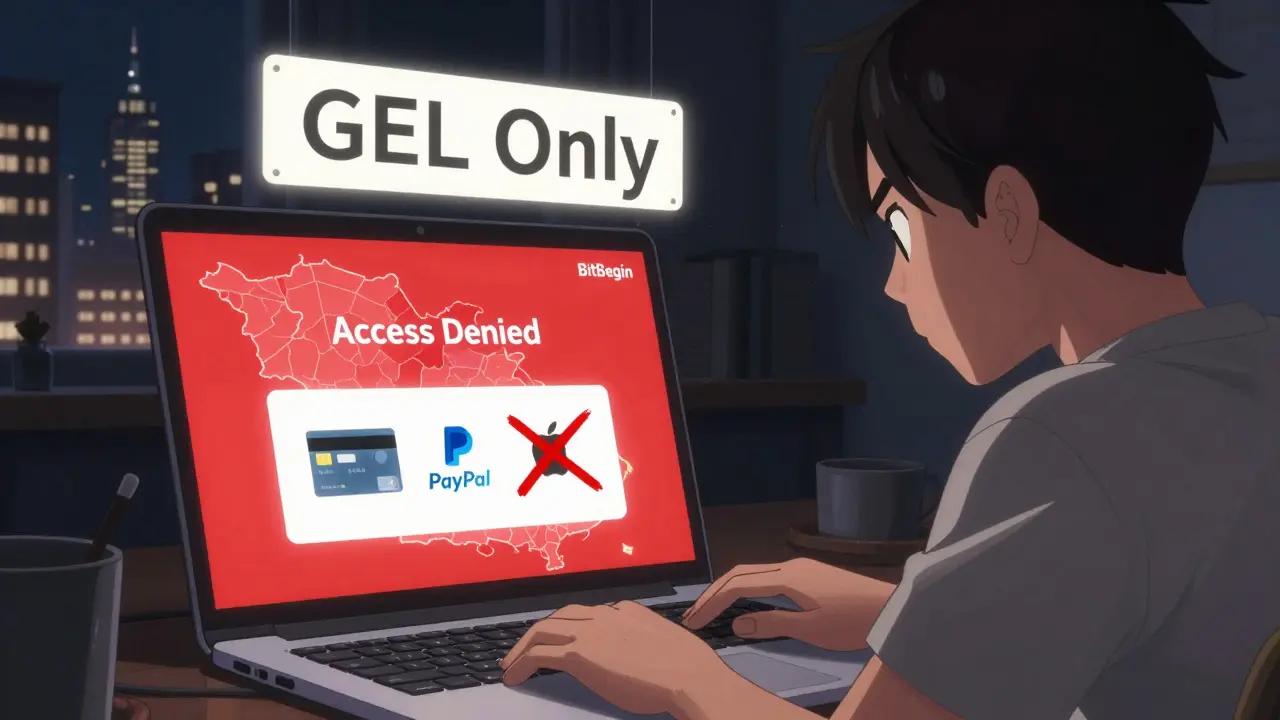
Fiat On-Ramps: Only for Georgians
This is BitBegin’s real differentiator. It’s one of the few exchanges that lets you deposit and withdraw Georgian Lari (GEL) via bank transfer. Most global exchanges don’t support GEL at all. If you live in Georgia and want to buy crypto with your local bank account, BitBegin is probably your only real option. But here’s the catch: you can’t use credit or debit cards. No Apple Pay. No Google Pay. No PayPal. Only bank transfers. That’s a major inconvenience if you’re used to instant buys on Coinbase or Kraken. You’ll have to wait for bank processing times - sometimes up to three business days. And if you’re not in Georgia? Forget it. BitBegin doesn’t allow users from most countries. Even if you have a VPN, you’ll likely get blocked during KYC. The platform explicitly restricts access to users from sanctioned countries like Sudan and North Korea, but in practice, it also blocks most international users simply because it doesn’t have the infrastructure to support them.KYC and Security
Like any regulated exchange, BitBegin requires full KYC. You’ll need to upload a government-issued ID and a selfie. The process is straightforward, but it’s mandatory. No anonymous trading here. That’s a good thing if you care about compliance. It’s a bad thing if you value privacy. Security-wise, BitBegin claims to follow AML/CFT standards aligned with FATF guidelines. It says it uses multi-signature wallets and cold storage. But there’s no public proof - no transparency reports, no third-party audits, no proof of reserves published. That’s a red flag for anyone used to exchanges like Coinbase or Kraken, which publish regular attestations. The BRIT token, BitBegin’s native token, is described as an open-source, MIT-licensed blockchain project governed by a DAO. But there’s no public dashboard showing how decisions are made. No voting records. No community proposals. It sounds like a decentralized project, but it operates like a centralized one. Don’t assume the DAO is real unless you see evidence.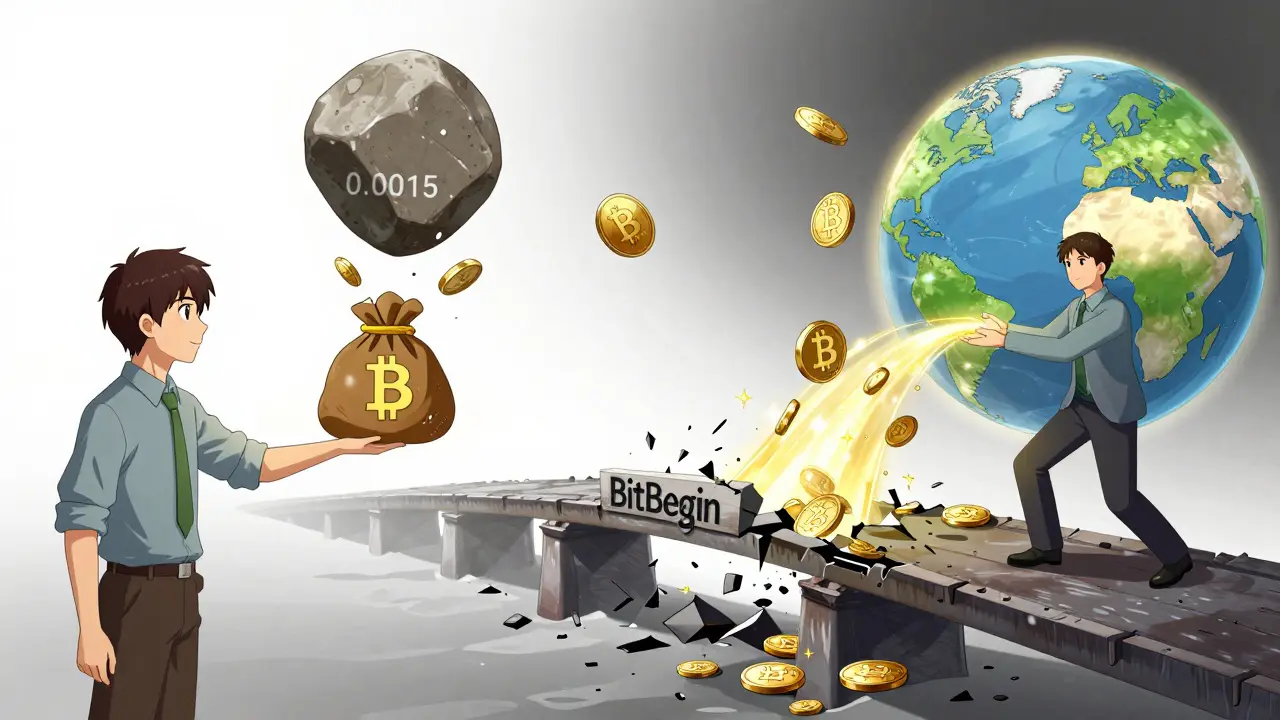
Mobile App and User Experience
The platform works on desktop and mobile browsers. There’s no official app on the App Store or Google Play. That’s unusual for a modern exchange. Most competitors have polished apps with push notifications, one-tap trades, and biometric login. BitBegin’s mobile site is functional, but clunky. It loads slowly on weak connections. The interface isn’t intuitive for beginners - there’s no guided onboarding, no tutorial pop-ups, no help center with video guides. Customer support is limited. You can submit tickets via email, but response times are slow. There’s no live chat. No phone number. No community forum. If you get stuck, you’re mostly on your own.Who Is BitBegin For?
BitBegin isn’t for everyone. It’s not even for most crypto users. It’s perfect for one group: Georgian residents who want to buy crypto with their local bank account and don’t need dozens of altcoins. If you’re in Tbilisi, Batumi, or Kutaisi, and you want to trade BTC or ETH without using a foreign exchange that doesn’t support GEL - then BitBegin is your best bet. It’s not for international users. It’s not for traders who need low withdrawal fees. It’s not for DeFi enthusiasts, NFT collectors, or anyone looking to trade lesser-known tokens. And it’s definitely not for people who want a slick mobile app or instant card purchases.The Bottom Line
BitBegin is a regional exchange with a clear purpose - serving Georgian crypto users. It’s legitimate, regulated, and offers something no global exchange does: direct GEL integration. That’s valuable. But if you’re outside Georgia, or if you trade more than just the top 10 coins, you’ll find it limiting. High withdrawal fees, low asset selection, no app, no card deposits, and no real community support make it a poor choice for anyone else. Think of it like a local grocery store in a small town. It doesn’t have everything. But if you live there, it’s the only place that sells what you need. Outside that town? You’re better off going to a big supermarket. If you’re in Georgia - give it a try. If you’re anywhere else - stick with Binance, Kraken, or Coinbase. You’ll save money, time, and frustration.Is BitBegin a safe crypto exchange?
BitBegin is registered with the Georgian government and follows AML/CFT rules, which makes it safer than unregulated platforms. But it doesn’t publish proof of reserves or undergo third-party audits, so you can’t fully verify its security. It’s relatively safe for Georgian users, but lacks the transparency of global exchanges like Coinbase or Kraken.
Can I use BitBegin if I’m not in Georgia?
Technically, you might be able to sign up with a VPN, but BitBegin blocks users from most countries outside Georgia. Even if you get past registration, KYC will likely fail because the system checks your location and bank details. It’s designed for Georgian residents only.
Does BitBegin support credit card deposits?
No. BitBegin only accepts fiat deposits via bank transfer in Georgian Lari (GEL), US Dollars (USD), or Euros (EUR). You cannot use credit cards, debit cards, PayPal, or other instant payment methods. This makes it slower and less convenient than most global exchanges.
What are the withdrawal fees on BitBegin?
Withdrawal fees are high compared to global exchanges. Bitcoin withdrawals cost 0.0015 BTC (around $100), and USDT withdrawals on TRC20 cost 5 USDT. There are no fee discounts for high-volume traders or BRIT token holders. These fees make frequent trading or moving funds expensive.
Does BitBegin have a mobile app?
No, BitBegin does not have a dedicated mobile app on the App Store or Google Play. You can only access the platform through a mobile browser. The interface works, but it’s not optimized for mobile use - no push notifications, no biometric login, and slower load times than native apps.
What is the BRIT token?
BRIT is BitBegin’s native token with a total supply of 10 billion. It’s described as an open-source, MIT-licensed blockchain project governed by a DAO. However, there’s no public evidence of active DAO voting, community proposals, or decentralized governance. Most users treat it as a utility token with no real functionality beyond being listed on the exchange.
How many cryptocurrencies does BitBegin support?
BitBegin supports between 32 and 50 cryptocurrencies, including BTC, ETH, SOL, TRX, LTC, ADA, and a few lesser-known tokens like NEVA and ADON. This is far fewer than global exchanges like Binance (350+) or Coinbase (200+), making it unsuitable for traders looking for niche or new altcoins.
Amy Garrett
January 1, 2026 AT 15:54Brandon Woodard
January 2, 2026 AT 17:08Antonio Snoddy
January 3, 2026 AT 19:45Rajappa Manohar
January 4, 2026 AT 07:00Daniel Verreault
January 4, 2026 AT 13:17Jacky Baltes
January 5, 2026 AT 23:18prashant choudhari
January 6, 2026 AT 17:01Willis Shane
January 7, 2026 AT 15:29Jake West
January 8, 2026 AT 08:51Shawn Roberts
January 9, 2026 AT 05:30Abhisekh Chakraborty
January 10, 2026 AT 20:15dina amanda
January 11, 2026 AT 11:50Emily L
January 13, 2026 AT 06:24Gavin Hill
January 14, 2026 AT 02:22SUMIT RAI
January 15, 2026 AT 09:52Andrea Stewart
January 15, 2026 AT 18:54Josh Seeto
January 17, 2026 AT 04:03surendra meena
January 17, 2026 AT 16:22Kevin Gilchrist
January 18, 2026 AT 13:17Khaitlynn Ashworth
January 19, 2026 AT 11:17NIKHIL CHHOKAR
January 20, 2026 AT 08:08Mike Pontillo
January 21, 2026 AT 10:06Brandon Woodard
January 22, 2026 AT 13:04