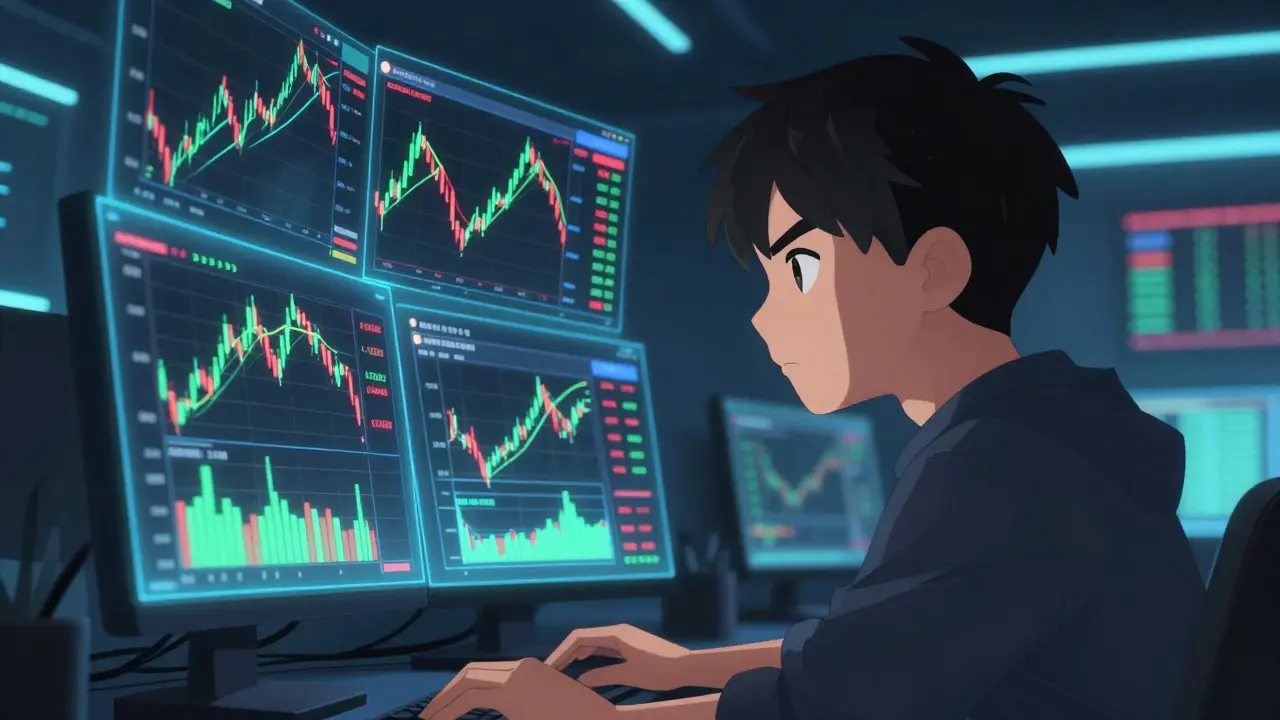
Key Takeaways for Futures Traders
- Directional Trading: Use long positions for bullish views and short positions for bearish views.
- Hedging: Protect your spot holdings by taking opposite positions in the futures market.
- Leverage Risk: High leverage (up to 100x) increases gains but drastically raises liquidation risks.
- Perpetual Swaps: These are the most popular contracts because they have no expiry date.
- Risk Control: Never risk more than 1-2% of your total capital on a single trade.
The Basics of Directional Trading
For most people, the first step into futures is directional trading. This is simply betting on the price movement. If you think Bitcoin is going up, you open a long position. If you think a crash is coming, you go short. Unlike traditional markets, the crypto world loves perpetual swap contracts. These are a type of future that never expires. You can hold a position as long as you have enough margin to cover it. This flexibility is why most retail traders prefer them over quarterly contracts. However, keep an eye on the "funding rate." This is a periodic payment exchanged between long and short traders to keep the contract price pegged to the actual spot price of Bitcoin. If everyone is longing, the funding rate goes up, and longs pay shorts. If you hold a position for weeks, these fees can eat into your profits.Using Futures to Hedge Your Portfolio
If you already own Bitcoin in a cold wallet, you are exposed to every single price drop. This is where hedging comes in. Think of it as an insurance policy. Suppose you have 1 BTC and you expect a market dip over the next month, but you don't want to sell your coins because of taxes or long-term belief. You can open a "short hedge" in the futures market. If the price drops, your spot Bitcoin loses value, but your short futures position gains an equal amount. You've essentially "locked in" the price. On the flip side, a "long hedge" is for those who need to buy Bitcoin in the future (perhaps for a business purchase) and are terrified the price will moon before they have the funds ready. By going long now, they protect themselves against rising costs.Managing Leverage and Capital Efficiency
Leverage is the most dangerous tool in your kit. Platforms like Bybit or Binance allow you to trade with up to 100x leverage. This means with $1,000, you can control a position worth $100,000. But here is the math that kills traders: at 100x leverage, a mere 1% move in the opposite direction results in a 100% loss of your margin, leading to immediate liquidation. Even at 10x leverage, a 10% drop wipes you out. To survive, you must master margin management. Avoid "cross margin" if you are a beginner, as it puts your entire account balance at risk for one trade. Instead, use "isolated margin," which limits your potential loss to the specific amount allocated to that single trade.| Leverage Ratio | Buying Power | Price Drop to Liquidation | Risk Level |
|---|---|---|---|
| 2x | $2,000 per $1k | ~50% | Low/Moderate |
| 10x | $10,000 per $1k | ~10% | High |
| 25x | $25,000 per $1k | ~4% | Very High |
| 100x | $100,000 per $1k | ~1% | Extreme |
Technical Strategies for Day Trading
Bitcoin doesn't sleep. It trades 24/7, which means volatility can spike while you're asleep. Day traders use Technical Analysis (TA) to find high-probability entries. Two of the most effective tools are the Relative Strength Index (RSI) and Bollinger Bands. When the RSI dips below 30, Bitcoin is often "oversold," suggesting a potential bounce. Bollinger Bands help you see if the price is overextended relative to its average. If you can't watch the charts all day, automated trading bots from platforms like 3Commas can execute these strategies for you. These bots can be programmed to buy a dip and sell at a specific profit target, removing the emotional stress that leads to "revenge trading" after a loss.Reducing Costs and Fee Leakage
Many traders ignore fees until they see their profit disappear. In high-frequency trading, a 0.075% fee on every trade adds up quickly. To keep more of your money, you should focus on being a "maker" rather than a "taker." Maker fees are lower because you provide liquidity by placing a limit order that doesn't execute immediately. Taker fees are higher because you "take" liquidity by buying at the current market price. Most top-tier exchanges offer VIP programs if you trade high volumes, sometimes bringing fees down to 0.00%. Additionally, holding the exchange's native token often grants a discount on trading costs.
The Psychology of Sentiment Analysis
Bitcoin is driven as much by hype as it is by tech. Regulatory news from the US SEC or a sudden tweet from a major influencer can shift the market by 5% in seconds. Successful futures traders monitor "sentiment." This means tracking social media trends on X (formerly Twitter) and Reddit. If the sentiment becomes excessively bullish (extreme greed), it's often a signal that a correction is coming. Conversely, when the crowd is in a panic (extreme fear), it's often the best time to look for long entries. This contrarian approach-buying when others are scared and selling when they are greedy-is a hallmark of professional trading.Bulletproof Risk Management
No strategy works without a safety net. Because Bitcoin is prone to "flash crashes," a stop-loss order is non-negotiable. A stop-loss automatically closes your position if the price hits a certain level, preventing a total account wipeout. Professional traders use a strict position-sizing rule: never risk more than 1% to 2% of your total equity on a single trade. If you have $10,000, you only risk $100 to $200. This ensures that even a string of ten losing trades won't bankrupt you. Diversification also helps. Instead of putting everything into a Bitcoin long, you might split your capital between Bitcoin futures and other assets like Ethereum or traditional commodities to reduce correlation risk.What is the difference between spot and futures trading?
Spot trading is the actual purchase of the asset; you own the Bitcoin and can move it to a private wallet. Futures trading is a contract to buy or sell Bitcoin at a future date. You don't own the underlying asset, but you can profit from its price movements in both directions.
Can I lose more than my initial investment in futures?
On most modern retail exchanges using isolated margin, you can only lose the margin you allocated to that specific trade. However, if you use cross-margin, a single bad trade can drain your entire account balance. High leverage increases the speed at which this happens.
How do funding rates work in perpetual swaps?
Funding rates are payments made between long and short traders every 8 hours (typically). If the futures price is higher than the spot price, longs pay shorts. This mechanism ensures that the futures price stays close to the actual market price of Bitcoin.
What is a "short squeeze" in Bitcoin futures?
A short squeeze happens when a large number of traders hold short positions and the price unexpectedly rises. To close their losing positions, these traders must buy Bitcoin, which pushes the price even higher, forcing more shorts to liquidate and creating a rapid upward price spike.
Is Bitcoin futures trading legal?
Legality depends on your country. In the US, regulated futures are available through the CME (Chicago Mercantile Exchange). Many offshore exchanges also operate, but they may have different regulatory standings. Always check your local laws before trading derivatives.
Next Steps for Different Trader Types
For the Beginner: Start with a "paper trading" (demo) account. Practice placing limit orders and setting stop-losses without using real money. Once you are comfortable, start with 2x leverage and isolated margin only.
For the HODLer: Focus on the hedging strategy. Learn how to calculate the exact amount of futures to short to offset your spot holdings during a bear market.
For the Advanced Trader: Explore funding rate arbitrage. This involves longing the spot market and shorting the perpetual futures market to collect the funding fee, creating a market-neutral strategy with lower risk.
Jimmy vasquez
April 29, 2026 AT 06:03The part about funding rates is super important. A lot of newbies ignore them and then wonder why their balance is bleeding out while the price is just sideways. It's basically the cost of staying in the game for perpetuals.
Andrew Todd
April 29, 2026 AT 12:46Only Americans really get this right. The rest of you are just gambling with fake money. If you don't have a huge bank roll, just stay out of futures. It's a game for winners.
Robert Smith
April 30, 2026 AT 16:34100x is actual madness 💀
Sri Astuti
May 1, 2026 AT 22:58It is honestly laughable that some people still believe RSI is a magic wand for Bitcoin because in a true parabolic bull run the RSI stays overbought for weeks while the price just keeps mooning, and if you try to short just because the indicator says so, you will get absolutely liquidated into oblivion while the whales laugh at your pathetic little stop loss 🙄🙄🙄
VIVEK SINGH
May 3, 2026 AT 14:54Oh look, another guide telling people to use a 1% risk rule. How revolutionary. I'm sure the market cares deeply about your tiny percentage when a flash crash wipes out every single limit order on the book in three milliseconds. Good luck with your spreadsheets while the house takes everything.
Elle Kharitou
May 4, 2026 AT 07:23I truly believe that the journey of trading is more about the growth of the soul than the growth of the wallet, and while the technical side is vital, we must remember to breathe and maintain our inner peace so we don't let the volatility of the market dictate our happiness 🌟🙏✨ It's so lovely to see a guide that encourages beginners to start with paper trading before diving into the deep end 🌊
Emily A
May 5, 2026 AT 22:16The distinction between maker and taker fees is a fundamental concept that most amateur traders fail to grasp. It is simply inefficient to use market orders when a limit order provides a significant cost advantage over a high volume of trades.
Carli Bates
May 6, 2026 AT 06:46imagine thinking a bot can actually save you from your own bad decisions lol like the bot just helps you lose money faster and with more precision
Felix Eduardo Velasquez
May 7, 2026 AT 09:30Hedging is the only way to survive a multi-year cycle without selling your core positions. It requires a shift in mindset from 'winning a trade' to 'preserving wealth.' Most people fail because they treat futures as a lottery ticket rather than a financial tool for risk mitigation.
Aaron Zeiler
May 9, 2026 AT 09:10isolated margin is the way to go if you dont want to wake up to a zero balance just because one altcoin decided to dump 40% overnight
Rachel S
May 10, 2026 AT 07:10The sheer volatility of the crypto market is absolutely terrifying! 😱 One simply cannot overstate the danger of high leverage; it is a recipe for financial catastrophe if one is not extremely cautious! 📉
Kathleen Warren
May 11, 2026 AT 07:28If you're feeling overwhelmed by all the numbers, just remember that it's okay to take it slow. You don't have to jump into the deep end right away. Just take a little bit of time to learn the basics first.
Gabrielle Danis
May 11, 2026 AT 13:34Proper position sizing is the only variable that truly matters in the long run. No matter how accurate your entries are, a single oversized position without a stop-loss will eventually lead to a total loss of capital.
Brendan Thraxton
May 13, 2026 AT 01:48definitely start with that paper trading mentioned in the post it's a great way to get the hang of the UI without the stress of losing real cash
Janis Naglis
May 13, 2026 AT 22:15Using delta-neutral strategies to capture the funding rate is such a sophisticated play!!! It really optimizes the capital efficiency for those who aren't looking for directional exposure, but rather a steady yield through arbitrage!!! 🚀📈
Lynne Teperman
May 15, 2026 AT 14:34wild swings and neon charts just a total psychedelic trip for the wallet
Gabby Puche
May 16, 2026 AT 04:08Love the tip about the funding rates! Totally helpful for anyone trying to hold positions a bit longer 💖✨