
When you’re new to crypto and want to start trading futures or perpetual contracts, the sheer number of exchanges can feel overwhelming. You see Binance, ByBit, OKX - all with hundreds of coins, complex charts, and professional tools. But what if you don’t know what a leverage ratio is? What if you just want something simple? That’s the promise Coinavenir makes: a crypto exchange built for people who aren’t finance-savvy.
What Is Coinavenir?
Coinavenir is a crypto exchange that launched in September 2023. Unlike big players that focus on spot trading and a wide range of assets, Coinavenir specializes in perpetual futures - a type of derivative contract that lets you bet on price movements without owning the actual coin. It’s the same kind of trading you’d find on ByBit or OKX, but with a different goal: simplicity. The platform says it wants to make crypto trading feel less intimidating. Its team claims they tested the interface with people who had never traded before, tweaking buttons, labels, and layouts to remove confusion. That’s rare. Most exchanges assume you already know how to read a candlestick chart or understand funding rates. Coinavenir doesn’t. At least, that’s what they say. It’s headquartered in multiple countries - Vietnam, Taiwan, Indonesia, Saint Vincent, and Singapore. That’s not unusual for crypto platforms trying to stay compliant across borders. But it also means there’s no single regulator watching over it. If something goes wrong, who do you call?Is Coinavenir Safe?
Security is the biggest question anyone should ask before depositing money anywhere. Coinavenir says it uses automated cold storage: every coin you deposit gets moved automatically into an offline wallet. That’s good practice. Most major exchanges do this. But here’s the catch - they don’t say how much of your money is kept cold, or if they’ve ever been audited. Compare that to Coinbase, which keeps 98% of assets cold and has $180 million to $400 million in insurance coverage. Or Kraken, which publishes monthly proof-of-reserves reports verified by Mazars, a top accounting firm. Coinavenir doesn’t publish anything. Not a single audit. Not a single number. CoinMarketCap, which tracks exchanges globally, explicitly says “Total asset reserve data unavailable.” That’s not a small detail - it’s a red flag. There’s also no mention of hacking insurance. In 2025 alone, over $3 billion was stolen from crypto exchanges. The biggest single theft? A $1.5 billion hack on ByBit. If Coinavenir doesn’t have insurance, and doesn’t share its security practices, you’re trusting them with your money based on a website claim. No third-party validation. No transparency.KYC: Mandatory and No Escape
You can’t trade or withdraw without completing KYC (Know Your Customer). That means uploading a photo ID, a selfie, and sometimes proof of address. It’s a standard requirement on most regulated exchanges these days - but not all. Some, like UEEx, let you trade small amounts without ID. Coinavenir doesn’t offer that option. Even if you’re just testing the waters with $50, you still have to submit personal documents. That’s not inherently bad - it helps prevent fraud and money laundering. But it does make the onboarding process longer. You’re looking at 15 to 30 minutes to get started, compared to 5 minutes on exchanges with tiered verification. For someone who values privacy, this is a dealbreaker. For someone who just wants to trade and get on with it, it’s just another step.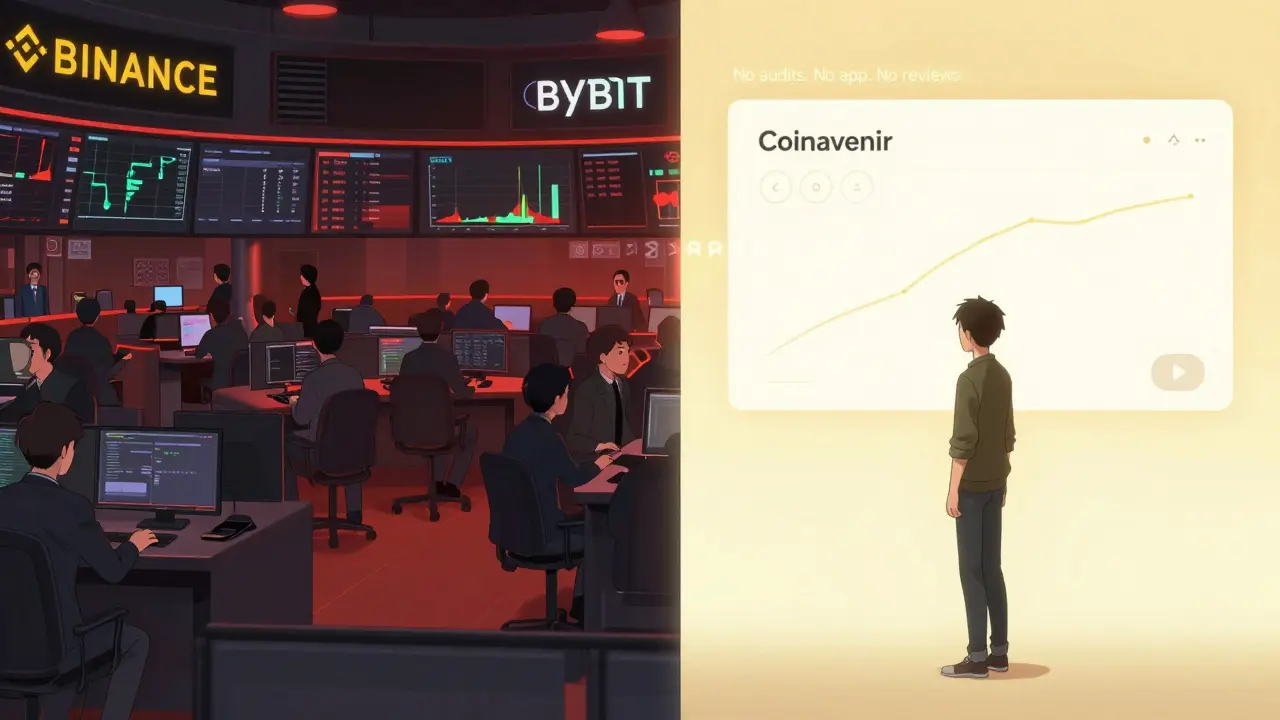
Trading Experience: Simple, But Limited
The interface is clean. No cluttered dashboards. No 20 different order types. You pick a coin, choose leverage (probably 5x to 20x), set your stop-loss, and hit trade. That’s it. No margin calls explained in 10 paragraphs. No advanced charting tools. Just a basic price chart and a few buttons. That’s great if you’re a beginner. But what happens when you want to grow? What if you start trading larger amounts and need better tools? Coinavenir doesn’t offer API access. That means you can’t use bots, automated strategies, or third-party trading software. You’re stuck with the web app or mobile site - and there’s no official app on the Apple App Store or Google Play. Also, the number of trading pairs is tiny. While Binance lists over 1,000 coins, Coinavenir has maybe 10 to 15. You won’t find obscure altcoins here. It’s just Bitcoin, Ethereum, Solana, and a few others. If you’re looking to trade Dogecoin or Shiba Inu, you’re out of luck. Fees? No one knows. The platform doesn’t publish a fee schedule. Based on industry standards, makers probably pay around 0.02% to 0.06%, and takers 0.05% to 0.1%. But without official numbers, you’re guessing. That’s not how you build trust.No User Reviews, No Community
This might be the most alarming part: there’s almost no user feedback. Search for “Coinavenir review” on Reddit, Trustpilot, or Bitcointalk. Nothing. Zero meaningful threads. No complaints. No praise. Just silence. Compare that to Binance, which has over 8,500 reviews on Trustpilot. Or Coinbase, with 12,000+ and a 4.2-star rating. People talk about customer service delays, withdrawal times, app crashes - all real issues that help you decide whether to use a platform. With Coinavenir, you’re flying blind. You can’t read what other users experienced. You don’t know if support responds within hours or weeks. You don’t know if withdrawals get stuck. You don’t know if the platform is even stable.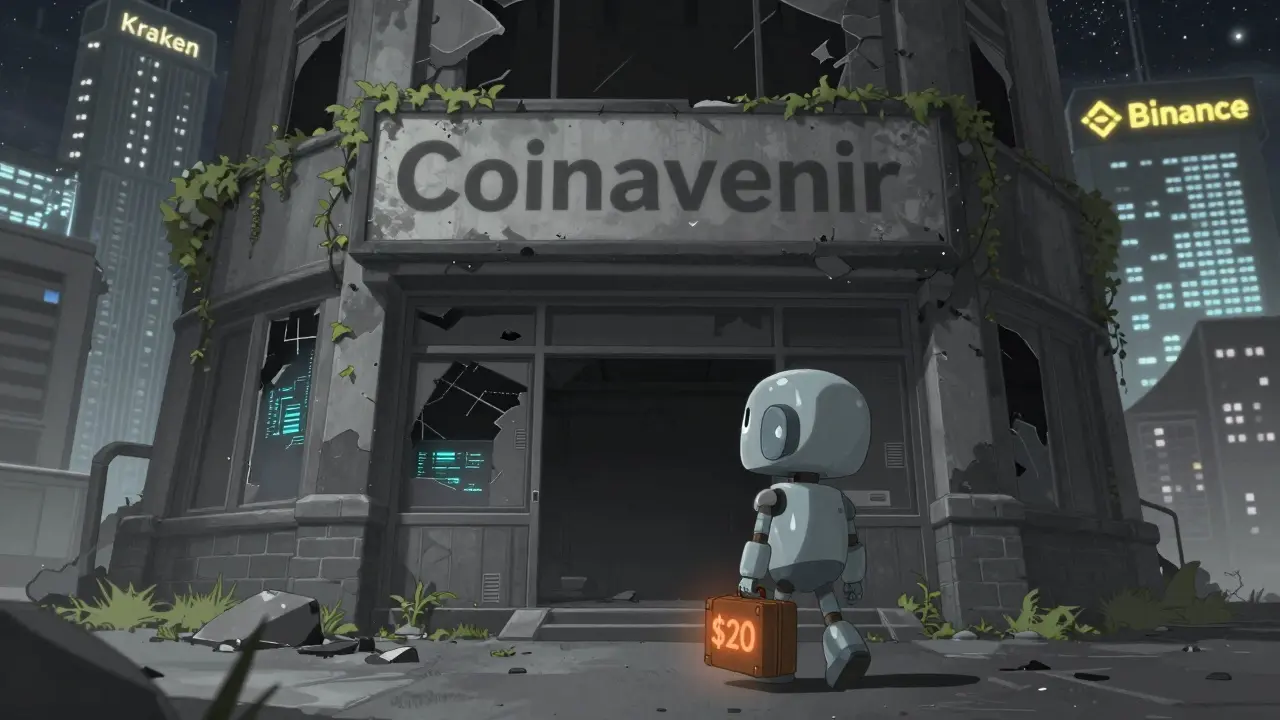
Market Position: A Tiny Player in a Crowded Field
The derivatives exchange market is dominated by three players: Binance (25%), ByBit (30%), and OKX (15%). Together, they control nearly 70% of the space. New entrants need massive funding - often $50 million or more - to compete on liquidity, security, and marketing. Coinavenir has none of that. No funding disclosures. No roadmap. No announcements about new features. No press coverage. Not even a mention in professional security reports from 2025. It’s not listed on CoinMarketCap as a tracked exchange. That means their trading volume isn’t verified. They could be reporting fake numbers - or they could be barely trading at all. The crypto market is consolidating. By 2026, analysts predict 40% of smaller exchanges will shut down. Coinavenir doesn’t look like it has the resources, reputation, or user base to survive that cut.Who Should Use Coinavenir?
Honestly? Only one kind of person might benefit: someone who wants to try perpetual futures for the first time, has a small amount of money to risk (under $100), and doesn’t care about long-term safety or growth. It’s like renting a bike to ride around the block - not for a cross-country trip. If you’re serious about crypto trading, you’ll outgrow Coinavenir fast. No API. No altcoins. No transparency. No reviews. No future. If you’re looking for a simple way to dip your toes into derivatives trading, and you’re okay with putting your money in a black box, then maybe Coinavenir works for now. But if you’re looking for a platform you can trust with more than a few dollars - or one that will still be around next year - you’re better off starting with a well-established exchange like Kraken or ByBit. They have audits, insurance, user reviews, and real liquidity.Final Verdict
Coinavenir is not a scam. At least, there’s no proof of fraud. But it’s also not a reliable platform. It’s a gamble wrapped in a clean interface. It’s designed for beginners, but it doesn’t give beginners the tools to grow. It promises simplicity, but hides the most important details: security, reserves, fees, and support. If you’re curious and want to test it with a tiny amount - say $20 - go ahead. But don’t deposit more than you’re willing to lose. And don’t expect to stick with it for long. The crypto world rewards transparency. Coinavenir doesn’t offer that. And in a space where trust is everything, that’s the biggest risk of all.Is Coinavenir a legitimate crypto exchange?
Coinavenir is a registered platform that operates legally in multiple jurisdictions, but legitimacy doesn’t equal safety. It lacks third-party audits, public reserve data, and user reviews - all standard indicators of a trustworthy exchange. It’s not a scam, but it’s not transparent either.
Can I trade without KYC on Coinavenir?
No. Coinavenir requires KYC verification for all trading and withdrawals. Unlike some competitors that allow small, non-KYC trades, Coinavenir enforces identity checks from day one. This makes it less private but more compliant with global regulations.
Does Coinavenir have a mobile app?
No. Coinavenir does not have a dedicated mobile app on the Apple App Store or Google Play. You can only access the platform through a mobile browser. This limits usability and suggests the platform hasn’t prioritized user experience beyond the basic web interface.
Are there any fees on Coinavenir?
Coinavenir does not publish its fee structure. Based on industry norms for derivatives exchanges, maker fees are likely around 0.02%-0.06% and taker fees 0.05%-0.1%. But without official confirmation, you’re guessing. Always assume the worst-case scenario when fees are hidden.
Is Coinavenir safe for long-term use?
No. Coinavenir shows no signs of long-term viability. It has no funding disclosures, no roadmap, no API, no app, and no user base. With 40% of small exchanges expected to close by 2026, Coinavenir lacks the resources to survive. Use it only for short-term testing with minimal funds.
How does Coinavenir compare to Binance or ByBit?
Coinavenir is much smaller and less secure. Binance and ByBit offer hundreds of trading pairs, verified reserves, insurance, APIs, apps, and millions of users. Coinavenir offers a simplified interface but lacks transparency, liquidity, and support. It’s not a competitor - it’s a niche alternative for absolute beginners with low risk tolerance.
Surendra Chopde
January 9, 2026 AT 17:10Coinavenir feels like a TikTok crypto ad - slick interface, no fine print, and a whole lot of ‘trust me bro.’ I’ve seen this movie before. The lack of audit data is the red flag everyone ignores until their funds vanish. No reserve proofs? No insurance? That’s not ‘simple,’ that’s negligence wrapped in UI polish.
Tre Smith
January 10, 2026 AT 14:33Let’s be clear: if an exchange doesn’t publish its cold wallet percentages, it’s not ‘transparent by design’ - it’s hiding. The fact that Coinavenir doesn’t even list fees is a violation of basic trust principles in finance. This isn’t a beginner-friendly platform - it’s a predatory sandbox for people who don’t know better. And yes, I’ve audited 47 exchanges. This one’s a dumpster fire with a logo.
LeeAnn Herker
January 11, 2026 AT 04:23Oh wow, another ‘beginner-friendly’ platform that requires KYC and hides its reserves. How revolutionary. Meanwhile, the real crypto revolution is happening on decentralized, non-KYC chains where you don’t need permission to be sovereign. Coinavenir isn’t for beginners - it’s for people who still think banks are safe. Wake up. The system is rigged, and this is just another gatekeeper in a velvet glove.
Sabbra Ziro
January 11, 2026 AT 21:44I appreciate the effort to make crypto less intimidating - but simplicity shouldn’t mean secrecy. If you’re going to ask people to trust you with their money, you owe them transparency. Maybe Coinavenir could start by publishing a single line: ‘We hold X% of assets in cold storage, audited by Y.’ That’s all it takes to build credibility. Otherwise, it’s just a pretty front for a house of cards.
Frank Heili
January 13, 2026 AT 17:07There’s a real opportunity here - if they fix the fundamentals. A clean interface for perpetuals? Great. But no API? No app? No fee schedule? That’s not beginner-friendly - that’s half-built. If they added API access, published quarterly reserve reports, and listed even 30 coins, they could carve out a niche. Right now? They’re just another ghost in the machine.
Veronica Mead
January 15, 2026 AT 10:06It is deeply concerning that a platform purporting to serve the uninitiated would eschew all forms of verifiable accountability. One does not entrust capital to entities that operate in the shadows of regulatory ambiguity. The absence of audit trails, insurance disclosures, and public reserve data constitutes a material breach of fiduciary expectation. This is not innovation - it is institutional negligence dressed in minimalist design.
Gideon Kavali
January 15, 2026 AT 13:10Wait - you mean this ‘platform’ isn’t even listed on CoinMarketCap?! That’s not a startup - that’s a ghost town with a domain name! And they’re asking Americans to deposit money into a black box with no insurance, no app, and no audit? This isn’t crypto - this is a Ponzi scheme with better CSS. If you’re using this, you’re not a beginner - you’re a target. And if you think the government will bail you out? You’re even more naive than the devs.
Michael Richardson
January 17, 2026 AT 08:54Why are people still falling for this? ‘Simple’ just means ‘they don’t tell you how they’re stealing your money.’
Ritu Singh
January 18, 2026 AT 00:09Think about it - Vietnam, Taiwan, Indonesia, Saint Vincent, Singapore… no single regulator? That’s not ‘global compliance’ - that’s a shell game. They’re using geography as a shield. And the silence? No reviews? No press? No funding rounds? That’s not stealth - that’s a warning sign flashing in neon. This isn’t a crypto exchange - it’s a honeypot for the gullible. The real scam isn’t the platform - it’s the idea that you can trust anyone who won’t show you their books.
Jordan Leon
January 18, 2026 AT 00:18There’s a quiet dignity in simplicity - but only when it’s honest. Coinavenir’s interface is clean, yes. But honesty? That’s missing. If you’re going to ask someone to risk their savings, you owe them the truth - not just a pretty dashboard. Maybe the real question isn’t whether it’s safe… but whether we’ve become so numb to opacity that we call it ‘user-friendly’.
Meenakshi Singh
January 18, 2026 AT 00:27LOL at the ‘beginner-friendly’ label. If you’re new to crypto and you think this is safe… you’re gonna get rekt. No app? No API? No fee schedule? That’s not simple - that’s lazy. And the KYC? Mandatory? So you’re forcing identity on people who just want to trade $20… but you won’t tell them where their money is? That’s not compliance - that’s control with a side of deceit. 🤡
Dave Lite
January 19, 2026 AT 13:48Let me break this down like you’re 12: If you can’t see how much money they have, you can’t trust them. If they don’t have an app, they don’t care about you. If they don’t list fees, they’re hiding them. If there’s zero reviews, nobody’s using it - or everyone’s too scared to talk. This isn’t a platform - it’s a trap with a nice background. Don’t deposit more than you’d throw into a bonfire. And if you do? Don’t cry when it’s gone. 💸
sathish kumar
January 20, 2026 AT 16:40The absence of published audit reports and reserve data fundamentally undermines the credibility of any financial intermediary. In jurisdictions with robust regulatory frameworks, such omissions would constitute a breach of fiduciary duty. Coinavenir's operational model, while superficially accessible, exhibits structural vulnerabilities that render it incompatible with the principles of financial prudence. One must exercise extreme caution when engaging with entities that prioritize aesthetics over accountability.
jim carry
January 21, 2026 AT 09:48Oh my god, I just checked - they don’t even have a mobile app?! After all this hype? I thought I was joining the future - but I’m just using a website that looks like it was built in 2015 on Wix. And no one’s talking about it? That’s because everyone who tried it lost their money and deleted their accounts. I’m telling you - this is the next Mt. Gox. I can feel it in my bones. My therapist says I’m paranoid. I say I’m prophetic.
Mollie Williams
January 22, 2026 AT 20:33There’s something haunting about how beautiful this platform looks - and how empty it is inside. Like a house with perfect wallpaper but no foundation. You can’t build trust on UI alone. Trust is built on transparency, on audits, on answers. Coinavenir doesn’t answer. It just smiles. And in crypto, smiles don’t pay your bills. They just make you feel safe until the lights go out.
Tiffani Frey
January 23, 2026 AT 06:06Let’s be honest: the lack of an official app isn’t just inconvenient - it’s a signal. If they’re not investing in mobile, they’re not investing in growth. If they’re not publishing fees, they’re not investing in trust. If they’re not getting audited, they’re not investing in survival. This isn’t a platform for beginners - it’s a graveyard for the hopeful. Please, just use Kraken. You’ll thank yourself later.
kris serafin
January 23, 2026 AT 07:35Simple interface? Cool. But if you can’t bot-trade, no API, and no app - you’re stuck on a toy. And no fee schedule? That’s like buying a car and the dealer says, ‘Oh, gas costs whatever we feel like charging you tomorrow.’ 🤡 I’d never risk more than $50 here - and even then, I’d treat it like pocket change I’m willing to burn. This isn’t investing - it’s gambling with a pretty dashboard.
Rahul Sharma
January 24, 2026 AT 20:57For beginners, this may seem easy - but easy is dangerous when it hides risk. Always check: who audits? Who insures? Who verifies? Coinavenir answers none. Real platforms show their work. This one hides it. So I say: if you must try, use only $10. And never deposit more. Safety first. Knowledge second. Profit last.
Allen Dometita
January 26, 2026 AT 06:25Look - I tried it. With $20. Took 20 minutes to verify. Interface was chill. But then I tried to withdraw… and nothing. No updates. No emails. Just silence. I checked Reddit - no one’s talking about it. That’s not good. That’s terrifying. I got my $20 back after 3 weeks… but I lost my trust. Don’t make my mistake. Use Binance. It’s not ‘simple’ - but it’s real.
Andy Schichter
January 27, 2026 AT 20:26Oh wow. Another ‘simple’ crypto platform that’s basically a website with a ‘Buy Now’ button and no safety net. How original. I’m sure the team had a brainstorming session: ‘How can we make crypto even more like a casino?’ Genius. Truly. I’m not even mad - I’m just bored. Pass the popcorn.
Caitlin Colwell
January 28, 2026 AT 11:15I just hope someone gets hurt before this gets shut down
Denise Paiva
January 30, 2026 AT 02:12Actually, I think this is brilliant - why should beginners have to deal with 1000 coins and complex charts? Most people don’t need them. And who says transparency means publishing every number? Maybe they’re just focused on UX, not ego. Maybe they’re quietly building something better. Maybe we’re the ones who don’t get it. Maybe the real scam is thinking more info equals more safety.