
For years, financial institutions treated Distributed Ledger Technology (DLT) as a shiny toy-great for whitepapers and pilot projects, but too risky for real money. That era is over. As of late 2025, the industry has hit a critical maturity inflection point. Banks are no longer asking if they should use blockchain; they are asking how to integrate it into their core operations without breaking compliance or losing customers.
The shift isn't just about hype. It’s about infrastructure. Traditional centralized databases have served us well, but they come with hidden costs: slow settlement times, high counterparty risk, and opaque record-keeping. DLT offers a different path. By maintaining identical copies of transaction records across a network of computers called nodes, it creates an immutable, programmable system that automates complex procedures and eliminates the need for trusted intermediaries in many scenarios.
From Bitcoin to Banking: The Evolution of Financial Ledgers
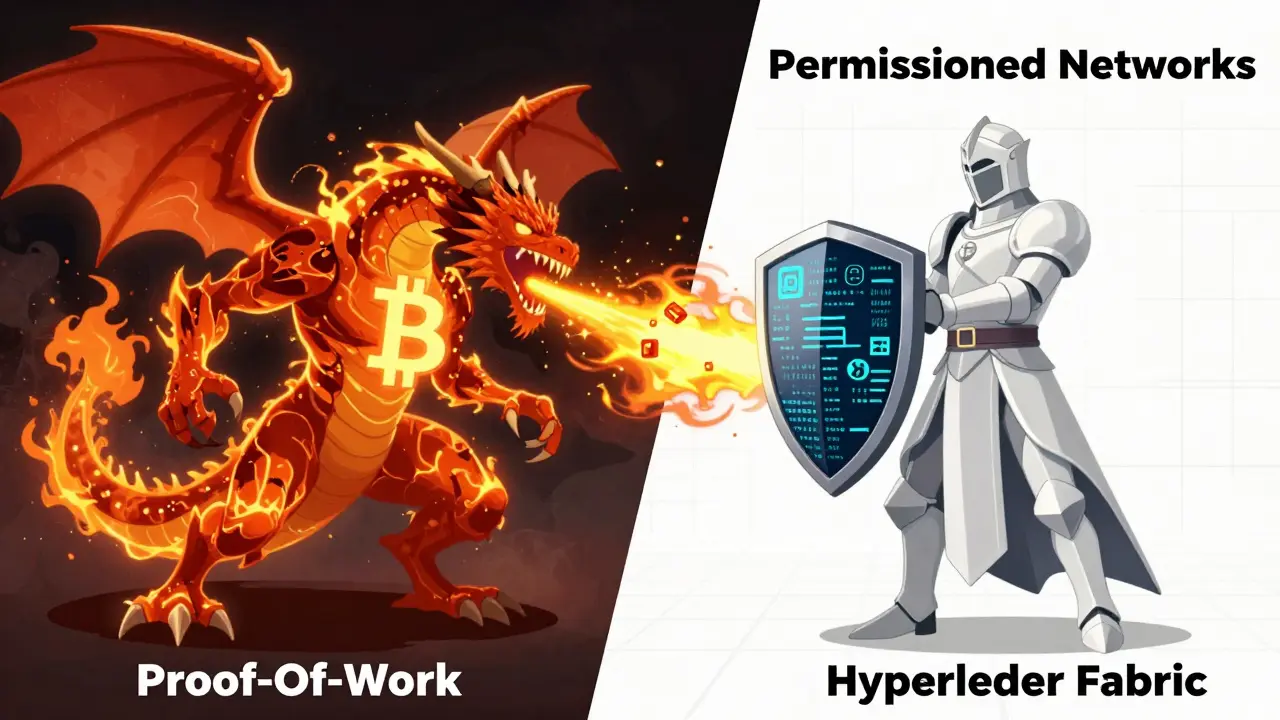
To understand where we are today, you have to look at where we started. Bitcoin introduced the world to permissionless systems using proof-of-work consensus. Miners solve complex mathematical problems to validate transactions, a process that consumes massive amounts of electricity-equivalent to Ireland's total consumption. While revolutionary for censorship-resistant payments, this model is rarely suitable for traditional finance due to its energy profile and lack of privacy controls.
Financial institutions needed something else. They turned to permissioned networks. Unlike public blockchains, these private ledgers restrict who can participate. They often use more efficient consensus mechanisms like proof-of-stake, which rewards seniority rather than computing power. This approach allows banks to maintain confidentiality while benefiting from the cryptographic security of digital signatures. Each transaction receives a unique digital fingerprint, making any attempt at data tampering immediately detectable-a feature confirmed by World Bank Group analysis as essential for regulatory trust.
Major Enterprise Platforms Powering Financial Infrastructure
Not all DLT platforms are created equal. In the enterprise space, two major players have emerged as the backbone of financial innovation: R3 Corda and Hyperledger Fabric.
R3 Corda was built specifically for banking, insurance, and capital markets. Its architecture avoids global transaction broadcasts, meaning only parties involved in a specific deal see the relevant data. This privacy-preserving design supports complex workflows like syndicated lending, trade finance, and Central Bank Digital Currencies (CBDCs). However, it is less suited for public blockchain applications or decentralized finance (DeFi) ecosystems.
Hyperledger Fabric, on the other hand, offers a modular, highly customizable permissioned blockchain. It provides fine-grained access control and integrates seamlessly with existing enterprise systems. Cloud partnerships with IBM Blockchain, Amazon Managed Blockchain, and Oracle have accelerated its adoption in clearing and settlement, KYC/AML compliance, and interbank payments. The trade-off? Setup complexity. Managing Hyperledger Fabric requires specialized technical expertise, which can be a barrier for smaller institutions.
| Platform | Primary Focus | Consensus Model | Key Advantage | Limitation |
|---|---|---|---|---|
| R3 Corda | Banking & Capital Markets | Permissioned | Privacy-first, no global broadcast | Limited DeFi compatibility |
| Hyperledger Fabric | Enterprise Integration | Modular Permissioned | Highly customizable, cloud-ready | Complex setup and management |
| Bitcoin Network | Public Payments | Proof-of-Work | Censorship resistance | High energy use, low privacy |
Swift’s Blockchain Leap: A New Global Standard
If there is one event that signals the end of the "pilot phase," it is Swift's strategic move in September 2025. The global financial messaging giant announced the addition of a blockchain-based shared ledger to its technology stack. This wasn't a side project; it was a core infrastructure update designed to facilitate the trusted, scalable movement of regulated tokenized value.
Javier Pérez-Tasso, CEO of Swift, described this as creating the "infrastructure stack of the future." The new ledger acts as a secure, real-time transaction log between financial institutions. It records, sequences, and validates transactions while enforcing rules through smart contracts. Crucially, it is built for interoperability, connecting existing legacy networks with emerging digital ecosystems. Major banks from 16 countries are already providing design feedback, signaling broad industry support for this standardized approach.
Solving the Oracle Problem: Data Integrity in Production
One of the biggest hurdles for DLT in finance is the "oracle problem." Blockchains are great at storing data, but they can't verify external data on their own. If market data fed into a smart contract is wrong, the contract executes incorrectly. This has stalled many projects at the pilot stage.
DZ BANK recently tackled this head-on in collaboration with Google Cloud. They developed an architectural solution for Smart Derivative Contracts (SDCs) that securely receives market data through Google Cloud technology. This addresses attack vectors and failure modes unique to decentralized systems. By solving the data integrity challenge, DZ BANK demonstrated that DLT could move beyond controlled test environments into production systems where regulated financial operations depend on absolute accuracy.
Real-World Use Cases Driving Adoption
So, what are banks actually doing with this technology right now? Here are the most impactful use cases:
- Cross-Border Payments: Traditional international transfers take days and involve multiple intermediaries. Tokenization enables real-time settlements. Jose Luis Calderón, CEO of PagoNxt Payments (a Santander company), noted that traditional models are "no longer suited to today's digital economy," highlighting the need for faster solutions in P2P payments and SME commerce.
- Clearing and Settlement: Smart contracts automate the matching and settlement of trades, reducing counterparty risk and eliminating the need for manual reconciliation. The Eurosystem's validation work shows that smart contract protocols can efficiently settle assets across separate DLT infrastructures.
- KYC and AML Compliance: Instead of each bank independently verifying customer identities, shared DLT ledgers allow institutions to share verified KYC data securely. This reduces duplication, cuts costs, and improves fraud detection.
- Tokenized Assets: Real-world assets like bonds, equities, and even real estate are being represented as digital tokens on DLT. This increases liquidity, allows for fractional ownership, and simplifies transfer processes.

Challenges Ahead: Energy, Complexity, and Regulation
Despite the progress, challenges remain. Public blockchains still face scrutiny over energy consumption. While permissioned networks are more efficient, they introduce complexity in setup and management. Integrating DLT with legacy mainframes requires significant engineering effort and specialized talent.
Regulatory clarity is improving but not uniform globally. Institutions must navigate varying requirements for data privacy, anti-money laundering, and consumer protection. However, the trend is clear: regulators are moving from observation to active engagement, helping to stabilize the framework for production deployments.
The Strategic Inflection Point
2025 is shaping up as a strategic inflection year. Institutions that remain stuck in pilot projects risk competitive disadvantage. As production blockchain systems become operational, early adopters will benefit from reduced operational costs, faster transaction speeds, and enhanced transparency. The technology’s ability to eliminate counterparty risk and automate complex settlement procedures represents fundamental infrastructure evolution, not just incremental improvement.
As academic research continues-highlighted by events like the IEEE International Workshop on Blockchain and Distributed Ledger Technologies-the integration of DLT with AI and IoT will further expand its capabilities. For finance, the question is no longer whether DLT will transform the industry, but how quickly institutions can adapt to stay relevant.
What is the main difference between DLT and traditional databases?
Traditional databases are centralized, meaning one entity controls the data. DLT is decentralized, with identical copies of records maintained across multiple nodes. This makes DLT more transparent, resistant to tampering, and capable of eliminating single points of failure.
Why do banks prefer permissioned blockchains over public ones like Bitcoin?
Banks need privacy, speed, and regulatory compliance. Public blockchains like Bitcoin are transparent to everyone and use energy-intensive proof-of-work. Permissioned blockchains restrict access, use efficient consensus mechanisms, and allow for confidential transactions between known parties.
How does Swift's new blockchain ledger change cross-border payments?
Swift's ledger enables real-time, trusted movement of tokenized value between institutions. It reduces reliance on intermediaries, lowers costs, and increases transparency, addressing the inefficiencies of traditional international payment models.
What is the "oracle problem" in DLT?
The oracle problem refers to the difficulty of getting accurate, trustworthy external data into a blockchain. Since blockchains can't verify outside information themselves, they rely on oracles. If an oracle fails or provides bad data, smart contracts may execute incorrectly.
Is DLT ready for full-scale production deployment in finance?
Yes, as of 2025, DLT has reached a maturity inflection point. Major institutions like Swift and DZ BANK are moving beyond pilots to production systems, supported by stabilizing regulatory frameworks and improved technical solutions for data integrity and interoperability.
Albert Lee
May 10, 2026 AT 02:58This is such a massive leap forward for the industry! I have been watching these pilots for years and it feels like we are finally seeing the real infrastructure take shape. The way Swift is integrating this into their core stack just gives me so much hope for faster, cheaper cross-border payments. It is exciting to think about how this will help small businesses who have suffered from slow settlement times for so long.
Matt Davis
May 10, 2026 AT 18:29You are all completely missing the point here. This isn't a revolution; it is just another expensive tech solution looking for a problem that doesn't exist. Banks have always had 'hidden costs' because they are inefficient by design, not because they lack blockchain. R3 Corda and Hyperledger Fabric are just fancy databases with extra steps. The energy argument is a red herring since permissioned chains don't use proof-of-work anyway. Stop pretending this changes anything fundamental about how finance operates.
Jesse Alston
May 12, 2026 AT 16:32Great breakdown of the enterprise platforms! 👍 One thing often overlooked is the specific role of oracles in making this viable. As mentioned with DZ BANK and Google Cloud, getting accurate external data onto the chain is the hardest part. If you get the oracle wrong, the smart contract fails regardless of how secure the ledger is. It's great to see major banks actually tackling this production-ready issue instead of just building sandbox toys.
Kimberly Herbstritt
May 13, 2026 AT 19:38I have to disagree with the hype surrounding Swift's move. Just because they added a shared ledger doesn't mean legacy systems are going away overnight. Interoperability is a nightmare. Connecting old mainframes to new DLT infrastructures is more complex than most people realize. I think we are still in the early stages of integration, not full adoption. Let's not get ahead of ourselves.
Sarah C
May 14, 2026 AT 19:29I really appreciate the detailed comparison between Corda and Fabric. It helps clarify why different institutions might choose one over the other based on their privacy needs versus customization requirements. The point about KYC/AML compliance being streamlined through shared ledgers is particularly compelling for reducing duplication across banks.
Bianca Vilas Boas Lourenço
May 16, 2026 AT 00:45Ugh, another article telling us everything is fine? 🙄 You guys really believe that 'immutable' means 'unhackable'? Please. The oracle problem is just the tip of the iceberg. What happens when the consensus nodes are compromised or when regulatory frameworks change overnight? It's all just a big trust exercise wrapped in cryptographic jargon. I'm not buying it. 😒
Ankush Pokarana
May 17, 2026 AT 14:06the shift from permissionless to permissioned networks represents a fundamental philosophical change in what we value as users we used to prioritize censorship resistance above all else but now efficiency and privacy seem to be the dominant drivers this raises questions about the centralization of power within financial systems if only known parties can participate who controls the rules of participation and how transparent are those decisions really
John Gonzalez Bentham
May 18, 2026 AT 07:33look at all these tech bros falling for the blockchain bandwagon again. its just a database with a attitude problem. the setup complexity of hyperledger fabric is a joke for smaller institutions they cant even maintain their current sql servers let alone a distributed ledger. swift moving in late 2025 doesnt mean anything they always move slow. total waste of time honestly.
Ellie Riddell
May 20, 2026 AT 00:09It is interesting to observe how quickly the narrative shifted from 'decentralization is freedom' to 'permissioned ledgers are efficient.' I suppose when you are dealing with billions in settlements, speed matters more than ideology. But does anyone else feel like we are trading one set of risks for another? Centralized databases failed due to opacity; will opaque permissioned ledgers fail due to lack of auditability?
Destiny Kilby
May 21, 2026 AT 14:01I find the section on tokenized assets quite intriguing. The ability to fractionalize real estate and bonds could open up investment opportunities for many people who previously couldn't afford them. However I am concerned about the regulatory clarity which seems to vary significantly by country. This fragmentation could hinder global adoption.
Yash Lodha
May 23, 2026 AT 11:15They claim it is secure but who monitors the monitors? The 'trusted intermediaries' are simply replaced by 'trusted node operators'. It is a classic surveillance capitalism play disguised as technological innovation. The data integrity solutions via Google Cloud mean Big Tech now has a backdoor into your bank's ledger. Wake up sheeple.
Jerry CUNNINGHAM SR
May 24, 2026 AT 00:07It is encouraging to see such a balanced view of the challenges. While the benefits of reduced counterparty risk are clear, the engineering effort required to integrate with legacy mainframes cannot be underestimated. We must ensure that the transition is inclusive and does not leave smaller institutions behind due to the high barrier to entry for managing complex DLT setups.
Shelby Cantu
May 24, 2026 AT 22:49Real-time settlements are a game changer for SMEs. No more waiting days for international transfers to clear. This technology actually solves a tangible pain point for everyday business owners.
Tobias Gjerlufsen
May 25, 2026 AT 12:15you idiots think this is safe? smart contracts are riddled with bugs. one exploit and millions vanish. the oracle problem is not solved it is just outsourced to google. you are walking into a honeypot. stop trusting code you did not write. it is suicide for your portfolio.
Ruben Michel
May 26, 2026 AT 19:18The distinction between public and private ledgers is elementary yet frequently misunderstood by the layperson. Permissioned networks offer the requisite confidentiality for institutional grade operations. To suggest that Bitcoin's proof-of-work model is relevant to interbank clearing is intellectually lazy. The sophistication of Hyperledger Fabric's modular architecture is what drives true enterprise value.
Gavin Wonnacott
May 28, 2026 AT 04:15I am sick of hearing about 'pilots' ending. They never end. They just get renamed. And now you want me to trust my money to a system where the 'nodes' are controlled by the same banks that crashed the economy in 2008? Absolutely not. This is a centralized scam dressed up as decentralization. Do not fall for it.
Samara McCallum
May 28, 2026 AT 10:06i guess we are just supposed to accept that privacy is a luxury item now? because if you want speed you lose transparency. it is funny how the definition of security changes depending on who holds the keys. maybe the drama is just in our heads though. 🤷♀️
Sheldon Friesen
May 29, 2026 AT 07:12Let's look at the positives here! The integration of AI and IoT with DLT mentioned at the end is fascinating. Imagine automated supply chain finance that adjusts in real-time based on IoT sensor data. That is the kind of innovation that truly transforms industries. Sure there are hurdles but the potential is immense!
Sudarshan Anbazhagan
May 30, 2026 AT 06:29it is imperative that we recognize the profound implications of this technological shift not merely as an operational upgrade but as a redefinition of trust mechanisms within the financial ecosystem the reliance on cryptographic proofs rather than institutional reputation marks a paradigmatic departure from traditional banking models however one must remain cognizant of the regulatory labyrinth that awaits
Sharada Vakkund
May 30, 2026 AT 21:45Thanks for sharing this comprehensive overview! It is important to highlight how DLT can democratize access to financial services through tokenization. I would love to see more discussion on how this impacts emerging markets specifically. Does anyone have insights on CBDC developments in Asia?