
Have you ever watched Bitcoin drop suddenly, only to bounce back up ten minutes later? It feels like a glitch, but it’s often just the market reacting to a "whale." In the world of cryptocurrency, a crypto whale is a large holder or trader with enough capital to influence market prices through their transactions. These aren't your average retail investors buying $50 worth of Ethereum. We’re talking about entities holding millions, sometimes billions, in digital assets. When they move, the market moves with them.
For years, these big players operated in the shadows. But blockchain technology changed the game. Because every transaction on networks like Bitcoin is a public ledger record that anyone can verify and Ethereum is a programmable blockchain platform supporting smart contracts is recorded publicly, we can actually see where the money is going. This transparency has given rise to following whale trading strategies, where retail traders try to mimic the moves of these giants to profit from their activity.
What Exactly Is a Whale?
Before you start chasing big trades, you need to know who you are looking at. The term "whale" isn’t just slang; it has a specific definition in this space. According to data from CoinLedger, a wallet is generally considered a whale if it holds more than 1% of a cryptocurrency's circulating supply. For Bitcoin, that means holding over 210,000 BTC (worth billions), while for smaller altcoins, the threshold might be lower in absolute terms but still represents massive control.
It’s important to distinguish between different types of whales:
- Institutional Investors: Hedge funds, family offices, and corporations like MicroStrategy that buy BTC as a treasury reserve asset.
- Market Makers: Entities that provide liquidity to exchanges, often moving large amounts to balance order books.
- High-Net-Worth Individuals: Early adopters or wealthy traders who treat crypto as a high-stakes portfolio component.
Not all whale activity is meant to signal a price direction. Sometimes, a whale is just moving funds from one exchange to another for security reasons. That’s why context matters more than just seeing a big number.
The Core Strategy: Mimicking the Giants
The basic idea behind following whale trading strategies is simple: if someone with unlimited resources is buying heavily, the price will likely go up due to increased demand. If they are selling, expect a drop. However, it’s not as straightforward as "buy what they buy." Whales often use sophisticated tactics to hide their intentions or manipulate the market.
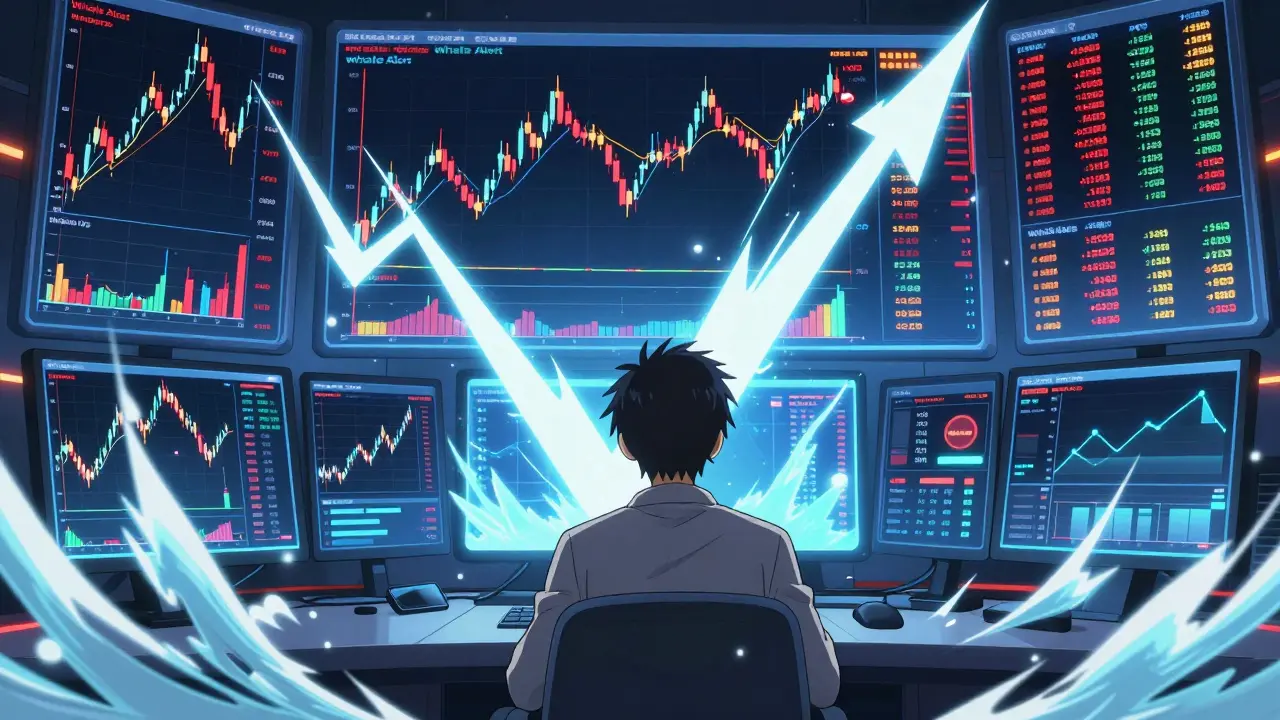
One common tactic is the "whale scoop." This happens when a whale deliberately pushes the price down to trigger stop-loss orders from retail traders. They absorb the cheap liquidity (the sell orders) and then reverse course, driving the price back up. This creates a sharp V-shaped recovery that catches many retail traders off guard. To spot this, you look for a sudden spike in volume followed by a quick reversal within a 30-to-60-minute timeframe.
Another pattern is accumulation. Whales don’t want to spike the price too early, so they break up large buys into smaller chunks over days or weeks. On-chain analytics tools can detect this gradual inflow into exchange wallets or cold storage addresses.
Essential Tools for Tracking Whales
You can’t do this manually by staring at the blockchain explorer all day. You need specialized software that aggregates this data and sends alerts. Here are the top platforms used by serious traders:
| Platform | Key Feature | Cost | Best For |
|---|---|---|---|
| Whale Alert | Real-time Twitter/Discord notifications for large transactions | Free / Pro ($29.99/mo) | Quick alerts on major moves |
| Glassnode | Deep on-chain metrics and historical data analysis | Paid (Enterprise tiers) | Data-driven fundamental analysis |
| Arkham Intelligence | Entity labeling and wallet clustering | Free / Paid ($299/mo) | Identifying specific entities behind wallets |
| Nansen | Smart Money labels and token flow tracking | $99/month | DeFi and NFT whale tracking |
When setting up your alerts, customize the thresholds based on your account size. If you have a $10,000 trading account, an alert for a $100,000 transaction is relevant. If you’re managing $100,000, you might want to filter for $1 million+ moves to avoid noise.
Risks and Pitfalls: Don’t Get Scooped
Following whales sounds like free money, but it comes with significant risks. The biggest trap is assuming every large transaction is a market-moving event. In reality, many large transfers are internal.
For example, Coinbase reported that 42% of large transactions are Over-The-Counter (OTC) trades. These happen between private parties and don’t hit the public order book, meaning they don’t immediately affect price. If you buy because you saw a huge transfer, you might be buying into a stagnant market.
There’s also the risk of spoofing. Institutional traders sometimes place large fake orders to trick retail traders into thinking they are accumulating or distributing, only to cancel the orders before execution. Dr. David Lifchitz of ExodusPoint Capital noted that 30% of apparent whale accumulation in 2023 was later revealed to be wash trading or misleading patterns.
Additionally, there is an information lag. Free tools often have a delay of 2 to 5 minutes. By the time you see the alert, the whale might have already completed their trade, and the price has adjusted. Institutional services like Chainalysis Reactor offer near-real-time data, but they come with a hefty price tag.

How to Combine Whale Data with Technical Analysis
Relying solely on whale tracking is dangerous. The most successful traders combine on-chain data with traditional technical analysis. This double-confirmation method filters out false signals.
Here is a practical workflow:
- Spot the Move: Your Whale Alert notifies you of a large deposit to Binance.
- Check the Chart: Look at the current price action. Is Bitcoin near a key support level? Is the Relative Strength Index (RSI) oversold?
- Analyze Volume: Use TradingView to check if volume is increasing alongside the whale activity. High volume confirms genuine interest.
- Look for Reversals: Wait for a candlestick pattern that suggests a reversal, such as a hammer or engulfing pattern, before entering.
Data from TradingView shows that strategies combining whale activity indicators with Fibonacci retracement levels achieved a 63% win rate, compared to just 52% for whale tracking alone. This highlights the importance of not jumping in blindly.
Regulatory Landscape and Future Trends
The environment for whale tracking is evolving. In February 2024, the SEC issued guidance stating that while retail traders face no restrictions on using whale data, platforms providing this data must comply with market surveillance requirements. This could lead to stricter rules on how data is shared.
Moreover, whales are getting smarter. Arkham Intelligence reported a 45% year-over-year increase in "wallet fragmentation," where whales split their holdings across dozens of addresses to avoid detection. This makes tracking harder but not impossible. New AI-driven tools are emerging to cluster these fragmented wallets and identify the true owner.
Despite these challenges, the strategy remains viable. As long as markets are driven by human psychology and liquidity dynamics, large players will continue to leave footprints. The key is to stay adaptable, use multiple sources of confirmation, and never risk more than you can afford to lose.
Is following whale trading strategies legal?
Yes, it is completely legal. Blockchain data is public information. Anyone can access and analyze transaction records. However, using insider information obtained through illegal means (like hacking an exchange) is illegal. Simply monitoring public ledgers is a standard analytical practice.
Can I track whales on centralized exchanges like Coinbase?
You cannot see individual user balances on centralized exchanges. However, you can track deposits and withdrawals to and from exchange hot wallets. Large deposits often precede selling pressure, while large withdrawals to cold storage often indicate long-term holding intent.
What is the best time frame for whale trading?
Whale scoops and short-term manipulations often play out on 15-minute to 1-hour charts. For larger accumulation trends, daily or weekly charts are more useful. Avoid scalping based on whale alerts unless you have very low-latency data feeds, as the delay can eat into profits.
Do whale tracking tools work for small altcoins?
They work differently. In small altcoins, a single whale can move the price significantly more than in Bitcoin. However, the risk of manipulation is higher. Always verify liquidity depth before entering a trade based on whale activity in low-cap tokens.
How do I distinguish between a whale buying and a whale moving funds?
Look at the destination address. If funds move from an exchange to a new, unknown wallet address, it’s likely accumulation (buying). If funds move between known exchange wallets or to a mixer service, it might just be internal management or privacy-seeking behavior. Tools like Arkham Intelligence help label these destinations.