
FTX was once one of the biggest names in cryptocurrency trading. At its peak, it handled $15 billion in daily trades, had a $18 billion valuation, and even paid $135 million for the naming rights to the Miami Heat’s arena. But by November 2022, it was gone - wiped out in a matter of days. If you’re wondering what happened to FTX, this isn’t just a review. It’s a breakdown of how a crypto giant collapsed under its own weight, and what it teaches us about trading platforms today.
How FTX Grew So Fast
FTX launched in May 2019 by Sam Bankman-Fried. It didn’t start as a monster. But it moved fast. Unlike other exchanges that stuck to basic spot trading, FTX pushed into advanced features: futures contracts settled in stablecoins, leveraged tokens up to 50x, prediction markets, and even tokenized stocks. Traders loved it. The platform made complex trades feel simple. You could bet on the entire altcoin market with one click using the Altcoin Index Perpetual Future. It had a sleek app, low fees (0.05% for makers, 0.1% for takers), and a native token called FTT that gave users discounts on trading fees.
By early 2022, FTX had over 1 million users. Its mobile app had been downloaded 1.2 million times. It had offices in the Bahamas, Hong Kong, and Singapore. It seemed unstoppable. But behind the polished interface and flashy sponsorships, something dangerous was happening.
The Hidden Flaw: No Separation Between Customer Money and Company Money
Here’s the core problem: FTX didn’t keep customer funds separate from its own money. Most reputable exchanges store customer deposits in cold wallets and keep corporate funds in separate accounts. FTX didn’t. Instead, customer deposits flowed into accounts controlled by Alameda Research - a trading firm also founded by Sam Bankman-Fried.
This wasn’t just sloppy. It was illegal under basic financial rules. Alameda used customer money to make risky bets. When the market turned, Alameda couldn’t pay its debts. It had $9 billion in liabilities but only $900 million in assets. And a huge chunk of those assets? FTT - FTX’s own token. That’s like a bank lending your savings to its own CEO to buy stock in the bank itself.
When CoinDesk published a leaked balance sheet on November 2, 2022, showing Alameda’s shaky finances, panic hit. People started pulling money out of FTX. The exchange couldn’t cover withdrawals. By November 8, FTX blocked all withdrawals. The website removed the withdrawal button. Customers were locked out.
The Collapse: A Perfect Storm
Binance, the world’s largest crypto exchange, briefly announced it would buy FTX to save it. But within 24 hours, it backed out. Why? Because its team looked at FTX’s books and realized the numbers didn’t add up. There was no way to verify customer balances. The system was built on lies.
On November 11, 2022, FTX filed for bankruptcy. Hours later, hackers drained over $600 million from its wallets. FTX posted on Telegram: “FTX has been hacked. FTX apps are malware. Delete them.”
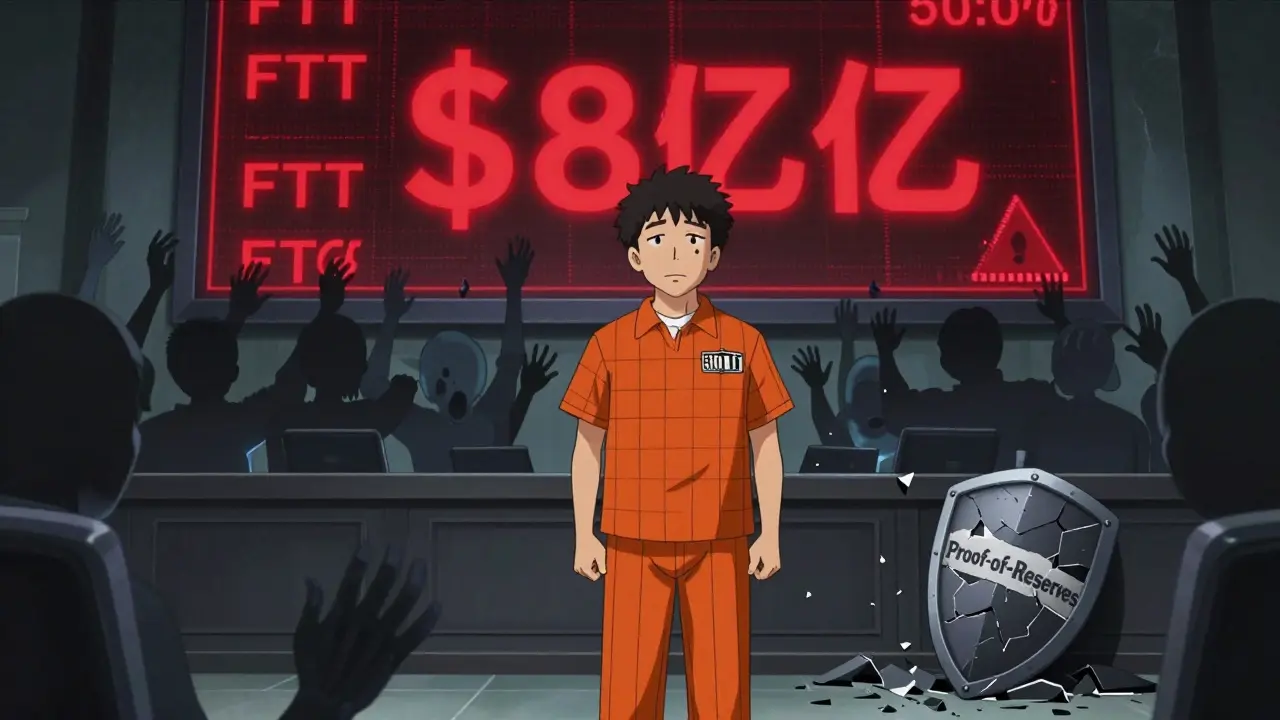
By then, $8 billion in customer funds had vanished. Around 1 million people lost money. The average account balance was $15,000. For many, it was their life savings. Reddit threads filled with posts like: “I had $47,832.15 in my FTX account. That was my life savings accumulated over 7 years.”
What Made FTX Different - and More Dangerous
Other exchanges had problems during the 2022 crypto crash. But FTX was unique in how it broke the rules.
- Competitors like Coinbase kept clear separation between customer and company funds. They published proof-of-reserves regularly.
- Kraken stayed conservative with leverage and collateral. It didn’t overextend.
- Binance had enough reserves to handle withdrawals, even during the panic.
FTX didn’t just ignore best practices - it mocked them. It claimed to use cold storage and insurance. But those were just words. When customers tried to withdraw, there was no money. The “insurance” didn’t exist. The “cold wallets” were empty.
The Fallout: Legal, Financial, and Industry-Wide
Sam Bankman-Fried was arrested in December 2022. In March 2024, he was sentenced to 25 years in prison for fraud, conspiracy, and money laundering. Caroline Ellison, former CEO of Alameda Research, pleaded guilty and cooperated with prosecutors.
The U.S. Securities and Exchange Commission (SEC) called it “major fraud.” Professor Gary Gensler, SEC chair, told Congress: “FTX highlights the need for comprehensive regulatory oversight.”
Regulators didn’t wait. The European Union fast-tracked MiCA regulations. The U.S. Congress started working on the Digital Commodities Consumer Protection Act of 2023 - a law designed to prevent another FTX.
On January 31, 2024, FTX officially announced it would not restart. It would liquidate assets and try to return money to customers. So far, $16 billion in assets have been recovered - but that’s not enough. Experts estimate customers will get back only 20% to 40% of what they lost.

What FTX Teaches Us Today
FTX didn’t fail because of a hack. It failed because it was built on deception. It looked like a modern, high-tech exchange. But underneath, it was a Ponzi scheme disguised as innovation.
Here’s what you need to remember:
- Never trust an exchange that doesn’t publish proof-of-reserves. If they won’t show you their wallet balances, don’t trust them.
- Ask: Is my money separate from the company’s money? If you can’t find a clear answer, walk away.
- Be wary of native tokens that promise discounts. FTT was supposed to save you money. Instead, it became a weapon that destroyed the whole system.
- High leverage is a trap. 50x trading sounds exciting. But it only works if the exchange is solvent. FTX wasn’t.
FTX’s collapse didn’t just hurt its users. It made everyone in crypto more cautious. Today, the best exchanges are the ones that move slowly, stay transparent, and prioritize security over flashy features.
Is FTX Still Active?
No. FTX is dead. Its website is offline. Its app was removed from the App Store and Google Play. Its headquarters are empty. The company is in liquidation. The only thing left is a court case and a long, slow process to return a fraction of the lost money.
If someone tries to sell you “FTX recovery services” or “FTX token airdrops,” it’s a scam. FTX has no plans to come back. Don’t fall for it.
Was FTX a legitimate crypto exchange?
No. FTX appeared legitimate on the surface - with advanced features, big sponsorships, and a polished app. But behind the scenes, it was built on fraud. Customer funds were secretly moved to Alameda Research, a trading firm owned by the same person who ran FTX. This is not just poor management - it’s criminal. The U.S. Department of Justice convicted Sam Bankman-Fried of fraud, conspiracy, and money laundering. FTX was never a legitimate exchange.
Can I get my money back from FTX?
Possibly, but not all of it. As of early 2026, the bankruptcy trustee has recovered about $16 billion in assets. However, total customer losses were around $8 billion, and there are also claims from creditors and investors. The court plans to start returning funds in Q2 2024, but estimates suggest customers will receive between 20% and 40% of what they lost. There is no guarantee you’ll get even that much. The process is slow, legal, and uncertain.
What happened to the FTT token?
FTT, FTX’s native token, crashed to near zero after the collapse. Before November 2022, it was worth over $50. By November 9, it was worth less than $1. The token’s value was tied directly to FTX’s survival - and when FTX failed, FTT became worthless. Trading of FTT stopped on all exchanges. Today, it has no value and no market.
Why did Binance try to buy FTX?
Binance initially said it would buy FTX to prevent a market panic and protect users. But after reviewing FTX’s internal records, Binance found that customer funds were missing and balance sheets were falsified. Within 24 hours, Binance withdrew the offer, saying it could not verify the data. This was a turning point - it confirmed to the world that FTX’s problems were real and far worse than anyone thought.
Are there any safe crypto exchanges today?
Yes. Exchanges like Coinbase, Kraken, and Gemini have maintained strong reputations by keeping customer funds separate from company funds, publishing regular proof-of-reserves, and operating under strict regulatory oversight. They don’t offer 50x leverage or risky tokenized products. They focus on security, transparency, and compliance. If you’re looking for safety, choose one of these - not a platform that promises high returns without clear answers.
Anthony Marshall
March 9, 2026 AT 22:20Lindsay Girvan
March 10, 2026 AT 05:56William Montgomery
March 10, 2026 AT 22:25Mara Alves Mariano
March 11, 2026 AT 16:27Adam Ashworth
March 13, 2026 AT 11:34Chelsea Boonstra
March 14, 2026 AT 15:31Anshita Koul
March 14, 2026 AT 21:18PIYUSH KOTANGALE
March 15, 2026 AT 09:13Douglas Anderson
March 17, 2026 AT 09:03Tina Keller
March 19, 2026 AT 06:15Alex Thorn
March 20, 2026 AT 15:38Howard Headlee
March 21, 2026 AT 17:12Julie Tomek
March 23, 2026 AT 06:09Zephora Zonum
March 23, 2026 AT 08:17ann neumann
March 23, 2026 AT 08:48Allison Davis
March 24, 2026 AT 01:02Tom Jewell
March 25, 2026 AT 13:56karan narware
March 27, 2026 AT 09:30Michael Suttle
March 28, 2026 AT 04:08Jenni James
March 29, 2026 AT 08:55Brandon Kaufman
March 30, 2026 AT 00:48Craig Gregory
March 30, 2026 AT 13:32vishnu mr
March 30, 2026 AT 14:26Grace van Gent-Korver
April 1, 2026 AT 10:03