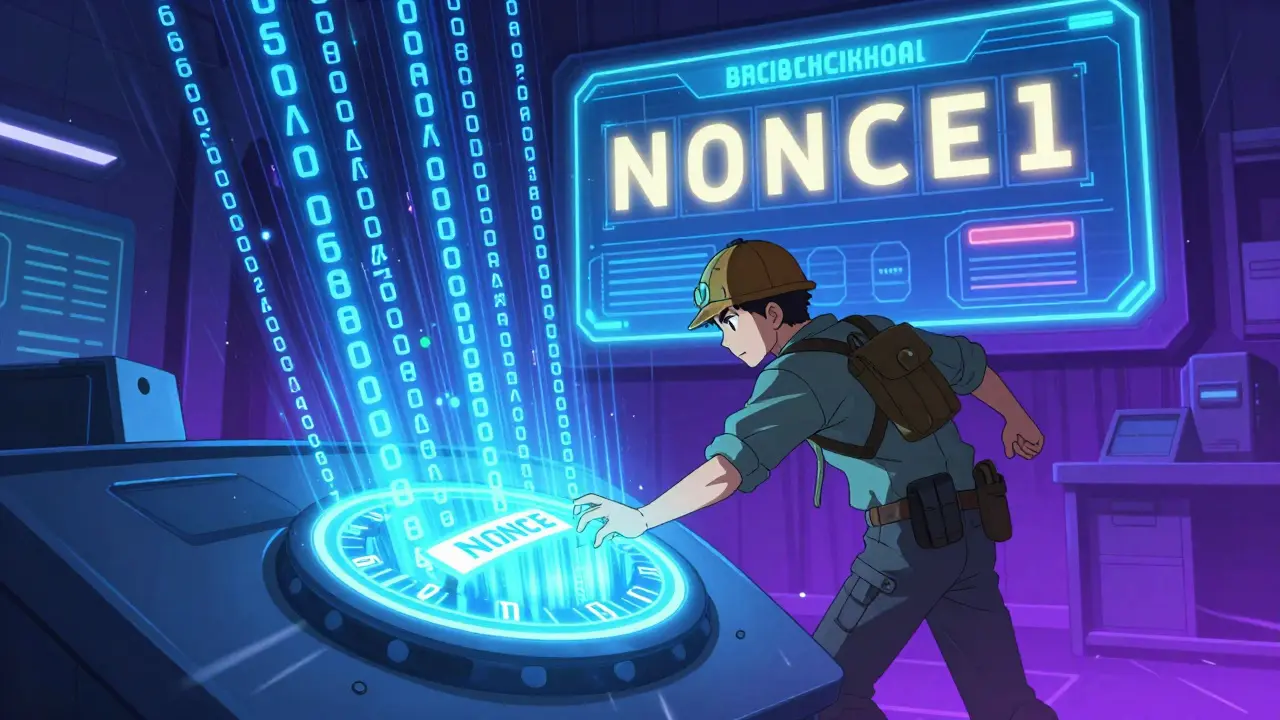
Bitcoin Nonce Finder Simulator
Nonce Simulation Calculator
Simulate how long it would take to find a valid Bitcoin nonce based on your mining hardware's hash rate. The current Bitcoin network difficulty requires approximately 19 leading zeros in the hash.
Enter your hash rate to see how long it would take to find a valid nonce
What Exactly Is a Nonce?
A nonce is a 32-bit number miners change over and over until they find the right one that makes a block’s hash meet the network’s target. It’s short for "number used once"-a term from cryptography-and it’s the only part of a Bitcoin block header that miners are allowed to freely tweak. Everything else-the previous block’s hash, the list of transactions, the timestamp, the version number-is fixed once the miner starts working on it. The nonce is the knob they turn to try and crack the code.
Think of it like a combination lock on a safe. The safe’s internal structure (the transactions, the previous hash) is locked in. The only thing you can change is the dial you turn. You spin it, test the lock, spin again, test again. Each time you turn the dial, you’re changing the nonce. You keep doing this until the lock opens. That’s mining.
How the Hashing Process Works
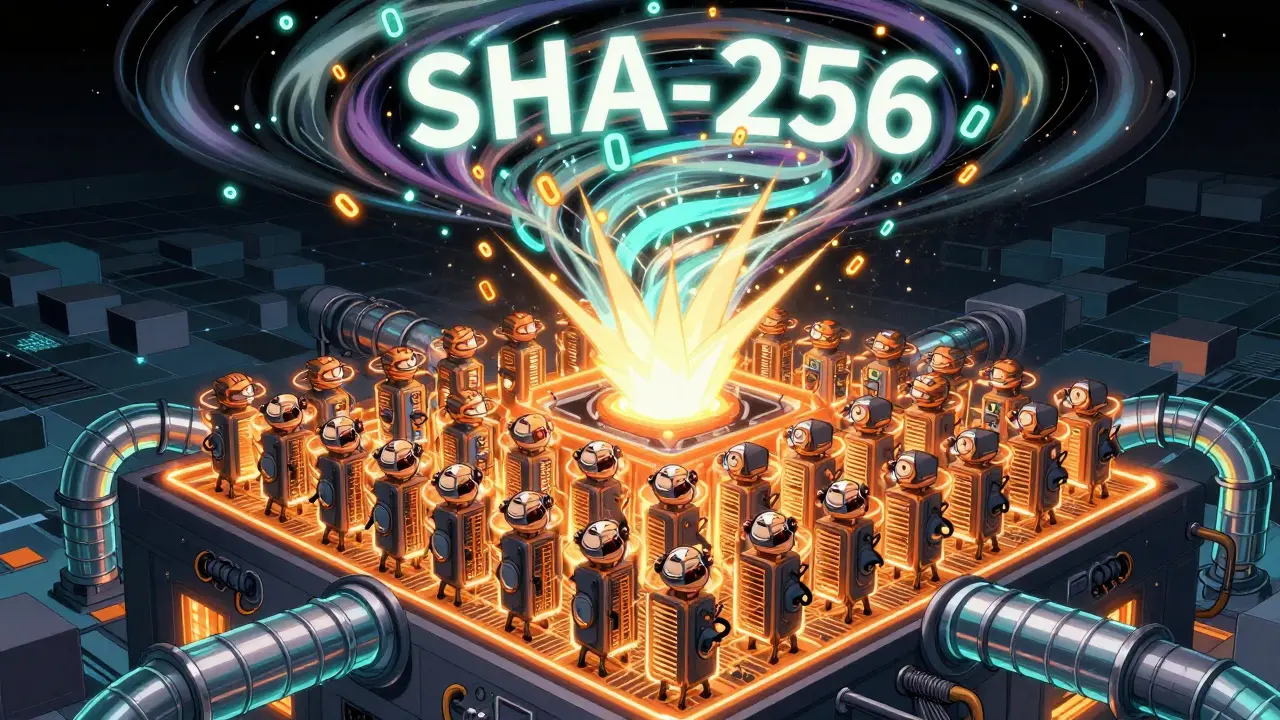
Miners take the block header-everything except the actual transaction data-and run it through the SHA-256 hashing algorithm twice. This produces a 64-character hexadecimal string. The goal? Make that string start with a certain number of zeros. Right now, Bitcoin requires about 19 leading zeros. That’s not random-it’s the difficulty target, adjusted every two weeks based on how fast blocks are being found.
Here’s the catch: SHA-256 is designed to be unpredictable. Even a tiny change in the input (like changing the nonce from 123,456 to 123,457) creates a completely different hash. There’s no pattern. No shortcut. No math trick. You can’t guess it. You just have to try every possible number until one works.
Each attempt is called a hash. Modern ASIC miners can do over 300 trillion hashes per second. That’s 300,000,000,000,000 guesses every second. And still, finding the right nonce feels like winning the lottery-because, in a way, it is.
Why the Nonce Isn’t Enough Anymore
The nonce is only 4 bytes long. That means there are 4,294,967,295 possible values (from 0 to 2³²−1). Sounds like a lot? It’s not. With today’s mining hardware, a single ASIC miner can cycle through every possible nonce in under a second.
So what happens when the nonce runs out? Miners don’t just stop. They tweak other parts of the block header. The most common fix is changing the "extra nonce" in the coinbase transaction-the first transaction in every block that pays out the mining reward. By altering the extra data in that transaction, they create a new block header, reset the nonce to zero, and start again. This process repeats thousands of times per second across global mining operations.
Some advanced miners even adjust the timestamp slightly (within a 2-hour window allowed by Bitcoin’s rules) or use the version field to create more variations. These aren’t bugs-they’re necessary adaptations. Satoshi Nakamoto’s original design assumed slower hardware. He didn’t predict ASICs that could burn through the entire nonce space in milliseconds.
How Big Is the Competition?
As of December 2024, the Bitcoin network is hashing at around 180 exahashes per second. That’s 180 quintillion attempts every second. To put that in perspective: if every person on Earth (8 billion people) had a supercomputer that could do one billion hashes per second, you’d still need over 22,000 Earths’ worth of computers to match Bitcoin’s current power.
And only one miner wins per block. The rest? They wasted electricity, time, and hardware wear. That’s why mining is done in pools. Instead of one person trying to find a block alone (which could take years), thousands of miners combine their hash power. Each miner submits "shares"-hashes that meet a lower difficulty than the network target. The pool tracks these shares, and when someone finds the real block, the reward is split based on how much work each miner contributed.
Right now, the top three mining pools-Foundry USA, Antpool, and F2Pool-control over half of the network’s total hash rate. That’s not because they’re smarter. It’s because they have more machines, cheaper power, and better cooling.
What Happens When You Find It?
When a miner finally finds a nonce that produces a hash below the target, they broadcast the block to the network. Other nodes instantly check the hash. They don’t need to try billions of combinations-they just run the hash once. If it matches, they accept the block. It’s fast. It’s simple. It’s asymmetric: hard to find, easy to verify.
That’s the genius of proof-of-work. It’s not about intelligence. It’s about brute force. The network doesn’t care who you are, where you live, or how much money you have. It only cares if you did the work. And the work costs real money-electricity, hardware, cooling. That’s what makes attacks expensive. To fake a block, you’d need to out-hash the entire network. That’s not just hard. It’s financially impossible.

Why This System Still Works
Bitcoin’s security doesn’t come from complex math or secret algorithms. It comes from scale. Over $32 billion a year is spent globally on electricity just to mine Bitcoin. That’s more than the annual energy bill of countries like Argentina or the Netherlands. That’s the price of trust.
Every block secured by a valid nonce adds another layer to the chain. Each one makes it harder to rewrite history. If someone tried to change a transaction from six months ago, they’d have to redo every block since then-and outpace the entire network at the same time. The cost? Trillions of dollars. The chance? Near zero.
That’s why, despite the energy debate, the centralization of mining, and the rise of proof-of-stake alternatives, Bitcoin’s nonce-based system remains unbroken. It’s slow. It’s wasteful. But it’s proven. And in a world full of digital fraud, that’s worth something.
What’s Next for Nonce Mining?
There are proposals to expand the nonce space-like Bitcoin Improvement Proposal 324, which suggests adding 40 extra bytes to the coinbase transaction. That would give miners more room to tweak inputs before exhausting the nonce. But even if adopted, it won’t change the core idea: find the right combination through sheer computing power.
Meanwhile, mining hardware keeps getting more efficient. New ASICs like the Bitmain Antminer S21 Hydro use liquid cooling to push more hashes per watt. Open-source firmware like Braiins OS+ helps squeeze out a few extra percent of performance. But the game hasn’t changed. It’s still a race to the bottom on electricity costs and hardware scale.
For individual miners? It’s nearly impossible to compete unless you have access to near-free power. Most people now join pools or avoid mining entirely. The dream of mining Bitcoin on your laptop is long gone. But the system? It’s still running. Still secure. Still powered by billions of nonce guesses every second.
Why This Matters Beyond Bitcoin
The nonce isn’t just a Bitcoin thing. It’s the foundation of proof-of-work as a concept. Other blockchains like Litecoin and Bitcoin Cash use the same mechanism, just with different hashing algorithms. Ethereum used it too-until it switched to proof-of-stake in 2022. That move cut its energy use by over 99%. But it also removed the physical, tangible cost of securing the network.
Bitcoin’s nonce system forces real-world resources into digital security. It turns electricity into trust. That’s why, even as alternatives emerge, no other system has matched its track record for resilience. It’s not elegant. It’s not efficient. But it works. And for now, that’s enough.
Abby Daguindal
December 15, 2025 AT 15:05SeTSUnA Kevin
December 17, 2025 AT 06:15Madhavi Shyam
December 17, 2025 AT 19:15Florence Maail
December 17, 2025 AT 23:45Chevy Guy
December 19, 2025 AT 11:31Rebecca Kotnik
December 21, 2025 AT 00:02Sue Bumgarner
December 21, 2025 AT 21:42Kayla Murphy
December 22, 2025 AT 07:16Kelsey Stephens
December 23, 2025 AT 03:42Craig Nikonov
December 23, 2025 AT 10:15Donna Goines
December 23, 2025 AT 13:58Greg Knapp
December 25, 2025 AT 11:48Elvis Lam
December 25, 2025 AT 15:35Patricia Amarante
December 26, 2025 AT 11:04Jack Daniels
December 28, 2025 AT 07:49Bradley Cassidy
December 29, 2025 AT 23:28Samantha West
December 30, 2025 AT 23:02