
Merkle Proof Verification Simulator
Simulate how a single transaction is verified using Merkle proofs. Enter a block size, select a transaction, and see the verification path.
Imagine you want to check if your $50 Bitcoin payment made yesterday is really part of the blockchain. You don’t need to download the entire 550GB blockchain to do it. That’s the power of Merkle proofs. They let you verify a single transaction using just a few hundred bytes of data - not millions. This isn’t magic. It’s math. And it’s why your phone wallet works at all.
How Merkle Proofs Work (Without the Jargon)
Think of a Merkle tree like a family tree made of hashes. Each transaction gets hashed - turned into a unique string of letters and numbers. Then, pairs of those hashes are combined and hashed again. Keep doing that until you get one final hash at the top: the Merkle root. This root is stored in the block header. It’s like a fingerprint of every transaction in that block.
Now, if you want to prove your transaction is in there, you don’t need all the data. You only need the hashes from your transaction up to the root. These are called the Merkle path. For example, if a block has 1,000 transactions, you only need about 10 hashes to prove yours is included. That’s it. No more, no less.
Here’s how it works step by step:
- You get your transaction’s hash.
- You ask a full node for the sibling hashes along the path to the root.
- You hash your transaction with its sibling, then hash the result with the next sibling, and so on.
- If the final hash matches the Merkle root in the block header, your transaction is confirmed.
It’s like proving you’re in a group photo by only showing your face and the faces of the people between you and the top of the stack. No one needs to see the whole photo.
Why This Matters for Everyday Users
Before Merkle proofs, verifying a Bitcoin transaction meant downloading the whole blockchain. That’s impossible on a phone. Today, 92% of mobile wallets use something called Simple Payment Verification (SPV), which relies entirely on Merkle proofs.
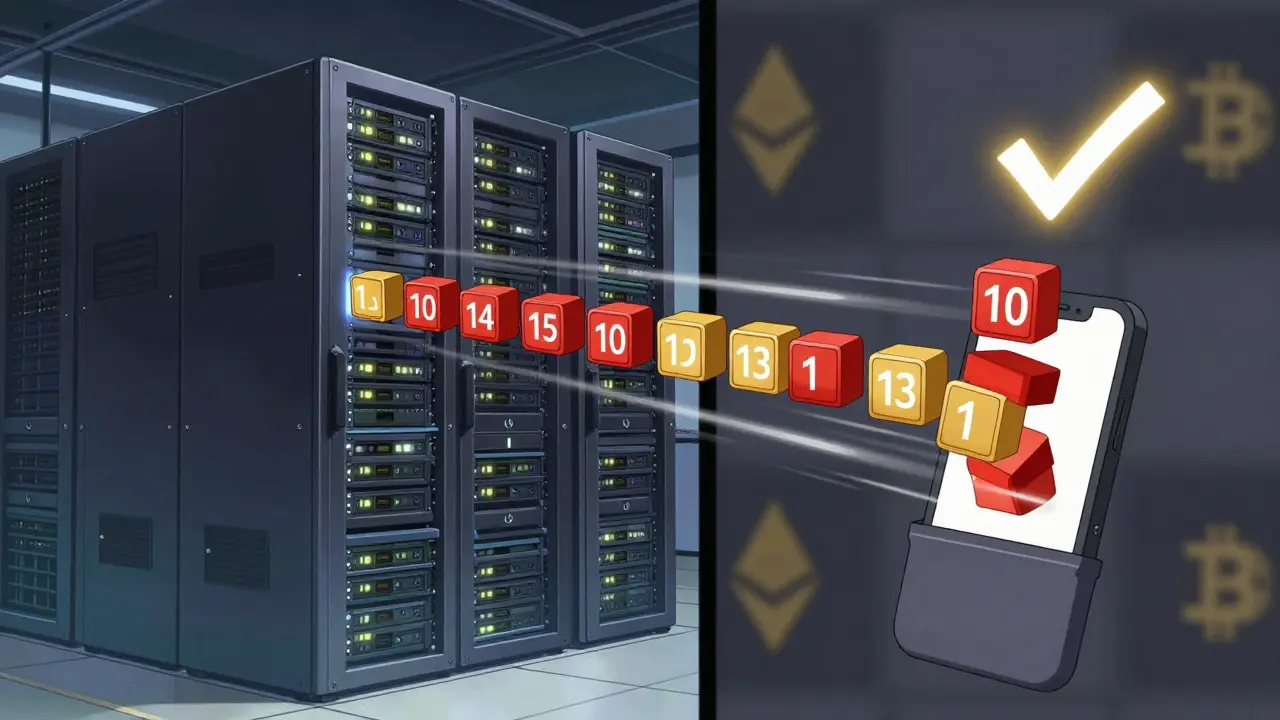
Trust Wallet, for example, serves over 30 million users. Without Merkle proofs, they’d need servers big enough to store the entire Ethereum and Bitcoin chains - and users would need gigabytes of storage just to check their balance. Instead, their app downloads a few kilobytes of proof and verifies in under 5 milliseconds on a phone.
This isn’t just about convenience. It’s about decentralization. If only big companies with giant servers could verify transactions, the network would be controlled by a few players. Merkle proofs let anyone - even someone with a $200 phone - become a full participant.
How Bitcoin and Ethereum Use It Differently
Bitcoin uses a simple binary Merkle tree. Every transaction is hashed, paired, and hashed again. If there’s an odd number of transactions, the last one is duplicated. Simple. Proven. Unchanged since 2009.
Ethereum uses something more complex: the Merkle Patricia Trie. It’s not just for transactions - it tracks account balances, smart contract code, and storage data all in one structure. This lets wallets prove not just that a transaction happened, but that your ETH balance is correct or that a smart contract returned the right value.
Ethereum’s eth_getProof RPC method returns a Merkle proof for any account. But there’s a catch. For complex contracts like USDT or Uniswap, these proofs can be over 1MB. That’s a problem for mobile apps. Some developers report timeouts because their apps aren’t built to handle large responses. Erigon, an Ethereum client, even limits proof requests to the last 100,000 blocks to avoid overload.
Bitcoin’s approach is lean. Ethereum’s is powerful but messy. Both rely on the same core idea: you don’t need the whole thing to prove part of it.
What Merkle Proofs Can’t Do
They only prove inclusion. Not validity.
Just because your transaction is in the block doesn’t mean it’s legitimate. Did you have enough funds? Did you sign it correctly? Did you double-spend? Merkle proofs don’t answer those questions. That’s why light wallets still need to connect to trusted nodes or use additional validation rules.
There’s also no guarantee of finality. A Merkle proof can confirm your transaction is in block 1,000,000 - but if the chain reorgs, that block might disappear. That’s why wallets wait for 6 confirmations. Merkle proofs help with inclusion. Consensus rules handle finality.
And they’re not immune to attacks. If someone controls enough nodes, they could feed you a fake proof. That’s why reputable wallets only connect to multiple trusted sources and cross-check responses.
Real-World Problems Developers Face
Building a wallet that uses Merkle proofs sounds simple - until you try it.
One developer on GitHub spent months fixing bugs in their light client. The biggest issues? Endianness - how bytes are ordered in the hash - and handling odd-numbered transaction lists. Bitcoin’s documentation says to duplicate the last transaction. But if you mess up the order, your final hash won’t match. And it’s not obvious why.
Another common problem: missing sibling hashes. If the node you’re querying doesn’t have the full history (like a pruned node), it can’t give you the proof. That’s why mobile wallets often connect to archive nodes or public APIs like Alchemy or Infura.
Even the best implementations have flaws. In 2022, Trust Wallet released three security patches for their Merkle verification code. One bug let attackers trick the app into accepting a fake transaction. It took a year to find and fix.
Learning curve? Around 40 hours for a developer new to cryptography, according to Blockchain Academy’s 2023 survey. That’s why most apps use libraries instead of writing their own.

The Bigger Picture: Why This Isn’t Going Away
Blockchain has grown. Bitcoin is over 550GB. Ethereum is over 1.5TB. And it’s still growing. Without Merkle proofs, most users couldn’t interact with these chains at all.
The light client wallet market is worth $4.2 billion and growing at 35% a year. Every major blockchain - Bitcoin, Ethereum, Litecoin, Solana, Polygon - uses Merkle trees or variants. Only two out of 100 protocols tested in 2024 didn’t use them.
Even Ethereum’s future upgrades, like EIP-4844 for blob transactions, are designed to make Merkle proofs smaller and faster - not replace them. Researchers are exploring vector commitments and zk-SNARKs as alternatives, but those are complex, experimental, and not yet battle-tested.
Bitcoin Core developers say Merkle trees are perfect for their philosophy: simple, secure, and provable. As Luke Dashjr put it, “Simplicity equals security.”
Dr. David Wong, speaking at Real World Crypto in 2024, said: “Merkle proofs have survived 45 years of cryptographic attacks. They’re not going anywhere.”
What You Should Know as a User
You don’t need to understand the math. But you should know this:
- Your phone wallet isn’t storing the whole blockchain. It’s using Merkle proofs to verify transactions.
- That’s why it’s fast, cheap, and works on slow networks.
- It’s secure - as long as you trust the node you’re connecting to.
- For maximum security, use a full node when you can. But for daily use, Merkle proofs are safe enough.
If you ever hear someone say “blockchain is too big for phones,” they’re wrong. Merkle proofs made it possible.
What’s Next for Merkle Proofs?
Future improvements are about optimization, not replacement.
Ethereum’s Prague upgrade in late 2024 will tweak how Merkle proofs handle blob data - making them smaller and cheaper to transmit. Researchers at UC Berkeley have shown vector commitments can shrink proof sizes by 63%. But these are still lab experiments.
For now, Merkle proofs remain the standard. They’re not flashy. They’re not new. But they work. And that’s why they’ve lasted.
Vidyut Arcot
December 3, 2025 AT 12:26Merkle proofs are one of those quiet heroes of blockchain. You don’t notice them until you try to run a wallet on a $100 phone and realize it actually works. Seriously, imagine having to download 550GB just to check if your coffee money went through. Mind blown.
Big thanks to whoever designed this - it’s elegant, simple, and scalable. The kind of engineering that lasts.
Jay Weldy
December 5, 2025 AT 10:42This is the kind of post that reminds me why I got into crypto. Not the hype. Not the price charts. But the actual cleverness behind it. Someone built a system where your phone can verify a global ledger without storing it all. That’s not just tech - that’s magic made real.
Melinda Kiss
December 6, 2025 AT 06:27Thank you for explaining this so clearly 😊
I’ve used Trust Wallet for years and never knew how it worked under the hood. Now I feel way more confident using it. Merkle proofs aren’t flashy, but they’re the reason I can check my balance on the bus without draining my battery. Small things, huge impact.
Christy Whitaker
December 7, 2025 AT 23:47Wow, another crypto fanboy post pretending this is revolutionary. It’s just hashing. You’re telling me people can’t even verify a transaction without a full node? That’s not innovation - that’s weakness. You’re trusting strangers on the internet. Again. Pathetic.
Nancy Sunshine
December 8, 2025 AT 08:51While the technical elegance of Merkle proofs is undeniable, one must consider the broader epistemological implications of trust delegation in decentralized systems. The very architecture that enables lightweight verification simultaneously necessitates reliance on third-party nodes - a paradoxical concession to centralized infrastructure.
Is it truly decentralization if the user’s capacity for independent verification is functionally constrained by network topology and API availability? This tension warrants deeper philosophical inquiry.
Alan Brandon Rivera León
December 10, 2025 AT 00:49Man, I remember trying to sync a Bitcoin node back in 2015. Took three days on my old laptop. Now I open my phone, tap once, and boom - my balance is there. No drama.
It’s wild how much engineering went into making something feel effortless. Hats off to the devs who made this work without turning wallets into full nodes.
Ann Ellsworth
December 10, 2025 AT 01:26Ugh. Merkle Patricia Trie? Please. That’s just Ethereum’s way of overengineering everything. Bitcoin’s binary tree is clean. Elegant. Functional. Ethereum’s solution is a bloated, gas-guzzling monstrosity that needs 1MB proofs for a simple balance check. It’s like using a jetpack to walk to the fridge.
And don’t get me started on how devs are still debugging endianness issues in 2024. Pathetic.
Ankit Varshney
December 11, 2025 AT 10:34Great breakdown. I work with blockchain in India and see how this makes a real difference. People here use cheap phones, slow networks. Without Merkle proofs, crypto would be a luxury. As it is, it’s accessible.
Ziv Kruger
December 11, 2025 AT 13:39Proof of inclusion isn’t proof of truth
That’s the real question isn’t it?
We’ve built a system that can verify presence but not validity
So what are we really trusting?
The math?
The nodes?
Or the illusion of decentralization?
Heather Hartman
December 13, 2025 AT 03:22Love this! It’s like the internet’s version of a library card - you don’t need to own every book to know if a specific one exists in the system. And it’s so fast! I love how tech can be both powerful and simple when done right. 💪✨
Catherine Williams
December 14, 2025 AT 19:20For anyone building a wallet - please, please use a well-tested library. Don’t roll your own Merkle verifier. I’ve seen teams waste months on byte-order bugs, missing siblings, and pruned node edge cases.
There’s no glory in reinventing the wheel when the wheel’s already been fireproofed.
Paul McNair
December 14, 2025 AT 21:34From the U.S. to India, this tech bridges gaps. My cousin in Jaipur checks his Bitcoin balance on a 5-year-old phone. My brother in Chicago runs a full node. Both are equal participants. That’s the beauty here - access without hierarchy.
Mohamed Haybe
December 16, 2025 AT 19:49Western tech bros patting themselves on the back for making crypto work on phones. Meanwhile in India we’ve been using SMS-based wallets for a decade. Merkle proofs? Cute. We solved real problems with zero bandwidth and no blockchain. You’re just catching up.
Marsha Enright
December 17, 2025 AT 02:09One thing I wish more people knew: Merkle proofs aren’t just for Bitcoin. They’re the reason your DeFi app can show your token balance without syncing the whole chain.
And yes - they’re secure enough for daily use. Just don’t connect to sketchy nodes. Use Infura or Alchemy. It’s like using a trusted DNS server. Simple.
Andrew Brady
December 18, 2025 AT 07:38They want you to believe this is secure. But what if the node you’re querying is compromised? What if the ‘trusted’ API is owned by a government-linked entity? This isn’t decentralization - it’s a facade. They’re handing you a key to a house… but the lock is controlled by someone else.
Sharmishtha Sohoni
December 20, 2025 AT 03:20Fun fact: Bitcoin’s Merkle tree uses SHA-256 twice. That’s why it’s called double-SHA. Most people don’t know that.
Durgesh Mehta
December 20, 2025 AT 20:24Really appreciate this post. I’m learning how to build light clients and this helped me connect the dots. The part about sibling hashes being missing on pruned nodes was eye opening. Thanks!
Nora Colombie
December 21, 2025 AT 22:59Oh please. You think Merkle proofs are safe? They’re just a way for big tech to control what you see. The blockchain is a lie. They can feed you fake proofs. They control the nodes. You’re being lied to. Wake up.
Greer Dauphin
December 22, 2025 AT 21:00Wait so if the node gives you the wrong sibling hash… you’re screwed? 😅
Also why is endianness still a thing in 2024? My toaster has better byte ordering than some blockchain libraries. LMAO.
Bhoomika Agarwal
December 24, 2025 AT 19:19Westerners think they invented everything. In India we had digital ledgers before your blockchain was a glint in some MIT nerd’s eye. Merkle trees? Cute. We used handwritten ledgers and community trust. No hashes needed.
Katherine Alva
December 25, 2025 AT 07:27It’s fascinating how something so mathematically simple can hold up an entire global economy 🤔
Like… a single root hash, built from nested hashes, proving truth without revealing everything. It’s poetry wrapped in cryptography.
And yet… we still trust strangers on the internet. 😅
Nelia Mcquiston
December 26, 2025 AT 06:59What happens when quantum computing breaks SHA-256? Merkle proofs rely on collision resistance. If that fails, the entire structure collapses. We’re building on sand. We need to start preparing now - not when the first quantum node goes live.
Vidyut Arcot
December 28, 2025 AT 04:28Good point about quantum. But let’s not panic. SHA-3 and lattice-based crypto are already in development. The blockchain community moves slow, but it moves. We’ll adapt. The system’s design allows for upgrades - the proof structure doesn’t change, just the hash function underneath.