
Slashing Risk Calculator
Calculate Your Slashing Risk
Risk Analysis Results
Potential Loss
Risk Level
Insurance Cost
Recommendation
When you stake your crypto on a Proof-of-Stake (PoS) blockchain, you’re not just earning rewards-you’re also taking on risk. One of the biggest risks? Slashing. It’s not a glitch. It’s not a bug. It’s built into the code. If your validator goes offline, signs two conflicting blocks, or acts maliciously, the network automatically takes a chunk-or all-of your staked assets. No warning. No second chance. Just gone.
For individual stakers, this might feel like a distant threat. But for institutions managing millions in assets-banks, custodians, hedge funds-slashing isn’t just a technical footnote. It’s a financial disaster waiting to happen. That’s why slashing insurance has become a non-negotiable part of the staking ecosystem.
What Exactly Is Slashing?
Slashing is an automated penalty system in PoS networks like Ethereum, Polygon, and Solana. Validators-nodes that propose and attest to blocks-are required to stay online, sign blocks correctly, and follow the rules. If they don’t, the protocol punishes them by burning part of their stake.
There are three main reasons slashing happens:
- Downtime slashing: Your validator misses too many block signatures because of a server crash, network issue, or misconfiguration.
- Double signing: Your validator signs two different blocks at the same height-a clear sign of malicious intent or a serious software error.
- Malicious behavior: Intentional attacks like consensus violations or attempts to disrupt the network.
The penalty isn’t arbitrary. It’s proportional. On Ethereum, for example, double signing can slash up to 100% of your stake. Downtime slashing is usually smaller-maybe 0.5% to 5%-but it adds up fast if your node is offline for days.
And here’s the kicker: it doesn’t matter if the failure was your fault. A power outage. A cloud provider glitch. A misconfigured script. The blockchain doesn’t care. It just sees a violation-and punishes it.
Why Slashing Insurance Exists
Traditional finance doesn’t operate on trust. It operates on insurance. If a bank’s server goes down, they have backup systems, redundancy, and liability coverage. Crypto staking didn’t have that-until now.
Slashing insurance emerged because institutions couldn’t justify staking without a safety net. Imagine a pension fund allocating $50 million to Ethereum staking. A single double-sign event could wipe out $5 million. No CFO is signing off on that without protection.
Slashing insurance fills that gap. It’s not about preventing slashing-it’s about absorbing the loss. Providers step in to reimburse you for slashed funds, so your portfolio doesn’t take the hit.
But here’s what most people don’t realize: slashing insurance isn’t one product. It’s a layered system.
How Slashing Insurance Works: The Layers
Think of slashing protection like an onion. Each layer adds security.
Layer 1: Provider Self-Insurance
Some staking providers, like DAIC Capital, set up their own insurance funds. They pool a portion of fees from all clients into a reserve. If a slashing event occurs, they pay out from that fund. It’s simple, but limited. If multiple validators get slashed at once, the fund might not cover everything.
Layer 2: Third-Party Insurance Partners
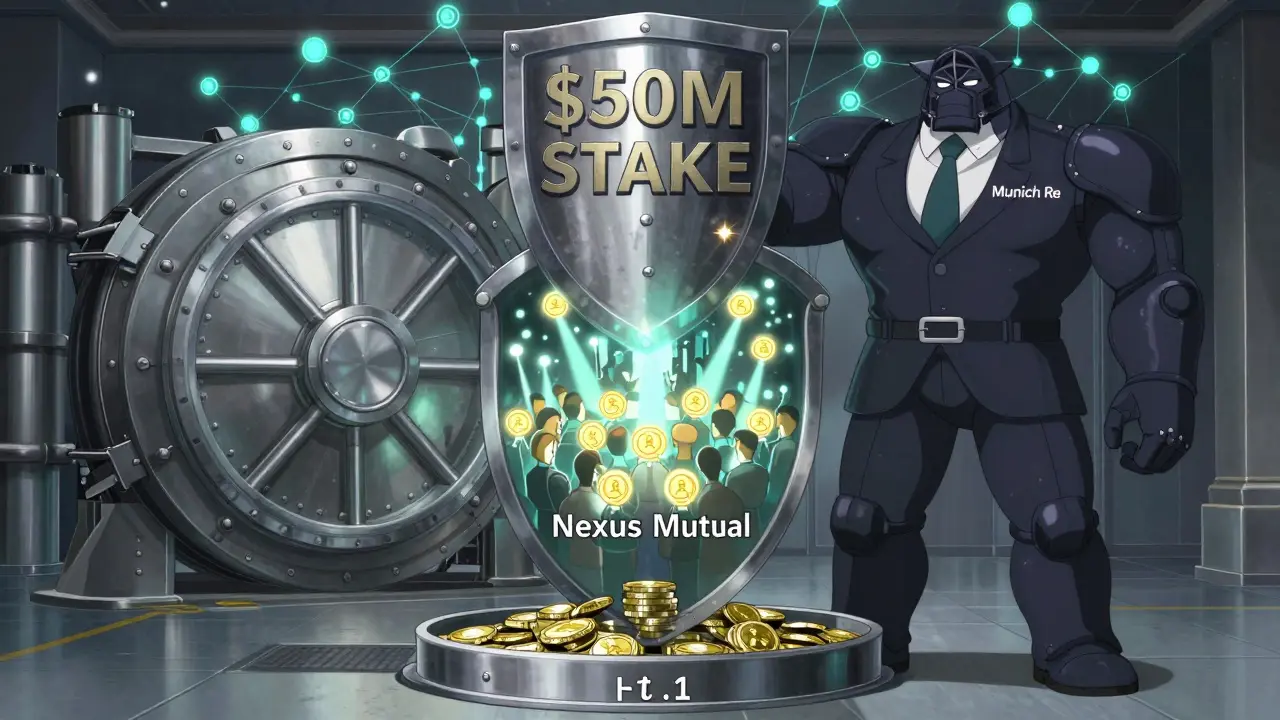
Figment partners with Nexus Mutual, a decentralized insurance protocol. Clients can buy coverage specifically for double-sign slashing on Ethereum. This isn’t a traditional insurer-it’s a community-backed pool of token holders who vote on claims. It’s transparent, but slower.
Layer 3: Reinsurance from Giants
Luganodes goes a step further. They work with Munich Re, one of the world’s largest reinsurance companies. That means if a major slashing event hits multiple validators across networks, Munich Re covers the overflow. This is institutional-grade protection. It’s not just a startup offering-it’s backed by 150-year-old financial infrastructure.
Blockdaemon covers 29 PoS networks with their insurance, targeting Fortune 500 companies. Their model is proprietary, but they claim full coverage for downtime and double signing. No one knows the exact terms, but the fact that banks are using it tells you everything.
Who’s Using It-and Who’s Not
Slashing insurance is overwhelmingly an institutional tool. Retail stakers rarely have access to it. Why? Because the cost and complexity don’t make sense for small stakes.
Here’s how adoption breaks down:
- Fortune 500 companies, banks, and custodians: Almost all use staking providers with built-in insurance. It’s a compliance requirement.
- Mid-sized crypto funds: Often choose providers with third-party coverage (like Figment + Nexus Mutual) to balance cost and protection.
- Individual stakers: Usually rely on choosing reliable validators, using uptime monitors, and accepting the risk. Some platforms like Coinbase offer basic protection, but it’s limited.
There’s a quiet shift happening. As more retail users move into staking through apps like Lido or Kraken, they’re indirectly benefiting from institutional-grade insurance. The providers are absorbing the risk-and passing the cost along as a small fee. You might not see an “insurance” checkbox, but it’s there.
What’s Covered-and What’s Not
Not all slashing insurance is created equal. Here’s what you need to ask before signing up:
- Does it cover downtime? Some only cover double signing. Downtime is far more common.
- Is coverage 100%? Most policies cap payouts at 90-100%. If your stake is $10,000 and you’re slashed $500, do you get it all back?
- Is it automatic? Luganodes includes it in every institutional contract. Figment requires you to opt into Nexus Mutual coverage separately.
- What’s the claim process? Some require on-chain proof, documentation, and a 30-day wait. Others auto-pay based on validator alerts.
- Which networks are covered? Ethereum? Solana? Polygon? Cosmos? Coverage varies by provider.
DAIC Capital, for example, only covers downtime slashing. If your validator double signs, you’re on your own. That’s a major gap. Meanwhile, Blockdaemon and Luganodes cover all three types.

The Hidden Cost: It’s Not Just About Money
Slashing insurance isn’t just a financial tool. It’s a signal of trust.
When a staking provider partners with Munich Re, it’s not just about money. It’s about credibility. It tells clients: We’ve been audited. Our systems are secure. Our risk models are validated by the world’s most conservative insurers.
Providers like Figment highlight their SOC 2 and ISO 27001 certifications. These aren’t marketing buzzwords. They mean their infrastructure meets global standards for data security and operational reliability. That’s what prevents slashing in the first place.
Insurance is the safety net. But the real protection comes from:
- Dedicated DevOps teams monitoring validators 24/7
- Automated alerts for node downtime
- Redundant server setups across cloud providers
- Regular software updates and patching
The best staking providers don’t just sell insurance. They prevent slashing before it happens.
The Future of Slashing Insurance
The market is still young. But it’s growing fast.
In 2025, Blockdaemon launched its industry-first comprehensive slashing insurance. Figment expanded its Nexus Mutual coverage to more networks. Aon, one of the world’s largest brokers, started developing blockchain-specific insurance products. Munich Re’s involvement is the clearest sign this isn’t a fad-it’s becoming infrastructure.
What’s next?
- Standardized policies: Right now, every provider defines coverage differently. Expect industry-wide standards to emerge.
- Retail access: As DeFi apps grow, we’ll see insurance bundled into staking wallets-no technical setup needed.
- Dynamic pricing: Premiums could adjust based on validator uptime history, network congestion, or slashing risk scores.
- Regulatory recognition: Governments may start requiring insurance for staking services operating under financial licenses.
The goal isn’t to eliminate slashing. That’s impossible-it’s a core security feature. The goal is to make staking safe for everyone who wants to participate. Whether you’re managing $10,000 or $10 billion, the risk is real. And now, so is the protection.
How to Choose the Right Protection
If you’re an institutional investor or a serious staker, here’s your checklist:
- Confirm the provider covers all three types of slashing: downtime, double signing, and malicious behavior.
- Ask if coverage is automatic or requires an opt-in fee.
- Check if they use reinsurance (like Munich Re) for large-scale events.
- Verify their infrastructure certifications (SOC 2, ISO 27001).
- Review their claim process. How fast do they pay? Do they need manual approval?
- Ask for a sample payout scenario. “If I stake $50,000 and get slashed 5%, do I get $2,500 back?”
Don’t just take their word for it. Look for public case studies, audit reports, or third-party validations. If they can’t provide them, that’s a red flag.
Is slashing insurance necessary for small stakers?
For most retail stakers with small stakes (under $10,000), slashing insurance isn’t practical. The premiums would cost more than the potential loss. Instead, focus on choosing reputable staking platforms with high uptime, like Coinbase, Lido, or Kraken. These services often include basic protection as part of their offering. If you’re staking more than $50,000, insurance becomes worth considering.
Can I get slashing insurance if I run my own validator?
It’s extremely rare. Most slashing insurance products are designed for clients of professional staking providers, not self-run validators. Providers need control over infrastructure to ensure reliability. If you’re running your own node, your best bet is to invest in robust monitoring tools, redundant servers, and automated alerts. Insurance isn’t available for solo operators-not yet.
Does slashing insurance cover losses from hacks or exchange failures?
No. Slashing insurance only covers penalties imposed by the blockchain protocol itself. If an exchange gets hacked or your wallet is compromised, that’s a separate risk. You’d need separate custody insurance or cold storage protection for those scenarios. Don’t confuse slashing with theft-they’re completely different.
How much does slashing insurance cost?
Pricing isn’t public. Most providers bundle it into their staking fees. Institutional clients typically pay between 0.5% and 2% annual management fees, which include insurance. Some providers, like Luganodes, include it at no extra cost. Others, like Figment’s Nexus Mutual add-on, charge a separate premium. The cost reflects network risk-Ethereum’s slashing penalties are higher than Solana’s, so coverage is more expensive.
What happens if the insurance provider goes out of business?
This is why reinsurance matters. Providers like Luganodes use Munich Re as a backstop. Even if the staking company fails, the reinsurer still honors claims. For providers without reinsurance, your coverage depends entirely on their financial health. Always ask: Is the insurance backed by a third party? Or is it just a fund they control? The former is far safer.
Ankit Varshney
December 2, 2025 AT 11:48Slashing is just crypto’s way of saying ‘you’re on your own’.
samuel goodge
December 3, 2025 AT 08:12It’s fascinating how we’ve built a financial system that punishes human error with existential finality-no grace, no mercy, no appeal. The blockchain doesn’t care if your server crashed because of a power surge during a hurricane. It just sees a signature mismatch and burns your stake. It’s not justice-it’s algorithmic nihilism.
And yet, we call this ‘decentralized trust.’
Insurance isn’t a crutch here-it’s the only thing keeping this whole edifice from collapsing under the weight of its own cruelty. The fact that Munich Re is now backing this? That’s not innovation. That’s surrender. The old world is stepping in to patch the holes in the new one.
What’s more terrifying: that slashing exists, or that we’ve normalized it?
Maybe the real risk isn’t the penalty-it’s the quiet acceptance that we’ve traded security for spectacle.
And now we’re paying for it with our capital, our peace of mind, and our faith in the system.
Who gets to decide what counts as ‘malicious behavior’? The code? Or the people who wrote it?
Slashing doesn’t make the network secure-it makes the validators terrified.
And fear doesn’t breed innovation. It breeds compliance.
Insurance doesn’t fix the problem. It just lets us pretend we’re not living on a knife’s edge.
Maybe the real revolution isn’t in the consensus mechanism-it’s in the insurance contracts.
Because if you need a reinsurance giant to make blockchain safe, then maybe it was never meant to be safe at all.
It was meant to be profitable.
And we’re just the collateral.
Alan Brandon Rivera León
December 4, 2025 AT 00:39I’ve been staking for three years now. Never got slashed. But I’ve seen friends lose entire positions over a single power outage. It’s brutal. I don’t blame people for wanting insurance-especially if they’re managing money for others. But I also think we’re building a safety net so thick we’re forgetting how to walk without it.
Maybe the real lesson isn’t about insurance. It’s about responsibility.
If you’re running a validator, you owe it to yourself and your stakeholders to have redundancy, monitoring, and backups. Not just insurance.
Insurance is the last line of defense. Not the first.
Darlene Johnson
December 5, 2025 AT 09:52Of course they’re selling insurance. Who do you think profits when the system collapses? The same people who built it. Slashing isn’t a feature-it’s a trap. They want you to stake, get scared, then pay them extra to not lose everything they already took from you in fees. It’s a pyramid scheme with blockchain glitter.
Munich Re? Please. They’re just laundering crypto risk into ‘legitimate finance.’ You think they care about you? They care about the premiums. You’re just a number in their actuarial model.
And don’t even get me started on ‘institutional-grade protection.’ That’s just code for ‘we’re too scared to let retail touch this.’
They’ll let you stake-but only if you sign away your soul to their insurance policy.
Ziv Kruger
December 6, 2025 AT 13:08Insurance is just capitalism’s way of turning fear into a subscription service
Heather Hartman
December 6, 2025 AT 20:50I love how this post breaks down the layers of protection. It’s like peeling an onion made of trust and risk. And honestly? It’s comforting to know there are people out there building guardrails for this wild space. Even if you’re a small staker, knowing the giants are securing the foundation gives me hope. Keep pushing for transparency. We need more of this.
Bhoomika Agarwal
December 7, 2025 AT 03:42Why are Americans so obsessed with insurance? In India we just pick good validators and move on. If you can’t handle a little slashing, maybe you shouldn’t be in crypto. This over-insurance culture is why your economy is so fragile. We don’t need Munich Re to tell us what’s safe. We know how to take risks.
justin allen
December 8, 2025 AT 14:01Slashing insurance? More like crypto welfare for rich people. You want protection? Build a better node. Don’t pay some hedge fund to babysit your 0.5% of ETH. This whole thing is a scam engineered by staking providers to extract more fees. And now they’ve convinced banks to pay for it too. Pathetic.
alex bolduin
December 9, 2025 AT 21:27It's wild how we treat crypto like it's both a revolution and a bank at the same time. We want decentralization but we also want someone to cover our losses. Maybe the answer isn't insurance. Maybe it's just better education. Learn how to run a node. Use multiple providers. Monitor your uptime. It's not that hard.
Insurance is fine if you're managing millions. But for most of us? It's just a distraction from the real work.
Sharmishtha Sohoni
December 10, 2025 AT 20:13Does any insurance cover slashing caused by a software bug in the staking provider’s own code? Or is that your problem?
ashi chopra
December 11, 2025 AT 13:36I’ve been watching this space for years. The fact that we’re even having this conversation shows how far we’ve come. But I worry we’re replacing one kind of trust-trust in code-with another-trust in corporations with insurance policies. Are we really safer? Or just more comfortable?
And what happens when the insurer refuses a claim? Who do you sue? A DAO? A German reinsurance giant?
There’s no clear answer. But I’m glad someone’s asking the questions.
Ivanna Faith
December 11, 2025 AT 16:18Slashing insurance is just crypto’s version of extended warranty on a toaster you bought on Amazon. You don’t need it. But if you’re rich enough to afford it, go ahead. Enjoy your peace of mind. I’ll be over here staking on my $200 VPS and laughing at your premiums.
Also why does everyone keep mentioning Munich Re like it’s some holy grail? They’re just a company. Not a deity. 🤷♀️
Christy Whitaker
December 11, 2025 AT 16:39You think this is bad? Wait till the first major insurance company denies a claim because ‘the validator’s uptime was 98.7% and that’s below our 99% threshold.’ Then you’ll see what real betrayal looks like. And don’t think they won’t bury the fine print in 47 pages of legalese. They already are.
And who’s auditing the auditors? Who’s checking if Luganodes actually has reinsurance or if it’s just a PowerPoint slide?
Don’t be fooled. This isn’t protection. It’s a confidence trick dressed in SOC 2 badges.
Catherine Williams
December 11, 2025 AT 19:52One thing I love about this breakdown is how it shows that safety isn’t just about tech-it’s about structure. The real win isn’t the insurance payout. It’s the fact that providers are now forced to build better systems just to qualify for coverage. That’s the hidden benefit.
Insurance didn’t fix slashing. It forced the industry to fix itself.
That’s worth celebrating.
Steve Savage
December 13, 2025 AT 14:14Been running my own node for 18 months. Never got slashed. I use three different cloud providers, automated alerts, and a backup power supply. It’s not hard. It just takes effort. Insurance is great for institutions. But for individuals? It’s a crutch. Build the muscle instead.
And honestly? If you’re staking more than $10k without monitoring your own node… maybe you’re in the wrong place.
Britney Power
December 14, 2025 AT 09:05The entire slashing insurance market is a regulatory arbitrage play disguised as innovation. Staking providers are exploiting the fact that traditional finance has no framework for blockchain risk-so they’re creating a pseudo-asset class and selling coverage against it like it’s a bond. But the underlying risk isn’t even properly modeled. The actuarial tables are guesswork. The claims history is nonexistent. And yet, Munich Re is signing on? That’s not due diligence. That’s FOMO.
This isn’t finance. It’s theater. And we’re all paying for front-row seats.
When the first multi-million dollar claim gets denied because ‘the validator was misconfigured by a third-party API,’ the whole house of cards will collapse. And the insurance brokers? They’ll be long gone with their fees.
Maggie Harrison
December 15, 2025 AT 20:43Love this breakdown 🙌 The layers make so much sense. Layer 1: provider fund. Layer 2: DAO insurance. Layer 3: Munich Re. It’s like a financial Russian nesting doll. And the fact that retail stakers are getting protected indirectly through Lido/Kraken? That’s the quiet revolution right there. We’re not just staking-we’re building a new safety net, one node at a time. 💪✨
Lawal Ayomide
December 17, 2025 AT 04:04Why are we even talking about insurance? In Nigeria, we don’t wait for permission to take risk. We just stake. If we lose, we learn. If we win, we celebrate. No insurance. No excuses. Just action. Maybe the West needs this lesson more than the blockchain does.
Akash Kumar Yadav
December 17, 2025 AT 06:21Slashing insurance? More like American capitalism’s latest money-printing scheme. You think India doesn’t have validators? We have more than you. We just don’t need to pay 2% extra to feel safe. You built a fragile system. Now you want a safety net. We built resilience. You built dependency.
Stop outsourcing your responsibility. Build better. That’s all.
Melinda Kiss
December 17, 2025 AT 11:56This post made me feel seen. I’ve been staking $8k through Kraken and always wondered if I was exposed. Knowing they’re covered under institutional insurance? That’s a relief. I don’t need to be a sysadmin-I just need to trust the right provider. And that’s okay. Not everyone can or should run a node. There’s value in delegation.
Thank you for explaining the layers. I finally get it.
Jay Weldy
December 19, 2025 AT 06:34It’s funny how we treat slashing like it’s some new threat. But in finance, losses happen. Markets correct. Systems fail. The difference here is that crypto doesn’t offer second chances. That’s why insurance feels so natural. It’s not about fear. It’s about sustainability.
We’re not trying to eliminate risk. We’re trying to make it manageable.
And that’s not weakness. That’s wisdom.
Nancy Sunshine
December 20, 2025 AT 14:49Let’s not romanticize this. Slashing insurance is not a moral victory. It’s a corporate liability shield. The staking providers who offer it are not heroes-they’re risk managers. And their goal isn’t to protect you. It’s to protect their balance sheet. The fact that you feel safe is just a side effect.
Don’t mistake compliance for care.
And if you’re relying on insurance to sleep at night? You’re already playing the wrong game.
Vidyut Arcot
December 21, 2025 AT 20:58For anyone starting out-don’t panic about slashing. Focus on choosing a provider with high uptime and clear terms. If you’re under $10k, you’re fine. If you’re over $50k, ask the right questions. And if you’re managing funds for others? Then yes, insurance isn’t optional. It’s professional.
You don’t need to be a hacker. You just need to be smart.
alex bolduin
December 23, 2025 AT 08:09Actually I think the real story here isn't insurance at all
It's how the industry is slowly becoming more like traditional finance not because it wants to but because it has to
And maybe that's not a bad thing
Ziv Kruger
December 23, 2025 AT 12:18So now we’re outsourcing our security to reinsurance companies? What’s next? A blockchain credit score?
ashi chopra
December 24, 2025 AT 03:43I wonder if in 10 years we’ll look back and laugh at how we thought insurance was the solution. Maybe the real innovation will be self-healing validators. Or AI that predicts and prevents failures before they happen. Insurance feels like a bandage on a broken leg.