
You’ve probably seen it flash across your social media feed or pop up in a crypto chat group. It’s got "Doge" in the name, it’s got "Chinese" in the title, and it promises the kind of wild returns that keep meme coin traders awake at night. But what exactly is Chinese Doge Wow, known by its ticker symbol $CHIDO? Is it the next big thing in the world of digital assets, or just another fleeting trend?
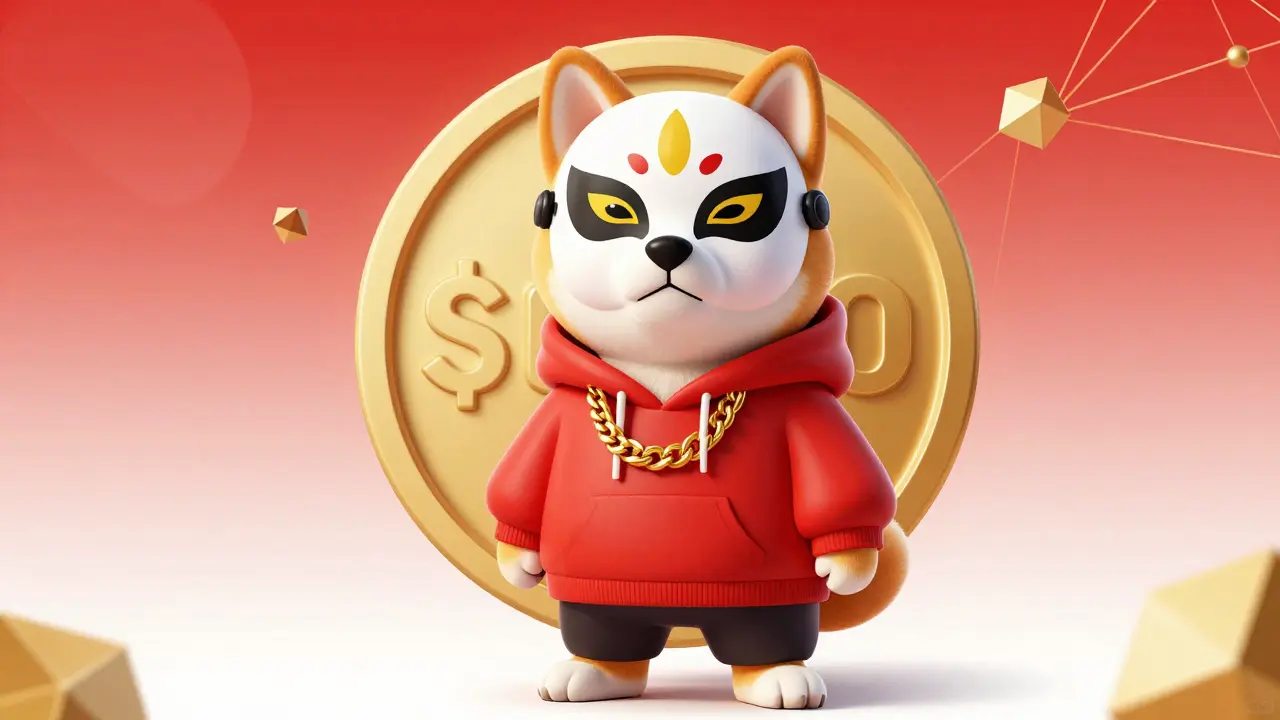
To put it simply, $CHIDO is a community-driven meme coin launched on the Base blockchain. It emerged during a specific cultural wave in mid-2024 often referred to as the "Chinese meta season," following the popularity of other Asia-themed tokens like Pei Pei. Unlike traditional cryptocurrencies built for utility or payments, $CHIDO exists primarily because people believe in its narrative and community.
The Origin Story: How $CHIDO Was Born
The story of $CHIDO begins in June 2024. This was a period where the crypto market saw a surge in interest for meme coins with specific cultural themes. Following the traction gained by Pei Pei, developers and early adopters looked for the next token to capture that same energy. Enter Chinese Doge Wow.
What makes $CHIDO interesting isn't just its name, but its structure. It operates on a decentralized community takeover model. There is no central development team calling the shots from a corporate office. Instead, funding and operational costs are managed directly by the community. This approach appeals to purists who distrust centralized entities controlling their investments. The project maintains a marketing wallet holding about 2% of the total supply to ensure longevity, but beyond that, the community is the engine.
Technical Specs and Tokenomics
If you’re looking at the numbers, here is what defines the $CHIDO ecosystem:
- Total Supply: Approximately 950 million to 951.47 million tokens.
- Blockchain: Exclusively on the Base network, a Layer 2 scaling solution for Ethereum.
- Trading Venues: Primarily traded on Uniswap V2 via the CHIDO/WETH pair.
- Centralized Listings: Currently not listed on major exchanges like Binance or Crypto.com.
The choice of the Base blockchain is significant. Base offers lower transaction fees and faster speeds compared to the Ethereum mainnet, making it easier for small trades to happen without getting eaten up by gas fees. However, being locked to one chain also limits accessibility. If you only trade on Solana or Ethereum mainnet, you can’t easily buy $CHIDO without bridging your funds first.
Price Performance: The Rollercoaster Ride
Let’s talk about price, because this is where things get real. Meme coins are volatile, but $CHIDO has experienced extreme swings. Here is a look at its historical performance based on data from CoinGecko and CoinMarketCap:
| Metric | Value | Date/Context |
|---|---|---|
| All-Time High (ATH) | $0.02003 USD | December 5, 2024 |
| All-Time Low (ATL) | $0.00002085 USD | September 2, 2024 |
| Current Price Range | ~$0.00019 - $0.0001944 USD | As of May 2026 |
| Decline from ATH | -99.03% | Since December 2024 |
That 99% drop from its peak is stark. It serves as a harsh reminder of how quickly sentiment can shift in the meme coin space. While short-term fluctuations showed some resilience-such as a 26.60% weekly increase reported by CoinGecko against a broader market rise of 5.20%-the long-term trajectory remains heavily depreciated from its highs.
Liquidity and Market Cap Reality
When evaluating any crypto asset, liquidity is king. Without enough buyers and sellers, even a small trade can move the price drastically. For $CHIDO, the situation is tight.
The market capitalization hovers around $185,000 USD. To put that in perspective, this ranks $CHIDO at #3133 on CoinGecko and over #7000 on CoinMarketCap. It is a micro-cap asset. More concerning is the trading volume. Reports have shown 24-hour volumes dropping from over $7,000 to near zero. When volume dries up, exiting a position becomes difficult. You might see a paper profit on your screen, but if there aren’t enough buyers on Uniswap, you can’t convert that back to stablecoins or ETH without slippage eating your gains.
Community vs. Centralized Control
The biggest selling point of $CHIDO is its lack of a central authority. With nearly 470,000 holder addresses, the ownership is relatively dispersed. This contrasts sharply with many new meme coins where the developers hold large, hidden wallets that could dump on retail investors at any moment.
However, this decentralization comes with a trade-off. There is no roadmap. There are no professional marketing campaigns funded by venture capital. There are no partnerships announced. The project lives or dies solely on the enthusiasm of its holders. In bull markets, this can lead to explosive growth. In bear markets or periods of low interest, it can lead to stagnation, as we’ve seen with the recent volume declines.
Risks You Need to Know Before Buying
If you are considering adding $CHIDO to your portfolio, you need to understand the risks involved. This is not an investment for the faint of heart.
- Extreme Volatility: The price has moved three orders of magnitude since launch. A 90% drop in a week is not uncommon for assets in this tier.
- Liquidity Risk: Trading only happens on decentralized exchanges on Base. If the liquidity pool drains, you may be stuck holding tokens you cannot sell.
- No Utility: $CHIDO does not solve a technical problem. It has no revenue stream. Its value is purely speculative, driven by hype and community sentiment.
- Lack of Exchange Support: Not being on Binance or Coinbase means fewer eyes on the chart and less easy access for mainstream users.
Compared to giants like Dogecoin or Shiba Inu, which have billions in market cap and institutional recognition, $CHIDO is in the speculative tail end. It competes with thousands of other meme coins, fighting for attention in a crowded noise.
Is $CHIDO Still Worth Watching?
For seasoned meme coin traders, $CHIDO represents a classic case study in community-driven projects. It shows how quickly a narrative can build momentum and how fast it can fade. The fact that it has survived more than six months with a dedicated holder base suggests some level of resilience. The recent short-term outperformance against the global market index indicates that when interest returns, the token can react positively.
However, for the average investor looking for stability or long-term growth, $CHIDO offers little comfort. The absence of development updates and the reliance on pure speculation make it a high-risk play. If you choose to engage, treat it like buying a lottery ticket rather than investing in a company. Only allocate funds you are prepared to lose entirely.
Where can I buy Chinese Doge Wow ($CHIDO)?
You can buy $CHIDO on decentralized exchanges (DEXs) such as Uniswap V2 on the Base blockchain. You will need a wallet compatible with Base (like MetaMask) and ETH on the Base network to swap for CHIDO. It is not currently available on centralized exchanges like Binance or Coinbase.
Who created Chinese Doge Wow?
$CHIDO operates as a community-taken-over project. While it was launched in June 2024, there is no active central development team. Governance and funding are managed by the community itself, distinguishing it from top-down corporate crypto projects.
Why did the price of $CHIDO drop so much?
The price dropped due to typical meme coin volatility and a decline in market interest. After reaching an all-time high in December 2024, trading volumes decreased significantly, leading to a loss of confidence and a 99% depreciation from its peak. Meme coins often suffer sharp corrections once the initial hype fades.
Is $CHIDO a scam?
There is no evidence suggesting $CHIDO is a fraudulent scheme in the traditional sense, as it is transparently traded on public DEXs and has a dispersed holder base. However, it carries extreme financial risk due to its lack of utility, low liquidity, and high volatility. Always do your own research before investing.
What is the total supply of CHIDO tokens?
The total circulating supply of Chinese Doge Wow is approximately 950 million to 951.47 million tokens. A small portion (around 2%) is held in a marketing wallet to support ongoing community efforts.