
When you look at a cryptocurrency price chart, you might see Bitcoin at $70,000 or Solana at $150. But that number alone doesn’t tell you which one is actually more valuable. That’s where market cap comes in. It’s the real measure of a crypto project’s size in the market-not just how expensive one coin is, but how much the whole thing is worth.
Think of it like this: a small company with shares trading at $1,000 each might be worth less than a giant company with shares at $10 each. The same logic applies to crypto. A coin priced at $500 might have a tiny market cap if only a few thousand are in circulation. Another coin at $2 could be worth billions if hundreds of millions are out there trading. Market cap cuts through the noise and shows you the true scale.
How Market Cap Is Calculated
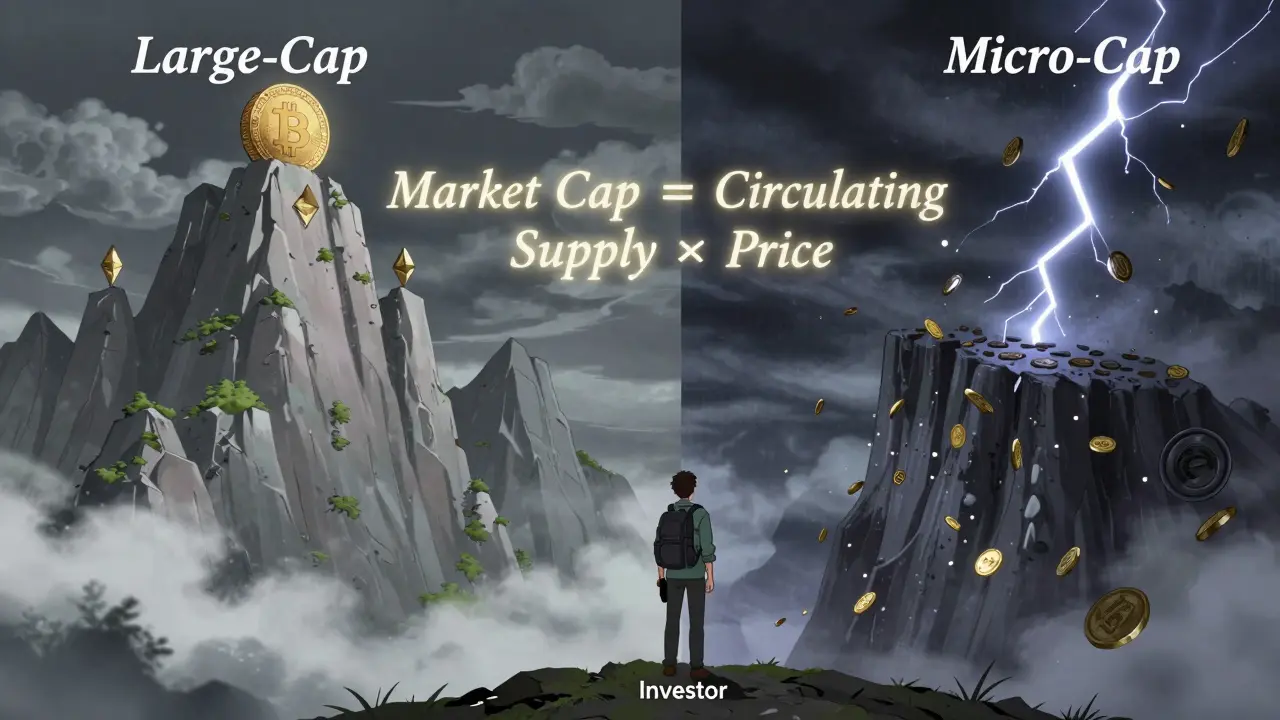
The formula is simple: Market Cap = Circulating Supply × Current Price.
Circulating supply means the number of coins or tokens that are actually out there and available to trade. It doesn’t include coins locked in wallets, reserved for team members, or coins that haven’t been mined yet. For Bitcoin, that’s about 19.7 million coins-not the full 21 million that will ever exist. The current price is the real-time trading value on major exchanges like Binance or Coinbase.
Let’s break it down with numbers:
- Bitcoin: 19.7 million coins × $70,000 = $1.38 trillion market cap
- Solana: 535 million coins × $148 = $79.2 billion market cap
- A small altcoin: 10 million coins × $0.50 = $5 million market cap
You don’t need to calculate this yourself. Platforms like CoinGecko and CoinMarketCap do it in real time, updating every second as prices change or new coins unlock. But knowing how it works helps you spot when something doesn’t add up.
Why Price Alone Is Misleading
Here’s the trap most beginners fall into: they think a $10 coin is more valuable than a $0.10 coin. Not true. A coin at $10 with only 1 million in supply has a $10 million market cap. A coin at $0.10 with 1 billion in supply has a $100 million market cap. The second one is ten times bigger-even though each coin costs less.
Imagine two lemonade stands. One sells cups for $5 each and sells 200 cups a day. The other sells for $0.50 and sells 20,000 cups. Which one makes more money? The $0.50 one. Crypto works the same way. Market cap tells you the total revenue, not the price tag.
Market Cap Categories: Large, Medium, Small, and Micro
Crypto investors group projects by market cap because they behave differently. Here’s how they’re typically broken down:
- Large-cap: Over $10 billion. Think Bitcoin, Ethereum, BNB. These are the giants. They move slowly. A $1 billion swing feels huge to most coins, but for Bitcoin, it’s just a Tuesday. They’re less volatile and often seen as safer.
- Medium-cap: $1 billion to $10 billion. Projects like Polygon, Chainlink, or Solana. These have proven use cases but still room to grow. They’re more responsive to market trends than large-caps.
- Small-cap: $100 million to $1 billion. These are emerging projects. Maybe they’ve got a solid team, but they’re not widely adopted yet. They can jump 50% in a week-or drop 70%. High risk, high reward.
- Micro-cap: Under $100 million. These are the wild cards. Many are new, experimental, or even scams. A single tweet can send them 300% up or 90% down. Only experienced traders should touch these.
Most investors start with large and medium-cap coins. They’re easier to research, have more liquidity, and are less likely to vanish overnight.
What Changes Market Cap?
Market cap isn’t static. Two things drive it: price and supply.
Price changes happen when people buy or sell. If everyone rushes to buy Ethereum, the price goes up, and so does the market cap-even if no new coins are created.
Supply changes are trickier. Here are the main ways:
- Token unlocks: Team members or early investors often get their coins locked for a year or two. When those locks expire, more coins hit the market. That increases supply and can lower the price-unless demand keeps up.
- Mining and staking rewards: New coins are added to circulation as rewards for securing the network. Bitcoin adds new coins every 10 minutes. Ethereum adds them through staking. More supply means more coins to trade.
- Token burns: Some projects destroy coins on purpose. Binance burns BNB quarterly. Solana burns transaction fees. When coins are burned, supply goes down. That can push prices up if demand stays steady.
These supply shifts are often scheduled. You can find them on project websites or trackers like CoinGecko. Knowing when unlocks happen lets you prepare for price swings.
Why Market Cap Matters for Investors
Market cap isn’t just a number-it’s a tool. Here’s how professionals use it:
- Comparing apples to apples: You can’t compare Dogecoin’s price to Bitcoin’s. But you can compare their market caps. That tells you which one the market believes is more valuable overall.
- Portfolio diversification: Smart investors spread money across large, medium, and small caps. Large-caps provide stability. Small-caps offer growth. Market cap helps you balance that mix.
- Understanding market moves: If Bitcoin’s market cap rises 5%, that’s a $65 billion swing. To make the same 5% move, a $500 million coin only needs $25 million in new buying. That’s why small-caps can explode fast-but they also crash harder.
- Spotting bubbles: If a coin’s price jumps 300% in a week but its market cap is still under $50 million, it’s probably a pump. If a $20 billion coin jumps 300%, that’s a real trend.
Market cap also helps you understand what kind of money it takes to move a coin. To push Bitcoin up 10%, you’d need over $100 billion in fresh buying. For a micro-cap coin? Maybe $5 million. That’s why big players avoid small-caps-they can’t even get in without blowing them up.

What About Fully Diluted Market Cap?
You might see another number: fully diluted market cap. That’s calculated using the maximum supply-all coins that will ever exist-even if they’re not out yet.
For Bitcoin, that’s 21 million coins × $70,000 = $1.47 trillion. But that’s theoretical. Right now, only 19.7 million are circulating. Fully diluted cap is useful for long-term planning, but it’s not the real market value. Most serious investors use circulating supply because it reflects what’s actually trading.
Some projects, especially new ones, list fully diluted cap to make themselves look bigger. Always check which one you’re looking at.
How to Use Market Cap in Real Life
Here’s how to put this into action:
- Use CoinGecko or CoinMarketCap to sort coins by market cap. Don’t just scroll by price.
- When you find a new coin, check its market cap first. If it’s under $10 million, be extra cautious.
- Look at the supply chart. Are there big unlocks coming in 3 months? That could mean price pressure.
- Compare similar projects. Two DeFi tokens might both be at $1.50, but one has $800 million in market cap and the other $80 million. The first is far more established.
- Track the total crypto market cap. When it’s rising, most coins are going up. When it’s falling, it’s a bear market-even if Bitcoin looks stable.
Market cap doesn’t tell you if a coin will go up. But it tells you how big the game is. And in crypto, size matters.
Is market cap the same as a company’s valuation in stocks?
Yes, it’s the same concept. In stocks, market cap = shares outstanding × price per share. In crypto, it’s circulating supply × price per coin. The math is identical. The difference is that crypto projects don’t have earnings or balance sheets like companies do, so market cap is the main metric investors use to judge value.
Can a cryptocurrency’s market cap go to zero?
Yes. If a project gets abandoned, hacked, or exposed as a scam, traders stop buying. The price drops to near zero, and the market cap follows. Many micro-cap coins have vanished this way. That’s why you should never invest more than you can afford to lose.
Does a higher market cap mean a cryptocurrency is better?
Not necessarily. A higher market cap means more people believe it’s valuable right now. But it doesn’t guarantee future success. Ethereum has a huge market cap because it runs smart contracts. A smaller coin might have a better technology but less adoption. Market cap reflects popularity, not quality.
Why does market cap change so fast?
Crypto markets are open 24/7, with no central exchange. News, tweets, or even a single large trade can swing prices in minutes. Add in token unlocks, burns, or exchange listings, and supply changes too. That’s why market cap can jump 20% in a day-something that rarely happens with big stocks.
Should I only invest in large-cap cryptocurrencies?
Not exclusively. Large-caps are stable, but they grow slowly. Many investors put 70% of their portfolio in large-caps like Bitcoin and Ethereum, then use 30% for medium or small-caps to chase higher returns. The key is balance. Avoid putting everything into micro-caps-they’re gambling, not investing.
Maggie House
February 20, 2026 AT 10:37Dana Sikand
February 22, 2026 AT 08:56Elizabeth Smith
February 23, 2026 AT 02:39Robert Kromberg
February 23, 2026 AT 07:23Curtis Dunnett-Jones
February 24, 2026 AT 15:42Felicia Eriksson
February 25, 2026 AT 11:16Patrick Streeb
February 26, 2026 AT 10:50Tracy Whetsel
February 28, 2026 AT 00:47Tanvi Atal
March 1, 2026 AT 07:02Colin Lethem
March 2, 2026 AT 13:30Kaitlyn Clark
March 4, 2026 AT 09:01Derek Sasser
March 5, 2026 AT 16:31Neeti Sharma
March 6, 2026 AT 10:42Nadia Shalaby
March 7, 2026 AT 02:47