
You’ve probably seen the term READ2N pop up in crypto discussions or on blockchain explorers. It’s a project that tries to mix two very different worlds: digital novels and cryptocurrency. But what exactly is it? Is it just another meme coin, or does it have a real use case?
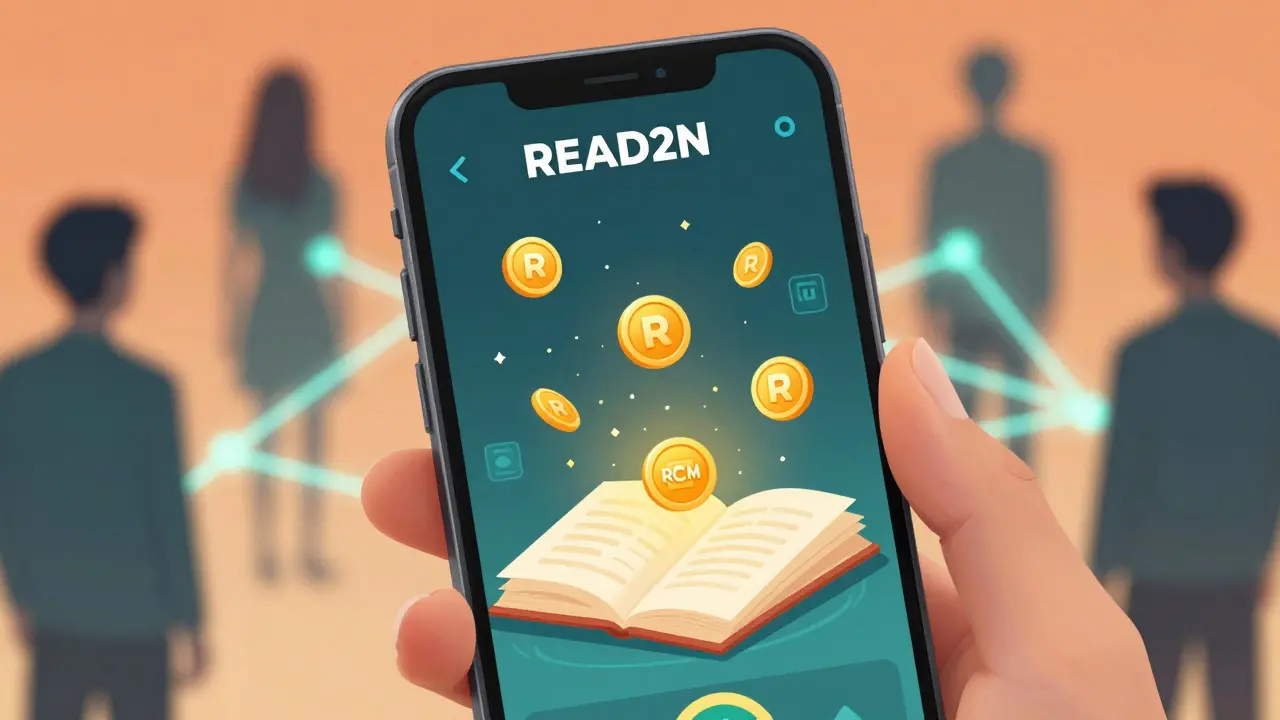
In short, READ2N (trading under the ticker symbol RCM) is a utility token built for a decentralized novel-reading platform. It operates on the BNB Smart Chain, using the BEP20 standard. The idea behind it is simple: reward readers and writers with tokens while managing intellectual property rights through non-fungible tokens (NFTs). If you are curious about how this works, why the price has dropped so much from its peak, and whether it is worth your attention, here is the full breakdown.
The Core Concept: Reading as Consensus
Most crypto projects focus on finance, gaming, or social media. READ2N takes a different path. Its central philosophy is that "reading creates consensus." In traditional publishing, authors get paid once when you buy a book. On the READ2N platform, the goal is to create a feedback loop where community engagement directly influences value.
Here is how the ecosystem is supposed to work:
- Content Access via NFTs: Instead of buying a static eBook, users might acquire access to specific novels or chapters through NFTs. This ties the intellectual property (IP) rights directly to a digital asset on the blockchain.
- Reward Mechanism: Users earn RCM tokens for reading, sharing, or creating content. Writers also receive rewards based on engagement.
- Governance: A portion of transaction fees and rental income goes into a pool that helps fund IP-NFT governance. Token holders can potentially vote on how these funds are used or how new IPs are managed.
This model attempts to solve a common problem in Web3: sustainability. Many platforms burn out because they lack real utility. By tying the token to an actual activity-reading fiction-the project aims to keep users engaged long-term.
Technical Specifications and Supply
To understand any crypto asset, you need to look at its technical foundation. READ2N was launched in 2022. It lives exclusively on the Binance Smart Chain (now often referred to as BNB Chain). This choice matters because BSC offers faster transactions and lower fees compared to Ethereum Mainnet, which is crucial for a high-frequency activity like reading or micro-transactions.
Let’s look at the hard numbers regarding the token supply:
- Total Maximum Supply: 7,000,000 RCM tokens.
- Circulating Supply: Reports vary. CoinMarketCap lists the circulating supply at 7 million, suggesting all tokens are in play. Other aggregators sometimes show conflicting data, which is common for smaller-cap tokens with fragmented liquidity.
- Smart Contract: You can verify the contract address on blockchain explorers like BscScan. Always double-check this address before interacting with the token to avoid scams.
The relatively small total supply of 7 million means that each token represents a larger slice of the pie compared to coins with billions in circulation. However, supply alone doesn’t determine value; demand and utility do.
Market Performance and Price History
If you check the charts for RCM, you will see a wild ride. Like many altcoins launched during the peak of the last bull market cycle, READ2N has experienced significant volatility.
At its highest point, READ2N reached an all-time high (ATH) of approximately $3.92 USD. As of recent data points in 2026, the price hovers between $0.16 and $0.30, depending on the exchange or aggregator you look at. This means the token is trading roughly 95% below its peak value.
Why such a big drop? Several factors contribute to this:
- Lack of Major Listings: READ2N is not listed on major centralized exchanges like Binance for direct trading. While Binance tracks the price for informational purposes, you cannot trade it there. This limits liquidity and makes it harder for retail investors to enter or exit positions easily.
- Low Trading Volume: Daily trading volumes are modest, often ranging from a few hundred to a few thousand dollars. Low volume means prices can swing wildly with just a single large buy or sell order.
- Market Correction: The broader crypto market has seen cycles of boom and bust. Projects that relied heavily on hype rather than sustained user growth often suffer the most during downturns.
Despite the decline, the token hasn’t disappeared. It maintains a presence on various data aggregators and continues to trade on smaller venues. This suggests there is still a core group of believers or early investors holding onto their bags.
Liquidity and Exchange Availability
One of the biggest hurdles for READ2N is accessibility. When you search for "RCM" on major platforms, you might find price charts, but no "Buy" button. This is because the token relies on decentralized exchanges (DEXs) or smaller centralized exchanges for liquidity.
This creates a few practical issues for traders:
- Price Discrepancies: Because liquidity is fragmented, one platform might list RCM at $0.17 while another shows $0.30. These differences aren't errors; they reflect isolated pools of money where supply and demand don't match across the board.
- Slippage Risk: If you try to buy or sell a large amount of RCM on a thin order book, you could experience high slippage. This means you get fewer tokens than expected when buying, or sell for less than the displayed price.
- Data Inconsistencies: Some aggregators report a market cap of nearly $1.8 million, while others show zero. This happens when automated bots fail to sync with the latest blockchain data or when trading pairs become inactive temporarily.
For anyone considering interacting with RCM, it is critical to use a wallet that supports BNB Smart Chain, such as Trust Wallet or MetaMask configured for BSC. You would likely swap BNB for RCM on a DEX like PancakeSwap, ensuring you have enough BNB left for gas fees.
Community and Adoption Metrics
A crypto project’s health isn’t just about price; it’s about people. READ2N currently has around 10,440 unique holder addresses according to CoinMarketCap. Is this a lot? In the grand scheme of cryptocurrency, no. Bitcoin has millions of holders. Even mid-tier DeFi protocols often have tens of thousands.
However, 10,000 holders is not nothing. It indicates a niche but dedicated community. These users are likely either avid readers interested in Web3, early investors who bought in during the 2022 launch, or developers experimenting with NFT-based IP models.
The platform’s adoption remains limited compared to giants like Axie Infinity or Decentraland, which operate in the gaming and metaverse sectors. Those industries attracted massive capital quickly. The literary world, by contrast, moves slower. Digitizing novel consumption via blockchain is a novel concept itself, and convincing mainstream readers to adopt wallets and manage NFTs for books is a steep uphill battle.
Risks and Challenges
No investment is without risk, and READ2N carries several specific warnings that you should consider before putting any money into it.
1. Regulatory Uncertainty
The intersection of copyright law, NFTs, and cryptocurrency is murky. Governments are still figuring out how to regulate digital assets. If regulations tighten around utility tokens or NFT-based content distribution, projects like READ2N could face legal headwinds.
2. Competition
While READ2N is unique in its focus on novels, it competes with traditional e-book giants like Amazon Kindle and Apple Books. These platforms offer seamless experiences without the friction of blockchain transactions. For READ2N to succeed, it must prove that the benefits of owning IP-NFTs outweigh the convenience of traditional platforms.
3. Liquidity Trap
With low trading volume, exiting a position can be difficult. If you decide to sell, you might not find enough buyers at the current price, forcing you to accept a lower rate or wait indefinitely. This is known as a liquidity trap.
4. Development Stagnation
Since its launch in 2022, public updates on major partnerships or feature releases have been sparse. Without continuous development and marketing, interest can fade. The team needs to demonstrate active progress to maintain confidence among existing holders.
Is READ2N Worth It?
That depends entirely on your goals. If you are looking for a quick flip or stable returns, READ2N is likely not the right choice. Its low liquidity and history of sharp declines make it unsuitable for conservative investing.
However, if you are fascinated by the concept of Web3 literature and believe that decentralized ownership of creative works is the future, READ2N offers a rare glimpse into that potential. It is an experiment in aligning incentives between readers, writers, and publishers using blockchain technology.
Remember, the fact that it trades at a fraction of its all-time high doesn’t mean it’s "cheap" in value terms-it might just mean the market has reassessed its viability. Do your own research (DYOR), check the latest smart contract audits, and never invest more than you can afford to lose.
What is the main use case for the READ2N (RCM) token?
The primary use case for RCM is within a Web3 novel reading platform. It serves as a utility token for rewarding users and creators, facilitating transactions, and participating in governance related to NFT-based intellectual property rights.
Which blockchain network does READ2N operate on?
READ2N operates on the BNB Smart Chain (BSC), utilizing the BEP20 token standard. This allows for fast and low-cost transactions compared to networks like Ethereum.
Can I buy READ2N on Binance?
No, READ2N is not listed for trading on the Binance exchange. While Binance may track its price for informational purposes, you cannot buy or sell it directly on their platform. You would need to use decentralized exchanges or other smaller venues.
What is the total supply of RCM tokens?
The maximum total supply of READ2N (RCM) is 7,000,000 tokens. Data sources generally indicate that the entire supply is currently in circulation, though some discrepancies exist across different trackers.
Why has the price of READ2N dropped significantly from its all-time high?
The price drop is attributed to several factors including limited exchange listings, low trading liquidity, broader market corrections in the crypto sector, and potentially reduced speculative interest since its launch in 2022.
Jan Gilmore
May 8, 2026 AT 20:55Let me save you the trouble of reading that entire wall of text because clearly nobody wants to do that. READ2N is a textbook example of a 'solution looking for a problem.' You don't need blockchain to read a novel. Amazon Kindle works fine. The idea that 'reading creates consensus' is just buzzword salad designed to sound profound while meaning absolutely nothing. It's a utility token with no utility, an NFT wrapper for books that people already own or borrow for free, and a governance model that only exists to give holders something to vote on so they feel involved in their own financial suicide. The price drop isn't a market correction, it's gravity finally catching up with hype. Don't touch it.
Samara McCallum
May 10, 2026 AT 13:02the tragedy of modern crypto is not the scams but the sincere belief that technology can fix human nature by making us read more fiction for tokens
Mike S
May 12, 2026 AT 06:38Oh look, another 'innovative' project trying to gamify literacy like we're five years old again. This is peak absurdity. You want to reward people for consuming content? Just pay them, you don't need a decentralized ledger to track who read chapter three. The fact that this thing is down 95% from its ATH tells you everything you need to know about the sustainability of 'literary consensus.' It's a ghost town with a smart contract. I'm laughing so hard I might actually buy some just to watch the liquidity evaporate in real time. Truly spectacular incompetence on display here.
Sheldon Friesen
May 12, 2026 AT 14:17I must say, however, that the technical specifications are quite... interesting! Isn't it fascinating how they chose BSC for lower fees? One might argue, perhaps sarcastically, that this shows a certain level of pragmatic thinking, even if the end result is less than stellar! Do try to verify the contract address before you lose your shirt, though! Safety first, my friends!
Caique Muniz
May 14, 2026 AT 03:55lol another rug waiting to happen. why would i care about nft ip rights when i can just pirate the book for free? this makes no sense at all
Bradley Geldenhuys
May 15, 2026 AT 08:01listen up folks. this is exactly what happens when you ignore fundamentals. the team needs to step up or get out of the way. stop holding bags like losers and demand progress or burn it. im tired of seeing these zombie projects clogging up the chain. wake up and smell the coffee or get crushed.
robert Whitehead
May 16, 2026 AT 23:22You people are wasting your time discussing this trash. READ2N is a regulatory nightmare waiting to happen. Copyright law doesn't care about your 'consensus.' If the SEC decides that these IP-NFTs are unregistered securities, this whole project goes to zero overnight. The lack of major listings isn't a feature; it's a symptom of institutional rejection. Stop pretending this is innovation. It's a Ponzi scheme wrapped in literary pretension. Get out now before you get left holding the bag while the developers cash out.
Michael Berggren
May 18, 2026 AT 21:47I see the potential here 📚✨ Even though the price is down, the concept of rewarding readers is cool. Maybe it will bounce back if they fix the UX issues. Keep DYOR everyone! 🚀💪
Kiran CS
May 19, 2026 AT 10:25How utterly tedious. To think that one could reduce the sublime art of literature to a mere transactional metric is beneath contempt. The notion that 'engagement' equates to value is a vulgar misunderstanding of both economics and aesthetics. One does not simply 'tokenize' Tolstoy. This project reeks of desperation and a fundamental ignorance of what makes culture valuable. It is a digital slumlord's dream come true, charging rent for access to words that should be free. Disgusting.
Bijan Das
May 19, 2026 AT 20:32looks like another scam to me. simple as that. dont waste your money on this junk
Ashley Rodriguez
May 21, 2026 AT 10:12i mean i get the idea but honestly it feels like so much extra work just to read a book why cant we just use kindle or something normal instead of dealing with wallets and gas fees it seems like too much hassle for most people unless they really love crypto stuff which i guess is fine but still seems complicated
Bridget Coogle
May 22, 2026 AT 07:34its okay to have doubts. the tech is new. maybe it takes time to grow.
Zara Zaman
May 22, 2026 AT 18:15This is typical foreign nonsense invading our digital space. American readers deserve better than this fragmented, insecure mess. We need strong domestic platforms that respect our laws and our privacy. Not this offshore gambling den disguised as a library. Keep your crypto away from our children.
Larry Port
May 24, 2026 AT 09:24I was curious about the supply mechanics. With only 7 million tokens, the scarcity argument holds some weight theoretically. However, without actual demand drivers, scarcity is meaningless. I wonder if the governance pool ever sees any real activity or if it's just dust collecting. It's an interesting experiment in behavioral economics, even if the execution is lacking.
Jocelyn Garcia
May 26, 2026 AT 07:47The alpha here is obvious: low cap, high risk, potential for massive gains if they list on a CEX. But let's be real, the DEX liquidity is thin as hell. Slippage will eat you alive. Only dip your toes in if you're ready to lose it all. Not financial advice, just observation.
Amit Varpe
May 26, 2026 AT 15:17Indian devs build better tech than this. Why are we even talking about this garbage? Make India great again in crypto! 🇮🇳
Bronwen Butler
May 27, 2026 AT 07:33everyone says its dead but i bet it pumps next week. contrarian play. buy the fear sell the greed
Pauline Larocco71
May 28, 2026 AT 06:12oh my gosh i tried to connect my wallet and it failed so many times. also the interface looks really outdated. hope they update it soon because right now its kinda confusing to navigate
beti macedo
May 29, 2026 AT 02:49It is truly inspiring to see such dedication to the arts in the digital age. Perhaps with more support, this platform will flourish and bring joy to many readers around the world.
H F
May 30, 2026 AT 12:34Right, well, I've been tracking this since day one. The volatility is insane, sure, but imagine if they actually got a partnership with a big publisher? That would change everything. It's a long shot, but the upside is there if you believe in the vision. Let's keep the faith, eh?