
The double-spending problem is the reason digital money almost failed before it even started. Imagine you have one digital dollar. You send it to your friend Bob. Then, right after, you send the same exact dollar to Charlie. If both transactions go through, you just created money out of thin air. That’s the double-spending problem - and it’s what made people think digital cash was impossible.
Why Digital Money Can Be Copied
Physical cash doesn’t have this issue. You can’t hand someone a $20 bill and then have another copy of that same bill in your pocket. But digital files? They’re copy-paste friendly. A Bitcoin isn’t a physical object. It’s a record in a computer file. That means, without safeguards, someone could duplicate that record and send the same coins to multiple people. Think of it like this: you download a song, then send it to ten friends. Each friend thinks they got the original. But you didn’t give them anything new - you just shared the same file over and over. Digital currency could’ve worked the same way. If no one stops it, a hacker could spend 1 BTC on a pizza, then send the same 1 BTC to buy a car - and both deals would look valid.How It Was a Showstopper Before Bitcoin
Before Bitcoin, digital currency projects either failed or relied on banks. Companies tried to build online payment systems, but they all needed a central authority - like a bank - to track who had what. That’s because without a trusted middleman, there was no way to know if a digital coin had already been spent. If you didn’t trust the company running the system, you had no protection. And if the company got hacked or went out of business? All your money vanished. That’s why digital money stayed stuck in theory. No one could build a system that worked without a central boss. Until Bitcoin came along.Bitcoin’s Solution: The Blockchain
Bitcoin’s answer to double-spending is simple, but brilliant: a public, unchangeable ledger called the blockchain. Every transaction ever made gets recorded on this ledger. And it’s not stored on one computer - it’s copied across thousands of computers around the world. When Alice sends 1 BTC to Bob, that transaction gets broadcast to the whole network. Miners - people running special computers - check if Alice actually owns those coins and hasn’t spent them already. They look at the blockchain history. If she already sent that coin to someone else, the network rejects the new transaction. Once miners agree the transaction is valid, they bundle it into a block. That block gets added to the chain of previous blocks. From that moment on, the transaction is confirmed. And once confirmed? It’s permanent.How Confirmation Prevents Double Spending
The magic isn’t just in recording transactions. It’s in making them irreversible. Each new block links back to the one before it using complex math. If someone tries to go back and change an old transaction - say, erase the fact that Alice already sent her Bitcoin - they’d have to redo every single block after it. And not just one copy. They’d have to redo every copy on every computer in the network. That’s impossible unless you control more than half of all the computing power on the network. That’s called a 51% attack, and it’s extremely expensive. The cost of buying that much power is higher than the value of the coins you could steal. So here’s how it works in practice: if Alice sends 1 BTC to Bob, and six more blocks get added after that transaction, it’s practically certain she didn’t double-spend. The deeper a transaction is buried in the blockchain, the harder it is to undo.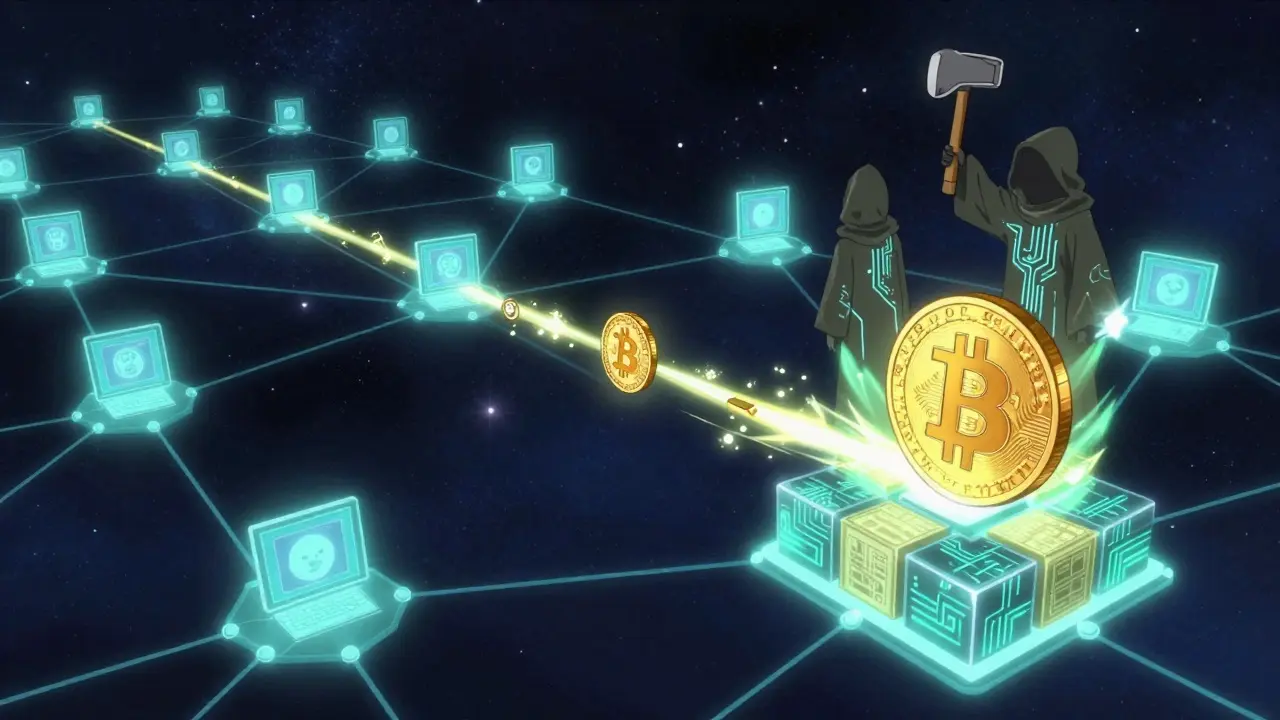
What Happens If Two Transactions Happen at Once?
Sometimes, two conflicting transactions pop up at the same time. Alice tries to send the same coin to Bob and Charlie. The network doesn’t instantly know which one is real. So both transactions get broadcast. Miners might pick one or the other to include in their next block. That creates a temporary fork - two versions of the blockchain. But the network doesn’t stay split. Miners keep building on the longest chain. Eventually, one chain becomes longer than the other. The shorter chain gets abandoned. All transactions on it are considered invalid. So if Bob got his transaction confirmed first, Charlie’s transaction gets thrown out. Charlie doesn’t get paid. And Alice doesn’t get to keep her coin. The network chooses the first valid transaction it sees - not because it’s fair, but because it’s the one that got the most support from miners.Other Cryptocurrencies Use the Same Idea
Bitcoin didn’t invent the blockchain. But it was the first to make it work. Since then, other coins like Ethereum, Litecoin, and Cardano all use the same core idea: a public, distributed ledger that prevents double spending. Some use different methods to agree on what’s real. Ethereum switched from mining (proof-of-work) to staking (proof-of-stake). Instead of using electricity to solve puzzles, validators lock up their own coins as collateral. If they try to cheat, they lose their stake. But even with different rules, they still rely on the same principle - a shared, unchangeable record of every transaction.Why This Matters More Than You Think
Double-spending isn’t just a tech glitch. It’s the difference between money and worthless data. If a currency can be copied, it loses value. Why would you accept Bitcoin if someone could spend it twice? Why trust it as a store of value? The whole point of money is scarcity. You can’t print more gold without mining it. Bitcoin does the same thing - but digitally. The blockchain makes sure no one can fake it. That’s why Bitcoin works. Not because it’s fast or cheap. But because it solves a problem that no one else could. It lets strangers trust each other without banks. That’s revolutionary.
Can Double Spending Still Happen?
Technically, yes - but only in rare cases. If a network is small, weak, or poorly designed, it might be vulnerable. Some altcoins with low mining power have been attacked. In 2018, a smaller coin called Verge lost $1.5 million because attackers double-spent coins using a flaw in its system. But Bitcoin and Ethereum? They’re too big. The cost of attacking them is in the billions. The risk isn’t worth it. So for the major cryptocurrencies, double spending is not a real threat anymore.What About Transactions That Aren’t Confirmed?
Here’s a real-world gotcha: if you accept a payment with zero confirmations, you’re taking a risk. Say you run a coffee shop. Someone pays you 0.1 BTC. You hand them their latte. But that transaction hasn’t been added to a block yet. If they try to double-spend right away, and the network picks their other transaction, yours gets canceled. That’s why most businesses wait for at least one confirmation - or even three - before handing over goods. It’s not about trust. It’s about math. The more blocks that get added, the safer it is.The Bigger Picture
The double-spending problem wasn’t just a coding challenge. It was the key to unlocking decentralized money. Before Bitcoin, digital cash was a dream. After Bitcoin? It became reality. The blockchain didn’t just fix a bug. It changed how we think about trust. You don’t need a bank. You don’t need a government. You just need a network of computers that agree on what’s true. That’s why the double-spending problem matters. Solving it wasn’t about making better software. It was about making a new kind of money - one that can’t be copied, controlled, or corrupted.What exactly is the double-spending problem?
The double-spending problem is when someone tries to spend the same digital currency more than once. Since digital money is just data, it can be copied. Without a way to verify transactions, a user could send the same Bitcoin to two different people, effectively creating money out of nothing.
How does Bitcoin stop double spending?
Bitcoin uses a public ledger called the blockchain that records every transaction. Miners validate each transaction by checking the history of coins. Once a transaction is confirmed and added to a block, it becomes part of an unchangeable chain. To reverse it, someone would need to control over half the network’s computing power - which is too expensive to be practical.
Can you double-spend on Bitcoin?
It’s nearly impossible on Bitcoin. If a transaction has six or more confirmations, reversing it would require rewriting the entire blockchain from that point - something that would cost billions and take years. Only very small, weak blockchains have ever been successfully attacked.
Why do merchants wait for confirmations?
A transaction with zero confirmations isn’t final. It’s still floating in the network. Someone could send a conflicting transaction, and if that one gets mined first, the original gets canceled. Waiting for one or more confirmations ensures the network has agreed the transaction is valid.
Do all cryptocurrencies solve double spending the same way?
Most use the same core idea - a distributed ledger that prevents reuse of coins. Some, like Ethereum, use proof-of-stake instead of proof-of-work, but they still rely on consensus and immutability. The method may differ, but the goal is always the same: make sure no coin can be spent twice.
Anastasia Danavath
March 15, 2026 AT 13:25Graham Smith
March 15, 2026 AT 18:57Henrique Lyma
March 16, 2026 AT 00:31anshika garg
March 17, 2026 AT 06:14Bruce Doucette
March 18, 2026 AT 08:11Arlene Miles
March 20, 2026 AT 03:38Elizabeth Kurtz
March 20, 2026 AT 16:15john peter
March 21, 2026 AT 01:41Marc Morgan
March 22, 2026 AT 13:40Anastasia Thyroff
March 24, 2026 AT 06:43Derek Lynch
March 24, 2026 AT 08:50Shreya Baid
March 25, 2026 AT 07:29Christopher Hoar
March 26, 2026 AT 10:19Robert Kunze
March 26, 2026 AT 20:05Sarah Zakareckis
March 28, 2026 AT 05:52Heather James
March 29, 2026 AT 21:17Jerry Panson
March 31, 2026 AT 19:07