
When you send Bitcoin, you aren't just moving money from one account to another. You are adding a record to a global, immutable ledger. But how does that ledger actually hold together? The answer lies in the Bitcoin block, which is the fundamental unit of data storage in the Bitcoin blockchain, serving as a container for validated transactions linked cryptographically to previous blocks. Think of it like a page in a notebook. Each page contains a list of transactions, and each page is glued to the previous one with cryptographic cement. If you try to rip out an old page or change a word on it, the glue breaks, and everyone knows someone tampered with the book.
Understanding this structure isn't just for miners or computer scientists. If you want to know why Bitcoin is secure, why transaction fees sometimes spike, or how developers build wallets and explorers, you need to understand the anatomy of a block. Let's break down exactly what goes into these digital containers.
The Two Main Parts of a Bitcoin Block
A Bitcoin block is not a single blob of data. It is divided into two distinct sections: the block header and the transaction list. The header is small, fixed, and critical for security. The transaction list is variable in size and contains the actual economic activity.
The block header is exactly 80 bytes long. That’s tiny. For context, this article is thousands of times larger than a block header. Despite its small size, the header contains all the information needed to validate the block’s place in the chain and prove the work required to create it. The transaction section follows immediately after, containing every transfer included in that specific block.
Anatomy of the Block Header
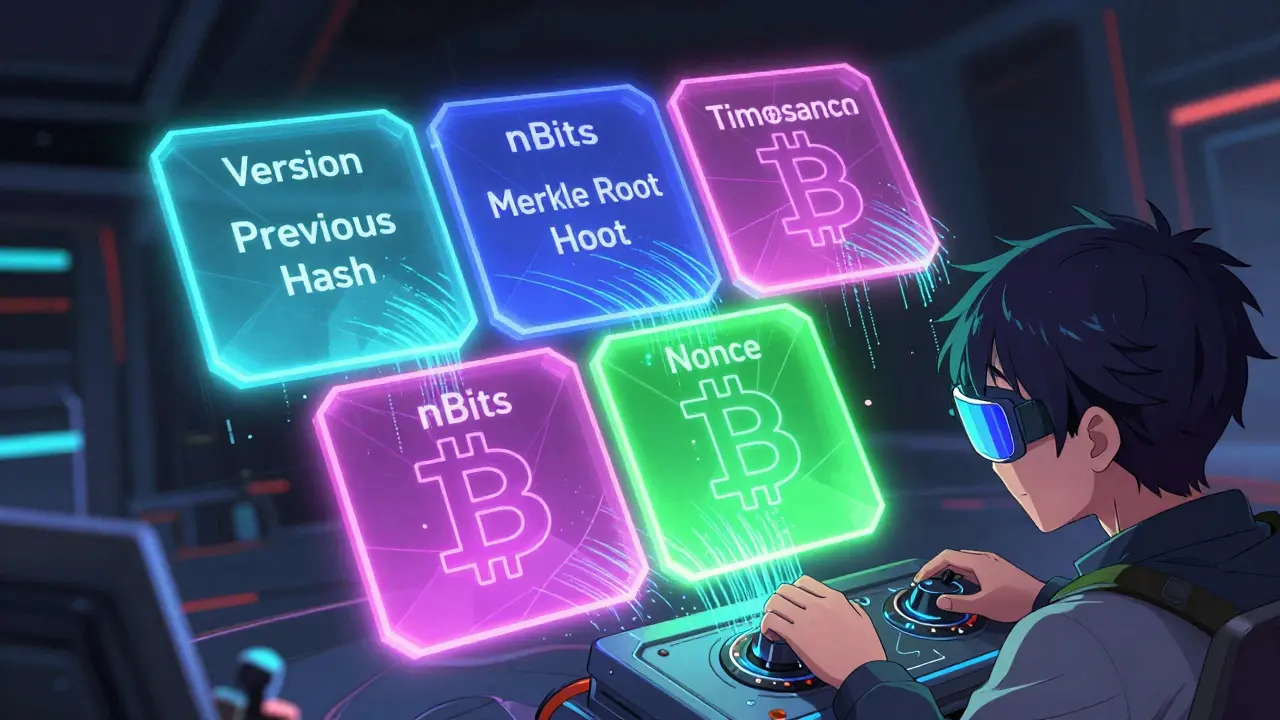
The 80-byte header consists of six specific fields. Each field has a precise size and purpose. Here is what they do:
- Version (4 bytes): This number tells nodes which set of rules to use when validating the block. As Bitcoin upgrades through soft forks, this version number changes to signal new features. For example, version 2 blocks were used during the SegWit activation period.
- Previous Block Hash (32 bytes): This is the cryptographic fingerprint of the parent block. It links the current block to the history before it. Changing even one bit in the previous block would change this hash, breaking the chain. This creates the "chain" in blockchain.
- Merkle Root (32 bytes): This is a hash derived from all the transactions in the block. It acts as a summary. If you change any transaction inside the block, the Merkle root changes, making the block invalid. This allows for efficient verification without downloading every single transaction.
- Timestamp (4 bytes): This records when the miner started working on the block. It must be within a reasonable range-specifically, later than the median time of the previous 11 blocks and no more than two hours in the future-to prevent manipulation.
- nBits (4 bytes): This is a compact representation of the target difficulty. It defines how hard the puzzle is. The lower the target, the harder it is to find a valid hash. This adjusts roughly every two weeks to keep block times near 10 minutes.
- Nonce (4 bytes): This is the number miners change repeatedly. They tweak this value, recalculate the header hash, and check if it meets the target. It’s the dial they turn until they hit the winning combination.
These six fields are hashed together using SHA-256 twice. The resulting hash must be less than or equal to the target defined by the nBits field. This process is called proof-of-work.
| Field Name | Size (Bytes) | Purpose |
|---|---|---|
| Version | 4 | Indicates protocol rules for validation |
| Previous Block Hash | 32 | Cryptographic link to the prior block |
| Merkle Root | 32 | Hash summarizing all transactions in the block |
| Timestamp | 4 | Time when mining began (Unix timestamp) |
| nBits | 4 | Encoded difficulty target |
| Nonce | 4 | Variable number adjusted to meet difficulty target |
The Transaction List and UTXOs
After the header comes the transaction list. Unlike the header, this part varies in size. A block can contain anywhere from one transaction (a coinbase transaction) to thousands, depending on the size of the inputs and outputs.
Each transaction references Unspent Transaction Outputs (UTXOs). In Bitcoin, you don’t have a balance like a bank account. Instead, you have a collection of UTXOs-bits of Bitcoin that haven’t been spent yet. When you spend Bitcoin, you consume existing UTXOs as inputs and create new UTXOs as outputs.
A standard transaction includes:
- Inputs: References to previous UTXOs, including the transaction ID and output index. These also include signature scripts proving ownership.
- Outputs: New UTXOs created by the transaction. Each output specifies an amount and a scriptPubKey, which defines who can spend it next (usually a public key hash).
- Locktime: An optional field that sets conditions for when the transaction can be included in a block, enabling time-based constraints.
The total size of these transactions determines whether a block fits within the limit. Originally, Bitcoin had a strict 1-megabyte limit per block. However, the introduction of Segregated Witness (SegWit) changed how size is calculated.
Segregated Witness and Block Weight
Before SegWit, signature data was bundled with the main transaction data. This caused issues with transaction malleability and limited block capacity. SegWit, activated in August 2017, moved signature data to a separate "witness" section.
This didn’t just fix malleability; it effectively doubled the block capacity. Blocks are now measured in "weight units." A base block can still be 1 megabyte, but witness data counts as only one-quarter of its actual size toward the limit. This means a block can weigh up to 4 megabytes, provided enough of that space is witness data.
In practice, most blocks today are full. Miners prioritize transactions with higher fees per byte. If you send a small transaction with a low fee, it might sit in the mempool for hours or days until a miner picks it up. Understanding block weight helps explain why your transaction might be delayed.

How Mining Validates the Structure
Miners don’t just pick transactions at random. They collect them from the mempool-a waiting area for unconfirmed transactions-and package them into a candidate block. They construct the header, setting the previous block hash, timestamp, and Merkle root based on the selected transactions.
Then comes the hard part: finding a nonce. Miners hash the header billions of times per second, changing the nonce each time. They are looking for a hash that starts with a certain number of zeros, determined by the current difficulty. This is computationally expensive and requires specialized hardware like ASICs.
Once a miner finds a valid hash, they broadcast the block to the network. Other nodes verify the block structure: checking the header hash, validating the Merkle root against the transactions, ensuring signatures are correct, and confirming the block follows consensus rules. If everything checks out, the block is added to their local copy of the blockchain.
This decentralized verification is key. No single entity controls the ledger. Thousands of nodes worldwide independently validate each block. If a miner tries to cheat-by double-spending or altering past transactions-the rest of the network will reject the block because the cryptographic proofs won’t match.
Evolution and Future Upgrades
The core block structure has remained stable since 2009, ensuring backward compatibility. However, upgrades have enhanced functionality without breaking the foundation. Taproot, activated in November 2021, introduced Schnorr signatures and improved privacy by allowing complex transactions to look like simple ones.
Future developments may further optimize scripting capabilities or introduce new consensus mechanisms, but they will likely preserve the header’s 80-byte format. Any change must maintain the integrity of the chain and require broad agreement from network participants.
For users, this stability means reliability. Your wallet works today because it understands the same block structure that Satoshi Nakamoto designed over a decade ago. For developers, it means interoperability. Tools built for Bitcoin can interact seamlessly because they all speak the same technical language.
Why is the Bitcoin block header only 80 bytes?
The 80-byte size is a design choice that balances efficiency and security. It includes all necessary metadata for linking blocks and proving work without excessive overhead. This small size allows lightweight clients to verify the chain quickly by downloading only headers, rather than entire blocks.
What happens if a miner finds a block with an invalid Merkle root?
Nodes will reject the block immediately. The Merkle root must accurately reflect all transactions in the block. If it doesn’t, the block fails validation, and the miner loses the reward and electricity costs associated with that attempt.
Can the block size limit be increased?
Changing the base block size requires a hard fork, which splits the network. SegWit avoided this by using a soft fork to increase effective capacity via weight units. Further increases would face similar political and technical challenges due to concerns about centralization and node operation costs.
How does the nonce help secure the network?
The nonce forces miners to perform computational work. Finding a valid nonce proves that significant energy was expended. This makes attacking the network prohibitively expensive, as an attacker would need to outcompute the honest majority to rewrite history.
What is the difference between a block and a transaction?
A transaction is a single transfer of funds between parties. A block is a container that groups many transactions together, adds a header with cryptographic links, and secures them via proof-of-work. Transactions are proposed by users; blocks are created by miners.