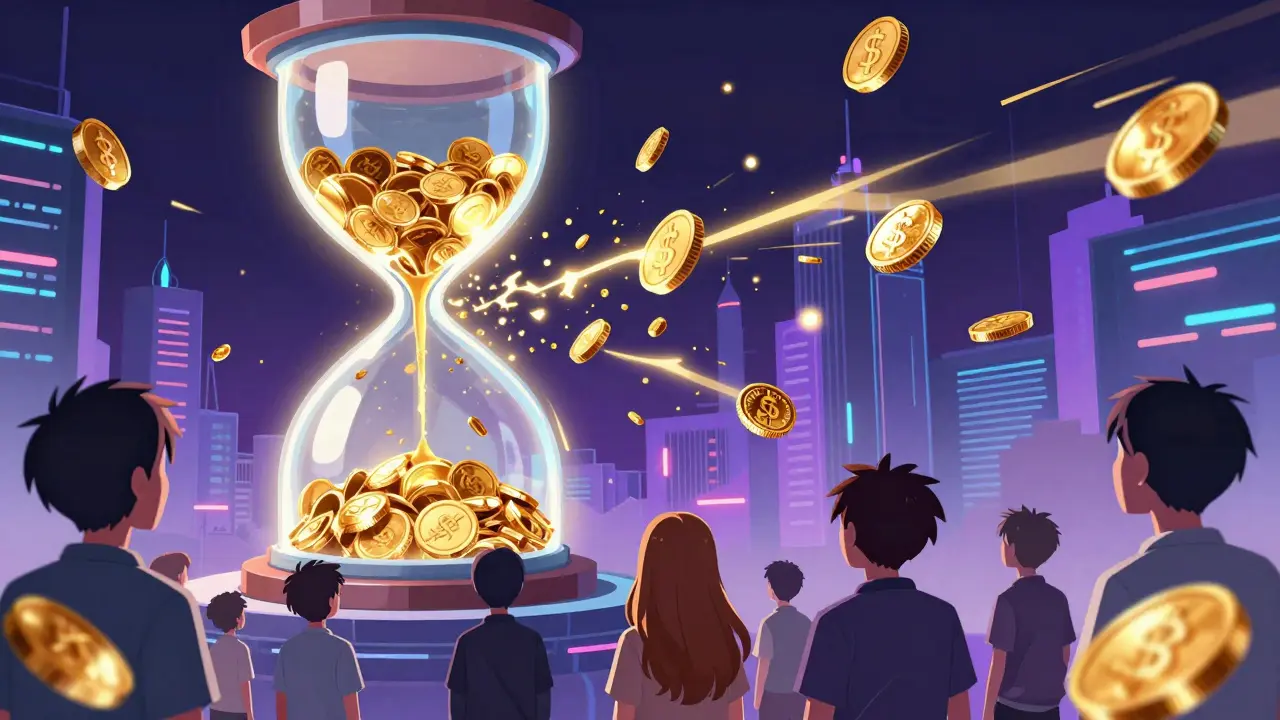
Imagine waking up to find that the amount of new money entering the economy was suddenly cut in half, while everyone still wanted to buy the same amount of goods. That's the basic engine behind a blockchain halving. For years, we've treated these events as magic buttons that trigger moon-shots, but as the market matures in 2026, the reality is getting more complex. We aren't just looking at one coin anymore; we're entering an era where multiple networks are slashing their supply almost simultaneously.
Whether you're a long-term holder or just curious about the tech, understanding these events is about more than just guessing the next price peak. It's about the survival of the networks themselves. When rewards drop, the people keeping the lights on-the miners and validators-start feeling the pinch. If the price doesn't rise to compensate for the lost rewards, the network's security could actually weaken. This creates a high-stakes game of chicken between token price and network stability.
| Network | Estimated Date | Key Impact |
|---|---|---|
| Bittensor (TAO) | Dec 2025 - Feb 2026 | First-ever halving; impacts subnet incentives |
| Ethereum Classic (ETC) | July 23, 2026 | Supply reduction at block 25,000,001 |
| Bitcoin (BTC) | April 2028 | Rewards drop from 3.125 to 1.5625 BTC |
The Bittensor Experiment: A New Kind of Supply Shock
Most of us are used to the simple math of Bitcoin, but Bittensor is introducing a wild card. Bittensor is a decentralized machine learning network that uses tokens to incentivize the sharing of AI models. Its first halving is a massive deal because it doesn't just affect one pool of coins; it ripples through dozens of subnets.
Right now, TAO has a hard cap of 21 million tokens. The halving triggers once 10.5 million tokens enter circulation. But here's the twist: Bittensor uses "Alpha tokens" within its subnets. When the TAO issuance drops, the relative dilution of these Alpha tokens increases. If you're running a subnet, you're not just worrying about the price of TAO; you're wondering if your specific incentive structure will collapse because there isn't enough liquidity to keep the validators happy.
This is the first real test of how a complex, multi-token ecosystem handles a supply shock. If TAO can weather this without its subnets crashing, it sets a blueprint for every other AI-blockchain hybrid coming to market.
Bitcoin's Fifth Halving and the 'Lengthening Cycle'
We all remember the 2024 halving. Bitcoin hit an all-time high near $110,000 in early 2025, proving that the historical pattern of "halving first, peak later" still holds some water. But as we look toward April 2028, something is shifting. The old "four-year cycle" is starting to look a bit stretched.
Why is this happening? It's not just the code; it's the macro world. We're seeing cryptocurrency halvings interact with institutional debt maturities and global interest rates. Big players like ARK Invest aren't trading on 90-day charts; they're accumulating for decade-long horizons. This institutional floor prevents the massive crashes we saw in 2014 or 2018, but it also slows down the explosive, vertical climbs.
When the fifth halving hits and rewards drop to 1.5625 BTC, the network will be in a different place. We're moving toward a future where "coinbase rewards" (the new coins given to miners) become secondary. Eventually, the only thing keeping Bitcoin secure will be transaction fees. If we don't see a massive surge in Layer 2 activity or high-value on-chain transactions, the miners might find it's no longer profitable to secure the network.

Ethereum Classic: The PoW Purist's Play
While the main Ethereum chain moved to Proof-of-Stake, Ethereum Classic stayed true to mining. Its halving on July 23, 2026, is a reminder that Proof-of-Work is still a powerful psychological driver for investors. Because ETC mimics the scarcity model of Bitcoin, it often attracts the same crowd during supply shocks.
The danger here is the "gap." ETC is squeezed between the TAO and Bitcoin events. If the market is already exhausted from a TAO rally, ETC might not get the attention it needs. However, if we see a synchronized supply shock across these three different ecosystems, it could create a compounding effect where the entire sector's liquidity tightens at once, forcing prices upward across the board.

The Long-Term Math: From 2026 to 2140
Let's get concrete about the numbers. Some models suggest Bitcoin could hit $900,000 by 2030. That sounds like a fantasy until you look at the global M2 money supply. When central banks print trillions, assets with a fixed supply-like Bitcoin's 21 million cap-act as a vacuum for that liquidity.
But there's a catch. Every halving reduces the impact of the next one. The first halving was a 100% reduction in new supply. By the time we hit the 20th or 30th halving, the change is so marginal it barely registers. We are currently in the "Golden Era" of halvings where the shocks are still large enough to move the needle. Once we hit the point of diminishing returns, the market will stop trading on the calendar and start trading purely on utility and adoption.
Common Pitfalls for Investors
If you're planning your strategy around these dates, avoid these three common mistakes:
- The "Buy the Rumor" Trap: Many people buy six months before the halving, which is exactly when the "smart money" is starting to sell. Remember that the biggest gains usually happen 6 to 18 months after the event.
- Ignoring the Hash Rate: Don't just watch the price. Watch the hash rate. If the price drops but the hash rate stays high, miners are absorbing the blow. If the hash rate plummets, the network is in trouble regardless of the supply shock.
- Assuming All Halvings are Equal: Comparing TAO's halving to Bitcoin's is like comparing a startup's stock split to a gold mine's production cut. The mechanics are different, and the risks in multi-token networks are much higher.
Does a halving always guarantee a price increase?
No. While historically linked to bull runs, a halving only reduces new supply. For the price to go up, demand must stay the same or increase. If interest in the project dies, the supply cut won't matter because there will be no buyers.
What happens when the last Bitcoin is mined in 2140?
Miners will no longer receive new BTC. At that point, the entire incentive for securing the network must come from transaction fees. This means the network must be busy enough that fees alone provide a living wage for miners.
Why does Bittensor's halving differ from Bitcoin's?
Bitcoin is a single-asset network. Bittensor has a complex architecture with various subnets and Alpha tokens. Its halving affects the balance between the main TAO token and these subnet-specific incentives, creating a more volatile liquidity environment.
Will institutional buyers care about the 2028 halving?
Likely less than retail traders do. Institutions focus on macroeconomic trends, regulatory clarity, and portfolio diversification. While they recognize the supply constraint, they are more likely to move based on global liquidity and interest rate changes.
How do I track when a halving will actually happen?
Don't rely on calendar dates. Halvings are based on block height (e.g., every 210,000 blocks for Bitcoin). Use a blockchain explorer to track the current block number and compare it to the target block where the reward reduction is coded.
Artavius Edmond
April 15, 2026 AT 05:46Man this is a wild way to look at the market. I've always just vibed with my holdings but thinking about how TAO and BTC might clash in a liquidity squeeze is actually pretty interesting. Definitely makes me want to keep a closer eye on the 2026 window.
Lane Montgomery
April 16, 2026 AT 18:00Too long. Just tell me when to buy.
EDOZIEM MICHAEL
April 17, 2026 AT 10:31the flow of money is like a river and the halving is just a dam we build to see how high the water rises before it spills over into new dimensions of value purely as a mental exercise in scarcity
Kieran Smith
April 18, 2026 AT 15:21I rly think the L2 stuff is where the real magic happens. If we get more apps using the chain then the miners wont even care about the reward drop becuase the fees will be huge!! Its such an exiciting time to be in crypto man
daniella davis
April 19, 2026 AT 15:31Umm please. Anyone with a basic grasp of macro economics knows that the M2 money supply argument is so overdone it's almost cute. I've been tracking these cycles since the early days and honestly the way people obsess over block heights is just so quaint. Its like we're all pretending this isnt just a giant game of musical chairs where the music is played by central banks anyway lol.
Omotola Balogun
April 19, 2026 AT 17:25The analysis of Bittensor is particularly astute, though one might argue that the correlation between Alpha tokens and TAO issuance is slightly more nuanced than presented. One must consider the inherent volatility of the AI-sector alongside the programmatic scarcity of the tokenomics to arrive at a truly precise valuation model.
Jason Davis
April 19, 2026 AT 17:56Actually the hash rate is the only thing that matters here. If the hardware gets too expensve for the small guys and only big firms stay the network becomes centralized which defeats the whole point of BTC. Just my two cents as a long time dev in the space.
Tracie and Matthew Hartley
April 21, 2026 AT 01:44lol imagine actually believing the 2028 cycle will be any different from the last ten years. its all just a bubble and we're just waiting for the big pop while people pretend to do "math" with money supply. i'll just hold my bags and laugh when it all crashes again
Akshay Gorad
April 21, 2026 AT 23:52It is important to remain disciplined during these periods of volatility. Focusing on the long-term utility rather than short-term price spikes is the only sustainable approach to investing in this asset class.
jennelle williams
April 22, 2026 AT 19:13scarcity is just a mirror of our own fear of not having enough
Chidinma Sandra okafor
April 22, 2026 AT 19:44Oh sure, because everything always works out perfectly in the digital world. I love how we just trust a piece of code to manage global wealth while the actual economy is burning. Truly a masterpiece of human delusion.
Alan Seiden
April 23, 2026 AT 22:42Absolute rubbish. The obsession with these 'halvings' is a cult-like behavior that distracts from the fact that these assets have no intrinsic value. Only a fool believes a programmed reduction in supply equals value creation. It is a mathematical fallacy pushed by people who cannot trade actual equities.
Samson Selleck
April 25, 2026 AT 14:14The juxtaposition of institutional liquidity floors against the programmatic decay of coinbase rewards creates a fascinating asymmetry in the risk-adjusted return profile. We are essentially witnessing the transition from a speculative venture-capital phase to a mature, yield-bearing treasury asset phase where the volatility is dampened by the sheer scale of the AUM involved. Most retail traders lack the cognitive framework to understand that the 'moon-shot' era is dead, replaced by a sophisticated game of basis trades and macroeconomic hedging.
Heather Warren
April 26, 2026 AT 22:28I totally agree with the point about not buying the rumor! It's so easy to get caught up in the hype right before the event. Just keep your head cool and focus on the long game, everyone can do this if they just stay patient!
Terrance Hausmann
April 28, 2026 AT 11:46I've always found that the best way to handle this stress is to just set a budget and stick to it no matter what the charts say because at the end of the day we're all just trying to find some stability in a world that feels like it's changing way too fast for any of us to actually keep up with.
Emily H
April 30, 2026 AT 07:18The detailed breakdown of the 2140 horizon is quite enlightening. It provides a necessary perspective on the ultimate evolution of the network's security model, shifting the focus from issuance to transaction utility.
Mikayla Murphy
April 30, 2026 AT 22:18It's really interesting to see how different people view these cycles. I think it's great that we can all share our perspectives here, even if we disagree on the outcome. Let's just be mindful of each other's risk tolerances.
logan bates
May 1, 2026 AT 06:09Keep the mining in the US and we win. Simple as that.