The Regulatory Machinery Behind the Block
These apps don't just decide to block crypto on their own. They follow strict mandates from a web of powerful regulators. The People's Bank of China (PBOC) sets the overarching monetary policy, while the Cyberspace Administration of China (CAC) monitors the digital flow of information. Together with the National Administration of Financial Regulation (NAFR) and the Ministry of Public Security, they ensure that no loophole is left open. Under the 2025 guidelines, these platforms are required to do more than just reject transactions. They must implement high-level Know Your Customer (KYC) and Anti-Money Laundering (AML) checks. If you try to move funds toward a known exchange or a suspicious forex gateway, the system doesn't just stop the payment-it flags your account. This creates a high-risk environment for anyone trying to bypass the rules, as your entire digital financial identity is tied to these apps.How the Technical Block Actually Works
So, how does an app know you're buying Bitcoin? It's not always as simple as looking for the word "crypto." The platforms use sophisticated transaction monitoring systems that analyze behavior patterns. They look for specific signatures associated with over-the-counter (OTC) trading, mining electricity payments, and known wallet-funding patterns.| Region | Primary Regulator | Status of Private Crypto | Enforcement Method |
|---|---|---|---|
| Mainland China | PBOC / CAC | Prohibited | Payment platform blocking & account freezing |
| Singapore | MAS | Regulated | Licensing and compliance frameworks |
| Hong Kong | SFC | Regulated / Sandbox | Institutional oversight & retail licensing |

The WeChat Loophole: Messaging vs. Payments
While the payment side is locked down, WeChat presents a unique challenge because it's also a messaging app. This creates a gap where the "planning" happens in a private chat, but the "payment" happens elsewhere. Criminal organizations often use the encrypted nature of WeChat chats to share wallet addresses or QR codes, coordinating trades that never actually touch the WeChat Pay ledger. This "off-chain coordination" is a nightmare for law enforcement. While tools like Know Your Transaction (KYT) can trace what happens on a blockchain, they can't see the conversation that led to the trade. This hybrid approach-using a legitimate social tool to facilitate an illegal financial move-is why the government is putting more pressure on Tencent to share data and tighten surveillance within the app's messaging functions.The Rise of e-CNY: The State's Answer to Bitcoin
China isn't against digital currency; it's against *private* digital currency. The solution is the e-CNY, a Central Bank Digital Currency (CBDC). Unlike Bitcoin, which is decentralized, the e-CNY is fully controlled by the PBOC. Alipay and WeChat Pay are now shifting from being just "crypto blockers" to becoming distribution channels for the e-CNY. This is a strategic move: by giving people a digital version of the yuan, the state provides the convenience of crypto (instant payments, digital wallets) without any of the risks they associate with it, such as capital flight or speculative bubbles. The e-CNY doesn't use a public blockchain; it's a controlled ledger that gives the government total visibility into every transaction.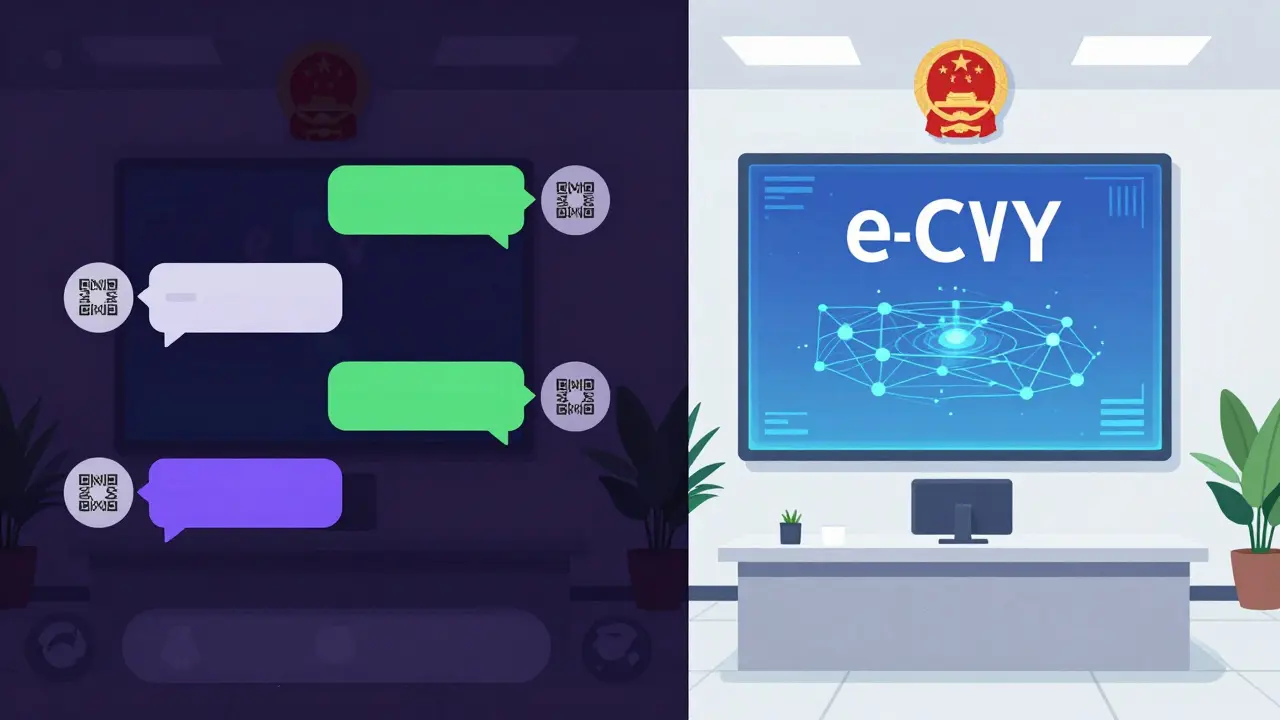
Risks for the User: The Cost of Circumvention
Some people still try to use offshore platforms or P2P networks to trade. But in 2026, the risks have never been higher. Because your real-name identity is linked to your payment app, a single flagged transaction can lead to a frozen account. In severe cases, this can escalate to criminal charges for "illegal fundraising" or violating capital control laws. Even though some officials, like those at the Shanghai State-owned Assets Supervision and Administration Commission, have hinted that the rules *might* soften as digital assets evolve, there has been no actual policy change. For now, the mandate is clear: avoid any link between your payment apps and cryptocurrency if you want to keep your accounts active.What This Means for the Future of Finance
The enforcement strategy in China is a blueprint for how a state can leverage private sector infrastructure to enforce public policy. By forcing the most popular apps in the country to act as digital police, the government has created a system where the cost of breaking the law is the loss of your ability to function in a cashless society. As we look ahead, the focus will likely shift toward cross-border blockchain projects like mBridge. This is a state-controlled framework involving Thailand, the UAE, and Hong Kong. It shows that China is interested in the *technology* of blockchain for institutional efficiency, but it will continue to crush any attempt by individual citizens to use private coins to opt out of the state's financial system.Can I still use Alipay to send money to a crypto exchange?
No. Alipay uses active monitoring to identify and block payments to known cryptocurrency exchanges. Attempting to do so will likely result in a rejected transaction and may flag your account for suspicious activity.
Why is WeChat Pay harder to monitor than Alipay?
Because WeChat is a social messaging app. Users can coordinate crypto trades through encrypted chats and share wallet addresses privately, meaning the actual "agreement" to trade happens outside the payment system's view.
Is the e-CNY the same as a cryptocurrency?
No. While it is a digital currency, it is centralized. It is issued and controlled by the People's Bank of China, unlike cryptocurrencies like Bitcoin which operate on decentralized networks.
What happens if my account is flagged for crypto activity?
Your account can be frozen, and you may be required to provide extensive documentation to prove the source of your funds. In extreme cases, you could face legal penalties for violating capital movement laws.
Does the ban apply to residents living outside of mainland China?
The strict enforcement is focused on mainland China. However, because Alipay and WeChat Pay are tied to Chinese identity and banking systems, residents using these accounts are generally subject to these restrictions regardless of their physical location.
vijendra pal
April 4, 2026 AT 08:49Bro this is just basic stuff!! 🙄 Everyone knows the PBOC is just scared of losing control over the currency flow. The e-CNY is basically just a spy tool with extra steps lol. Totaly expected from them!! 🇨🇳📉
Arlen Medina
April 6, 2026 AT 01:40Exactly. That's why the US system is superior. We have the freedom to invest in what we want without some bureaucrat freezing our accounts because they don't like a piece of code. China's just trying to build a digital cage for its people.
david head
April 6, 2026 AT 05:15totally agree with that 💯 its crazy how they just shut everything down like that
Alexandra Lance
April 7, 2026 AT 21:10Oh please, as if this isn't just a beta test for the global social credit system 🙄💅. They aren't just "blocking crypto," they're training their AI to detect financial dissent. Wake up people, the mBridge thing is just a way to export this surveillance state to the UAE and Thailand so they can track every single cent across borders. It's all about the Great Reset and controlling the flow of wealth so you can't even buy a coffee without a government permit 👁️✨.
Suvoranjan Mukherjee
April 9, 2026 AT 17:45From a technical standpoint, the transition from private rails to a CBDC like e-CNY represents a fundamental shift in the settlement layer. By utilizing a controlled ledger, the PBOC eliminates the need for clearinghouses while maintaining absolute oversight. It's a fascinating case of leveraging Distributed Ledger Technology (DLT) without the decentralization. If you're looking at the mBridge project, it's basically an attempt to optimize cross-border liquidity and reduce reliance on the SWIFT system, which is a huge strategic move for their international trade goals. Definitely keep an eye on how the interoperability between these sovereign ledgers evolves!
Patty Levino
April 10, 2026 AT 01:02It's really scary to think about how a single flagged transaction could basically lock someone out of their own life. In a society that's almost entirely cashless, losing access to Alipay or WeChat Pay isn't just a nuisance, it's a total loss of financial agency. I hope people trying to navigate this are staying safe and using cautious methods.
JERRY ORTEGA
April 10, 2026 AT 17:05it is what it is... just a bit of a bummer for the early adopters over there. they probably just need to find a way to move stuff off-shore before the net closes in completely
Joshua Aldrich
April 11, 2026 AT 14:27I think there is a deeper phellosophical point here about trust. We trust math in crypto, they want us to trust the state. Its a weird paradox because the tech is meant to remove the middleman, but the state is just becoming the ultimate middleman. probly gonna see more of this globally as govt's get scared of losing their monopoly on money.
sekhar reddy
April 12, 2026 AT 02:43The audacity of the state to claim they are protecting the economy while they essentially hijack the entire payment infrastructure! It is absolutely scandalous that such invasive monitoring is normalized!
Deepak Prusty
April 12, 2026 AT 23:46The technical implementation of behavioral analysis for OTC detection is standard in most advanced AML systems. This isn't unique to China, though the scale of enforcement is certainly more aggressive.
shubhu patel
April 14, 2026 AT 23:09I find it quite interesting how the social aspect of WeChat creates this weird grey area where people are still managing to coordinate things in private, although it seems like the government is quickly closing those gaps as well, which just shows how the tension between private communication and state surveillance is constantly evolving in such a digital-first society.
Earnest Mudzengi
April 15, 2026 AT 20:35This is just the start of the financial lockdown! They're using these apps as Trojan horses to map out every single node of the underground economy. Once the e-CNY is fully rolled out, the legacy banking system is dead and we're talking about total programmable money where they can just set an expiration date on your savings if you don't spend it fast enough. It's an absolute nightmare and the sheep just keep using the apps because it's "convenient"!
Hugo Lopez
April 16, 2026 AT 13:35I can see why they'd want to avoid the volatility of private coins, though the lack of privacy is a bit worrying 😊. Maybe there's a middle ground somewhere in the future? 🕊️
Carmelita Gonzales
April 17, 2026 AT 21:53so sad that people lose their savings just for trying to use new tech
Brooke Herold
April 18, 2026 AT 02:59It really highlights the cultural divide in how we view the role of government in our daily lives. In some places, this is seen as stability, while in others, it's an absolute horror story.
Nicholas Whooley
April 18, 2026 AT 04:00It would be beneficial for those currently utilizing these platforms to exercise extreme caution and perhaps explore more traditional, diversified methods of asset preservation to ensure their financial stability during this transition.
Taylor Meadows
April 18, 2026 AT 19:05I'm looking at the people in this thread and it's just sad how naive some of you are. You think this is just about "crypto"? It's about the total erosion of the individual. I can't help but feel exhausted by the lack of critical thinking here. Do you actually think your a little "private chat" on WeChat is saving you from a government that can see your heartbeat through your smartwatch? It's honestly pathetic to watch the delusion play out in real time.
Susan Wright
April 19, 2026 AT 02:06If anyone is wondering, the P2P networks are basically the only way left, but they're incredibly risky now because the "buyer" might actually be a government agent trying to bait you into a transaction. Just a heads up for anyone still trying to move funds.
alex rodea
April 19, 2026 AT 07:47Just keep trying your best and stay safe guys.