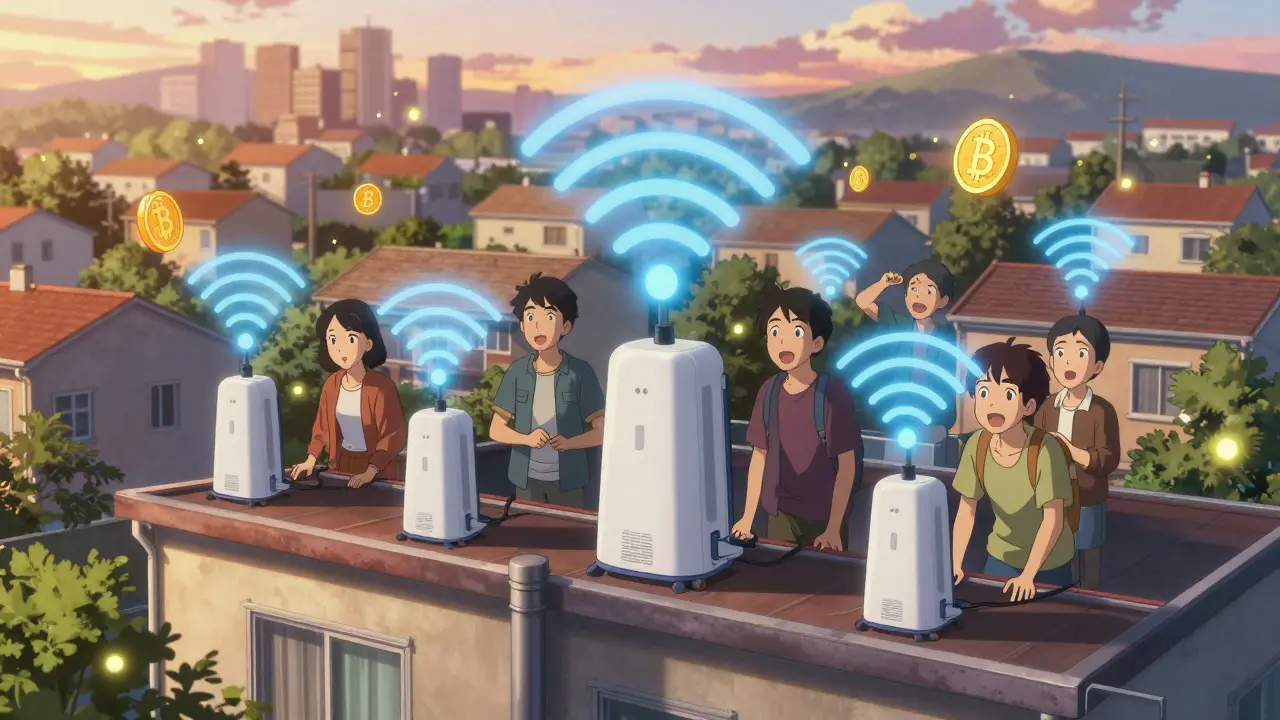
DePIN projects are changing how we build and use physical infrastructure-without corporations, without middlemen, and without waiting for governments to act. Instead of relying on a single company to install cell towers, share bandwidth, or manage energy grids, DePIN lets everyday people contribute their own hardware and get paid in cryptocurrency for it. Think of it like Uber or Airbnb, but for real-world infrastructure like internet access, solar power, or cloud storage. And instead of a company taking 30% of the profits, the network rewards you directly-no approval needed.
What Exactly Is a DePIN Project?
DePIN stands for Decentralized Physical Infrastructure Networks. It’s not just another blockchain buzzword. It’s a working system where people use their own devices-like a Wi-Fi hotspot, a solar panel, or an extra hard drive-to build public infrastructure, and get paid in tokens for it.
Here’s the twist: these networks don’t have CEOs, offices, or corporate boards. They’re run by smart contracts-self-executing code on a blockchain-that automatically track who contributed what and pay them fairly. No human has to approve your application. No corporate policy blocks you. If you have the hardware and the willingness to share, you’re in.
The magic happens because blockchain acts as three things at once:
- Administrative system: Anyone can join. No background checks. No permits.
- Payment system: You earn crypto when you provide service-no bank transfer delays.
- Record book: Every time someone uses your hotspot or stores data on your drive, it’s logged forever on a public ledger.
Two Types of DePIN Networks
Not all DePIN projects are the same. They fall into two clear categories based on what kind of resources they use.
Physical Resource Networks (PRNs)
These networks depend on hardware tied to a specific location. You can’t move them around like a file on your laptop. Examples include:
- Cellular networks: Helium’s hotspots provide wireless coverage. Each one is installed in a home or business and broadcasts internet to nearby devices.
- Electric vehicle charging stations: Owners install chargers and let others pay to use them, earning crypto each time.
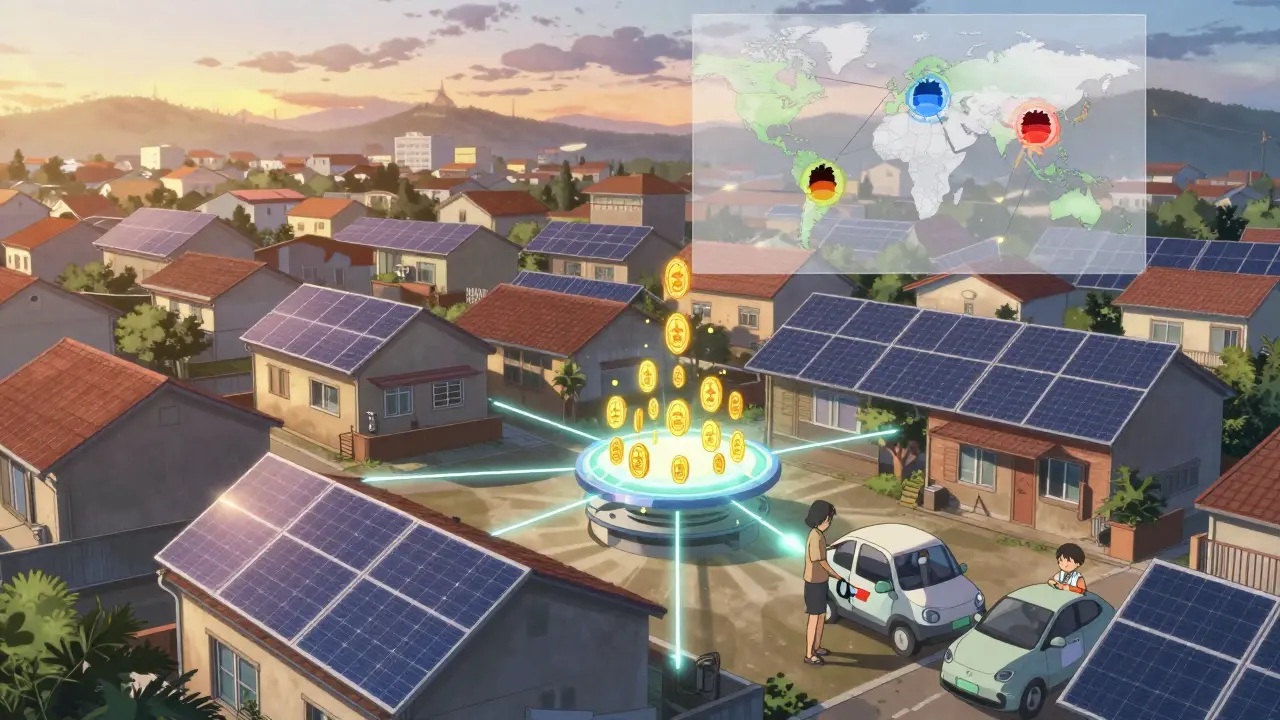
- Solar energy grids: People with rooftop solar panels feed excess power into a decentralized grid and get paid for it.
In PRNs, location matters. A hotspot in downtown Toronto gives better coverage than one in a remote forest. The system rewards better placement, better uptime, and more usage.
Digital Resource Networks (DRNs)
These networks use digital resources that aren’t tied to a place. Think of them like cloud storage or computing power, but owned by thousands of individuals instead of Amazon or Google.
- Decentralized storage: Projects like Filecoin let you rent out unused hard drive space. Your files are encrypted and split across many devices worldwide.
- Distributed computing: Golem lets you rent out your CPU or GPU for tasks like rendering 3D graphics or running AI models.
- Bandwidth sharing: Some networks let you share your home internet connection and get paid for routing traffic.
DRNs are location-independent. A computer in Sydney can help a researcher in Berlin without ever moving a single wire.
How Do People Get Paid?
There are three main ways you earn tokens in a DePIN network:
- Sharing excess resources: If your solar panels generate more electricity than your home uses, you can feed it into a DePIN grid. The network records the energy and sends you tokens in return.
- Building infrastructure: Some projects offer bonus rewards if you install new hardware. For example, Helium used to pay extra to early adopters who set up hotspots in underserved areas.
- Providing services: If someone needs to run a computation or download a file, they pay in crypto. You, as the provider, get paid automatically through smart contracts.
It’s not about being a tech expert. You don’t need to write code. You just need a device you’re not using to its full capacity-a spare router, an old laptop, or a sunny roof.

Why DePIN Beats Traditional Infrastructure
Traditional infrastructure is slow, expensive, and controlled by a few big players. DePIN flips that.
- No single point of failure: If one hotspot goes down, ten others pick up the slack. A centralized server farm? One power outage = total blackout.
- Lower costs: No corporate overhead. No shareholder demands. No expensive data centers. That savings gets passed to users as cheaper services.
- Global access: In rural Nigeria or remote Indonesia, telecom companies won’t build towers because it’s not profitable. DePIN lets locals build their own-using their own devices-and suddenly, internet is available.
- Transparency: Every transaction is on the blockchain. You can see exactly how much energy was shared, who used it, and how much was paid.
Imagine a town where the internet isn’t owned by a cable company. It’s owned by the people who live there. Every household contributes a little. Everyone benefits. That’s what DePIN makes possible.
Real Examples You Can Use Today
You don’t have to wait for DePIN to become popular. It’s already here.
- Helium Network: Over 2 million hotspots have been installed worldwide. People earn HNT tokens just by leaving a device on. In places like Mexico City and Manila, these hotspots now provide the only affordable internet access.
- Filecoin: Over 10 exabytes of storage have been contributed by users. That’s more than all the data stored by Netflix, YouTube, and Spotify combined.
- Golem Network: Artists and researchers rent out idle GPU power to render complex scenes or train AI models-paying a fraction of what AWS charges.
- SolarCoin: Homeowners in Germany and Australia earn tokens for every kilowatt-hour of solar energy they feed into the grid.
These aren’t experiments. They’re live, functioning networks with real users, real earnings, and real impact.
How DePIN Keeps It Fair
Without a company running things, how do you stop people from cheating? How do you make sure someone isn’t faking their solar output or using a fake hotspot?
It’s done through three layers:
- Proof of Location: Hotspots use GPS and radio signals to verify they’re where they say they are. If a hotspot claims to be in Toronto but its signal only reaches 50 meters, the network flags it.
- Proof of Work: Devices must prove they’re actively providing service. A hotspot that’s been offline for 3 days doesn’t earn rewards.
- Reputation Systems: Users rate providers. If a storage node keeps losing data, it gets downranked. No one trusts it anymore.
Smart contracts enforce all of this automatically. No human needs to step in. No complaints to customer service. Just code doing its job.
The Future of Infrastructure
DePIN isn’t just about replacing big tech. It’s about rebuilding infrastructure from the ground up-with communities, not corporations, in charge.
Imagine a future where:
- Your neighborhood’s Wi-Fi is owned by the people who live there.
- Your car charges using energy from solar panels on nearby homes.
- A student in Nairobi can rent supercomputer power to run AI models for pennies.
It’s not science fiction. It’s happening now. And the best part? You don’t need to be a millionaire to get involved. Just a router. A spare hard drive. A solar panel. Your time. And a smartphone to track your earnings.
DePIN turns your unused resources into public goods-and pays you for it. That’s not just innovation. That’s a revolution in how we build the world.
Carl Gaard
March 1, 2026 AT 04:23bella gonzales
March 1, 2026 AT 07:38Paul Reinhart
March 2, 2026 AT 18:34Samantha Stultz
March 3, 2026 AT 09:45Robert Conmy
March 5, 2026 AT 02:25Lilly Markou
March 6, 2026 AT 17:57McKenna Becker
March 7, 2026 AT 01:27precious Ncube
March 8, 2026 AT 14:36Jan Czuchaj
March 9, 2026 AT 14:59KingDesigners &Co
March 11, 2026 AT 14:58Felicia Eriksson
March 11, 2026 AT 18:03aaron marp
March 12, 2026 AT 02:58Patrick Streeb
March 12, 2026 AT 23:02Phillip Marson
March 14, 2026 AT 08:09Tracy Whetsel
March 14, 2026 AT 08:27Alyssa Herndon
March 15, 2026 AT 19:22Ifeanyi Uche
March 16, 2026 AT 05:31Jeff French
March 16, 2026 AT 16:46Elana Vorspan
March 18, 2026 AT 03:02Kenneth Genodiala
March 19, 2026 AT 14:01Paul Reinhart
March 20, 2026 AT 07:56