
Imagine living in a place where the government treats your investment profits like a lottery win, takes a cut of every single trade regardless of whether you made money, and forbids you from using your losses to lower your tax bill. For most, this sounds like a reason to quit. For millions of Indians, it's just another Tuesday in the world of digital assets. India has managed to snag the top spot in global India crypto adoption, creating a wild paradox: the more the government tries to squeeze the market with taxes, the more people seem to dive in.
The VDA Framework: How India Defines Crypto
To understand why this is happening, we first need to look at what the government actually thinks about these assets. In India, cryptocurrencies aren't considered legal tender-you can't buy a coffee with Bitcoin at a local shop legally-but they are recognized as Virtual Digital Assets (or VDAs). VDAs are digital representations of value or rights that are created or digitized in electronic form, as defined under Section 2(47A) of the Income Tax Act.
This classification is a double-edged sword. While it means you can legally trade and hold assets, it also allows the Central Board of Direct Taxes (CBDT) to apply a specific, and rather brutal, set of rules. The goal isn't to ban the tech-which is nearly impossible anyway-but to make sure the state gets a massive piece of the pie.
Breaking Down the Tax Nightmare
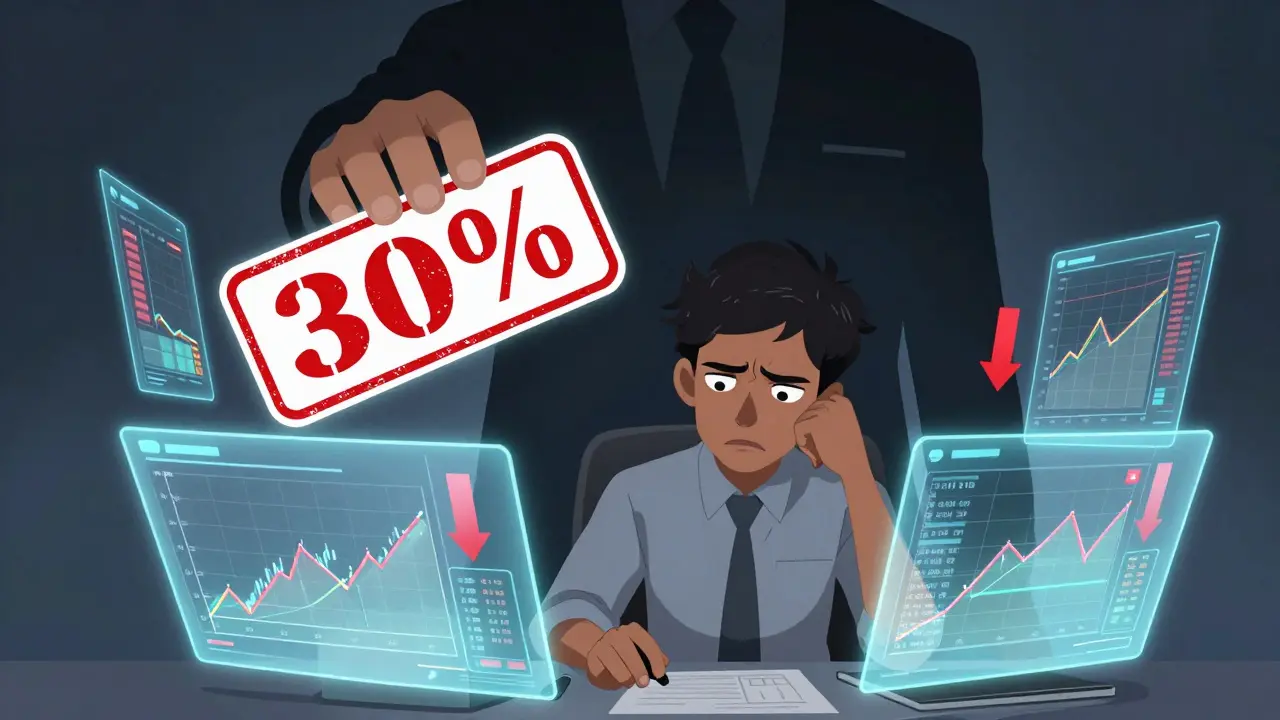
If you're trading in India, you're dealing with three different layers of financial friction. First, there's the flat 30% tax on all gains. This isn't your typical capital gains tax where you might pay a lower rate if you hold an asset for a year. Whether you day-trade or HODL for a decade, the government takes 30% of the profit. The real kicker? You cannot set off losses. If you make ₹1,000 on Ethereum but lose ₹1,000 on Solana, you still owe tax on that first thousand. You can't just call it a wash.
Then there's the 1% Tax Deducted at Source (or TDS). TDS is a mechanism where the tax is collected at the very moment the transaction occurs. Every time you trade more than ₹50,000, 1% is shaved off immediately by the exchange. For high-frequency traders, this is a liquidity killer. It's like trying to run a race while someone periodically ties your shoelaces together.
As of July 2025, the burden got even heavier with the introduction of an 18% Goods and Services Tax (GST). GST is an indirect tax applied to the supply of goods and services. Now, every time you pay a trading fee, a staking fee, or a withdrawal charge, you're paying an extra 18% on top of those service costs. Crypto platforms are now officially "Online Service Providers," meaning they have to register for GST regardless of how much they earn.
| Tax Type | Rate | Trigger/Application | The "Catch" |
|---|---|---|---|
| Income Tax (VDA) | 30% | On all realized gains | No loss set-offs allowed |
| TDS | 1% | Trades > ₹50,000 | Deducted upfront, impacts liquidity |
| GST | 18% | Platform service fees | Applies to staking, fees, and custody |
Why the Adoption Still Climbs
You might wonder: why would anyone bother? Why is India still leading the charts? It comes down to a few human drivers. For many young Indians, crypto isn't just about "trading"; it's about a hedge against traditional financial systems and a way to access global DeFi protocols. The appetite for digital ownership is simply stronger than the fear of the Income Tax Department.
There's also a huge push toward decentralized exchanges (DEXs) and self-custody wallets. When centralized exchanges implement 1% TDS and strict KYC, a portion of the community migrates to peer-to-peer (P2P) networks or offshore platforms. While the government wants to track everything via Schedule VDA in tax returns, the sheer volume of users makes total enforcement a game of whack-a-mole.
The Regulatory Tug-of-War
The government is starting to realize that pushing people too hard might just drive the entire industry-and the tax revenue-overseas. In August 2025, the CBDT actually started talking to the industry. They've been asking the tough questions: Is the 1% TDS too much? Has the 30% tax killed local liquidity? Are we just giving offshore exchanges a free pass while killing our own startups?
This shift is critical. For years, the Reserve Bank of India (RBI) has viewed crypto as a systemic risk to financial stability. However, the realization that India is a global hub for developers and users means the government can't just be a policeman; it has to be a regulator. We're seeing a transition from a purely punitive approach to one that's tentatively exploring a more sustainable framework.

The Trader's Compliance Struggle
If you're a real person trying to trade in this system, the paperwork is a nightmare. You can't deduct mining costs, you can't deduct the fees you paid to the exchange, and you can't use last year's losses to help you today. Everything must be reported under Schedule VDA, creating a permanent audit trail that the tax man can check years later.
For a high-frequency trader, the math often doesn't add up. Between the TDS eating into the principal and the GST inflating the costs of every trade, the "break-even" point moves significantly higher. Many traders have reported scenarios where their net tax liability actually exceeds their actual realized profits because of how losses are ignored. It's a brutal environment for anyone but the most successful whales.
What's Next for the Indian Market?
We are likely heading toward a more nuanced set of laws. The current "one size fits all" 30% tax is too blunt a tool. Expect the government to eventually distinguish between a casual investor and a professional trader. There's also a growing conversation about creating a specific legislative framework for digital assets rather than just tacking them onto existing tax laws.
Until then, India remains a living experiment. It's the only place where the government is practically daring people to invest in crypto by making it expensive to do so, and yet, people keep clicking "Buy." It proves that the demand for decentralized finance is an economic force that doesn't just go away because of a tax hike.
Do I have to pay the 30% tax if I didn't make a profit?
The 30% tax applies only to your gains. However, you cannot use your losses from one coin to offset the gains from another. If you made profit on Bitcoin but lost money on Ether, you still pay 30% on the Bitcoin profit.
How does the 1% TDS actually work?
When you sell or trade a crypto asset on an Indian exchange, the platform automatically deducts 1% of the total transaction value and sends it to the government. You can claim this back or adjust it against your final tax liability when you file your returns.
Is the 18% GST applied to the crypto price?
No, the GST is not on the price of the coin itself. It is applied to the services provided by the exchange, such as trading fees, withdrawal charges, and staking services.
Can I deduct my internet or electricity costs for mining?
Generally, no. Under the current VDA tax rules, the only deduction allowed is the cost of acquisition. Operational expenses like electricity, hardware, or trading fees cannot be deducted from your taxable gains.
What is Schedule VDA?
Schedule VDA is the specific section of the Indian Income Tax Return (ITR) where taxpayers must disclose all their transactions involving Virtual Digital Assets, including the date of acquisition, date of transfer, and the cost/proceeds of the trade.
Siddharth Bhandari
April 5, 2026 AT 13:25The 1% TDS is honestly the biggest headache for those of us trying to do any serious volume. It basically drains your capital before you even have a chance to compound. Most of the seasoned traders I know have already migrated to DEXs or used non-custodial wallets to bypass the centralized reporting systems, even if it means dealing with the risk of P2P transfers. The lack of loss set-off is just pure madness and makes the whole tax structure feel like a penalty rather than a regulation. It's really pushing the brain drain of blockchain developers out of the country.
vijendra pal
April 6, 2026 AT 08:49Bro totaly agree!! 🚀 its just crazy how govt think they can stop us with taxes lol. i just use P2P and keep it lowkey 🤫. the system is broken but the gains are too good to pass up!! 📈💰
akash temgire
April 7, 2026 AT 20:19The VDA framework is fundamentally flawed. It ignores the operational reality of liquidity providing. This is predatory.
shubhu patel
April 8, 2026 AT 06:52I think it is quite interesting how the community is reacting to this because even though the taxes are very high, the collective belief in the technology seems to be outweighing the financial burden, which just shows how much trust people have lost in the traditional banking systems over the last few years and why they are willing to take such a huge hit just to have some control over their own assets.
Evan Borisoff
April 8, 2026 AT 09:16Absolute joke of a system... compared to the US where we have a far more sophisticated regulatory approach involving the SEC and IRS that actually understands the nuances of cost-basis and capital gains, India is just treating this like a gambling den. This kind of blunt-force fiscal policy is just going to drive all the liquidity into offshore havens and leave the local ecosystem completely gutted while the government wonders why their tax revenue isn't hitting the projected milestones despite the adoption rates staying high. It is simply a failure of economic foresight.
Erica Mahmood
April 9, 2026 AT 15:58the slippage caused by that 1% tds is brutal for scalp trading. you literally cant make the math work on high frequency stuff if you're on a compliant local exchange. just move to cold storage and use dexs lol
Matthew Wright
April 11, 2026 AT 07:52Wait, so you can't offset losses... at all??? That is actually insane!!! I thought the US system was a headache with all the forms, but this is next level!!! How do people even track this without losing their minds???
Siddharth Bhandari
April 12, 2026 AT 17:18It's a nightmare. You basically need a dedicated spreadsheet or an expensive tax tool just to figure out how much you're being robbed. Most of us just accept the hit or move assets off-shore.
Arwyn Keast
April 13, 2026 AT 15:19Typical emerging market chaos. The sheer audacity to slap an 18% GST on top of a 30% flat tax is some peak bureaucratic inefficiency. The regulatory arbitrage here is laughable, and frankly, any 'investor' who stays within this framework is just a glutton for punishment. It's an economic wasteland for anyone with an actual understanding of market microstructure.
Krystal Moore
April 14, 2026 AT 17:37Omg this is literally a crime against humanity!! Who decided that you can't deduct losses?! It's like the government is just playing a game of SimCity with people's real money and they don't even care if we go broke as long as they get their 30%!! I can't even deal with this level of unfairness right now.
Sharhonda Walker
April 15, 2026 AT 19:43I've seen a lot of people tryin to use offshore exchanges to avoid the TDS but remember that the Indian govt still wants the 30% on your global income if you are a resident. Its way harder to hide than people think cuz of the FATCA and other reporting standards. Just be carefull with how u move funds back to your bank acount.
gladys christine
April 15, 2026 AT 21:15Slay those taxes anyway!! Just keep building and holding!! the vision is bigger than some tax forms!! keep going legends!!
Adriana Gurau
April 17, 2026 AT 14:16Imagine actually thinking this is 'adoption' and not just people being too stubborn to admit they're losing money to the state 🙄. Truly a peasant's game. 💅
June Coleman
April 19, 2026 AT 07:23Oh sure, because the government is *totally* known for being reasonable and flexible with their tax laws. I'm sure they'll just wake up tomorrow and decide to be nice to everyone. Totally believable.
Emily 2231
April 19, 2026 AT 17:40This is exactly how they start the social credit system. First they track your digital assets through Schedule VDA, then they freeze accounts that don't comply with the state narrative. It's all part of the globalist agenda to eliminate financial privacy under the guise of 'tax compliance' and 'financial stability' and we are just watching it happen in real time.
Robert Coskrey
April 21, 2026 AT 06:35I must agree that the current framework lacks the necessary sophistication to support a growing industry... However, the trend toward a more nuanced legislative approach is a positive sign for the long-term stability of the market.
JERRY ORTEGA
April 22, 2026 AT 18:07just a heads up for anyone new to this stuff. if you use a hardware wallet you have way more control and it makes the govt's whack-a-mole game much harder. keep it simple and stay safe out there
Arlen Medina
April 23, 2026 AT 03:29America does it better. Period. We have actual laws that make sense and a market that isn't run by people who think a 30% flat tax is a good idea. India is just playing catch-up while their taxpayers get fleeced by their own government. It's a joke.
Taylor Meadows
April 23, 2026 AT 09:39It's funny how everyone here acts like they're geniuses for using a DEX. You're all just gambling in a different casino and ignoring the fact that you're mentally enslaved to a chart. Your 'financial freedom' is just a different kind of cage.
david head
April 24, 2026 AT 13:01man that 18% gst on fees is just a sneak attack lol 😂 hope everyone is making it through the bear market with their sanity intact 🙌