
Imagine you are trying to crack a safe combination lock. You spin the dial, checking every number until it clicks open. In the world of Bitcoin mining, this spinning dial is called the nonce. While miners tweak many settings to maximize profit, only one variable actually solves the cryptographic puzzle required to add a new block to the blockchain. That variable is the nonce. Everything else-from transaction fees to block timestamps-is either fixed by the network or chosen for economic reasons, not for solving the hash.
Understanding the difference between the nonce and other mining variables is crucial for anyone looking under the hood of blockchain technology. It explains why mining requires massive amounts of electricity and specialized hardware, rather than just clever software algorithms. Let's break down exactly what the nonce does, how it differs from other parameters in the block header, and why it remains the single most important factor in mining success.
What Is the Nonce?
The term "nonce" stands for "number used once." In the context of Bitcoin, it is a 32-bit integer that miners change repeatedly during the mining process. Its sole purpose is to alter the output of the SHA-256 hashing algorithm so that the resulting hash meets the network's current difficulty target.
Think of the block header as a recipe. The ingredients include the previous block's hash, the Merkle root (a summary of all transactions in the block), the timestamp, the version number, and the bits (difficulty target). Most of these ingredients are locked in place before mining begins. The nonce is the only ingredient the miner can freely stir. By changing the nonce, the miner changes the entire flavor profile of the hash, hoping to find the specific combination that starts with enough leading zeros.
Because the nonce is a 32-bit number, it has approximately 4.3 billion possible values ($2^{32}$). Miners test these values billions of times per second using Application-Specific Integrated Circuits (ASICs). If a miner exhausts all 4.3 billion nonce values without finding a valid hash, they must change another variable in the block header-such as the timestamp or the extra nonce-and start the nonce counter over again.
The Block Header: Fixed vs. Flexible Variables
To understand why the nonce is unique, we need to look at the other components of the block headerthe data structure that summarizes a block of transactions. Not all variables in this header are created equal. Some are immutable, some are network-controlled, and only the nonce is miner-controlled for the sake of computation.
| Variable | Controlled By | Role in Mining | Flexibility |
|---|---|---|---|
| Nonce | Miner | Solves the cryptographic puzzle | High (4.3 billion iterations) |
| Previous Hash | Network | Links blocks together chronologically | None (Fixed) |
| Merkle Root | Miner (Selection) | Summarizes transactions | Medium (Limited by mempool) |
| Timestamp | Miner | Records time of block creation | Low (Constrained by rules) |
| Bits (Difficulty) | Network | Defines the target hash value | None (Auto-adjusted) |
The previous hash is completely fixed. It ensures the chain remains unbroken and tamper-proof. You cannot change it to solve the puzzle; it is simply a reference to history. The bits field represents the difficulty target, which is adjusted by the network every 2,016 blocks (roughly every two weeks) to ensure blocks are found every 10 minutes on average. Individual miners have zero control over this; it is a global setting.
The Merkle root offers some flexibility. Miners choose which transactions to include in their block based on fees. Changing the set of transactions changes the Merkle root, which in turn changes the hash. However, this is an expensive operation computationally and is limited by the available transactions in the mempool. It is not a practical tool for rapid iteration like the nonce.
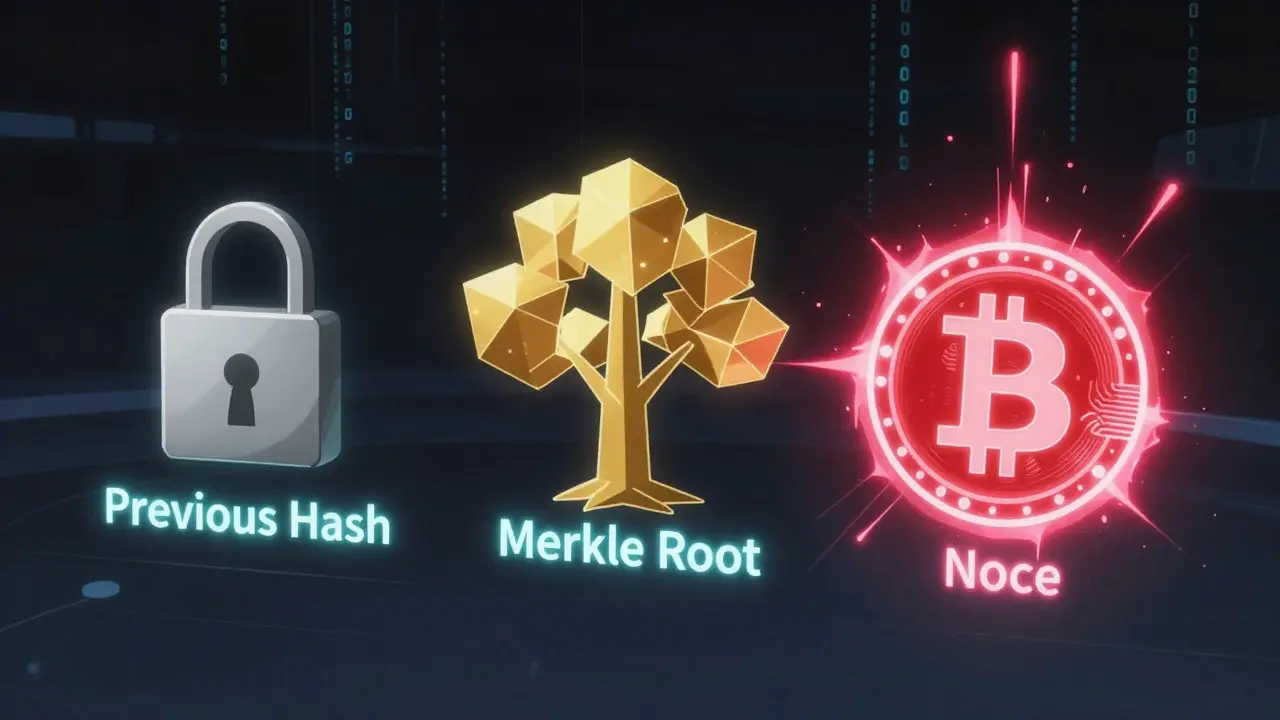
Why the Nonce Is the Primary Variable
The nonce is the engine of Proof of Workthe consensus mechanism that secures the Bitcoin network through computational effort. Unlike other variables that involve strategic decision-making, the nonce involves brute-force computation. This distinction is vital.
When a miner receives a new block template from a mining pool, the template includes the transactions, the previous hash, and the difficulty target. The miner's job is to find a nonce that produces a hash lower than the target. This process is random. There is no pattern to predict which nonce will work. It is purely a guessing game played at lightning speed.
This randomness is what secures the network. Because finding the correct nonce requires significant computational power, it becomes prohibitively expensive for any single entity to rewrite the blockchain. To alter a past block, an attacker would need to redo the work for that block and all subsequent blocks, racing against the rest of the network. The nonce makes this attack economically irrational.
Other variables, like transaction selection, allow miners to optimize profitability. A miner might choose high-fee transactions to maximize revenue. But this choice does not help them win the race to find the next block. Only the nonce does that. This is why mining hardware evolution has focused almost exclusively on increasing hash rate-the number of nonces tested per second-rather than improving software logic for transaction selection.
Exhausting the Nonce Space
With 4.3 billion possibilities, the nonce space seems large. But for modern ASIC miners, it is tiny. A powerful miner can cycle through all 4.3 billion values in less than a second. So, what happens when the nonce runs out?
When the nonce space is exhausted without finding a valid hash, the miner must change another variable in the block header to generate a new set of hashes. The most common approach is to adjust the timestamp. The protocol allows timestamps to vary within a certain range (usually up to two hours ahead of the median time of the last 11 blocks). By shifting the timestamp slightly, the miner creates a new block header, resetting the nonce counter to zero.
If the timestamp flexibility is insufficient, miners use the extra nonce. This is a workaround for the 32-bit limit. The coinbase transaction (the first transaction in the block that awards the block reward to the miner) contains a script that can hold arbitrary data. Miners embed a counter in this script. Changing this counter changes the Merkle root, which effectively resets the entire hashing process. This allows miners to test quadrillions of combinations, far beyond the initial 4.3 billion nonce limit.
Economic Implications: Fees vs. Block Rewards
While the nonce determines who finds the block, other variables determine how much money the miner makes. As of 2024, the Bitcoin block reward was reduced to 3.125 BTC due to the halving event. This shift increases the relative importance of transaction fees.
Transaction fees are determined by users, not miners. Users bid for inclusion in the next block by attaching fees to their transactions. Miners compete to build the most profitable block by selecting transactions with the highest fees per byte. This is a strategic optimization problem, distinct from the computational brute force of the nonce.
In the early days of Bitcoin, block rewards were the primary income source, and fee optimization was negligible. Today, as block rewards decrease, the ability to efficiently select and pack high-fee transactions becomes more critical for long-term profitability. However, even if a miner perfectly optimizes their fee selection, they still must rely on the nonce to actually win the block. You can have the best strategy in the world, but if your hash rate is too low, you won't get the chance to cash in.
Future Trends in Mining Variables
As Bitcoin mining matures, the focus remains on nonce efficiency. The industry is an arms race for energy efficiency and hash rate. Newer ASIC chips offer more hashes per watt, allowing miners to test more nonces for the same cost. Software optimizations play a minor role compared to hardware advancements.
Some experimental protocols explore alternative consensus mechanisms that reduce reliance on pure nonce-based proof of work, such as Proof of Stake or hybrid models. However, for Bitcoin, the nonce remains king. Its simplicity and security properties are deeply ingrained in the network's architecture. Any change to how the nonce functions would require a hard fork and broad community consensus, making it unlikely to change anytime soon.
For individual miners, understanding these variables helps in managing expectations. You cannot "outsmart" the nonce. You can only outspend it. Success comes from having cheaper electricity and more efficient hardware, allowing you to throw more guesses at the wall until one sticks.
What happens if a miner tries all 4.3 billion nonce values?
If a miner exhausts all possible nonce values without finding a valid hash, they must modify another part of the block header, such as the timestamp or the extra nonce embedded in the coinbase transaction. This changes the input to the hashing algorithm, allowing the miner to reset the nonce counter and continue searching.
Can miners change the difficulty target?
No, individual miners cannot change the difficulty target. It is a network-wide parameter that adjusts automatically every 2,016 blocks (approximately every two weeks) to maintain an average block time of 10 minutes. Miners can only adapt their hardware to meet the current difficulty.
Why is the nonce important for blockchain security?
The nonce requires significant computational effort to find, making it expensive to produce blocks. This cost prevents attackers from easily rewriting the blockchain history, as they would need to redo the work for multiple blocks faster than the rest of the network. This is the core principle of Proof of Work.
How do transaction fees relate to the nonce?
Transaction fees do not affect the nonce calculation directly. They determine the profitability of a block once it is found. Miners select transactions with higher fees to maximize rewards, but they still rely on the nonce to win the right to publish that block. The nonce is about winning; fees are about payout.
What is the extra nonce?
The extra nonce is a workaround for the 32-bit limit of the standard nonce. It is stored in the coinbase transaction of the block. By changing the extra nonce, miners alter the Merkle root, which allows them to generate new block headers and continue searching for a valid hash beyond the initial 4.3 billion nonce combinations.