You’ve probably heard the buzz around SyncSwap. It’s been a heavyweight champion on zkSync Era for years. But what about its presence on Linea? If you’re looking to park your stablecoins or swap assets on Consensys’ zero-knowledge network, SyncSwap (Linea) is likely popping up in your search results. The big question isn’t just whether it works-it does-but whether it actually has the life and liquidity you need right now.
Here is the hard truth: as of mid-2026, SyncSwap on Linea is technically robust but practically quiet. While the underlying technology is top-tier, the trading volume is currently negligible. This review breaks down why that is, how the tech stacks up against competitors like Uniswap or Aerodrome, and whether you should risk your capital here or wait for the ecosystem to mature.
What Exactly Is SyncSwap on Linea?
To understand SyncSwap on Linea, you first need to grasp what SyncSwap is at its core. Originally built for zkSync Era, SyncSwap is a decentralized exchange (DEX) designed specifically for zero-knowledge rollups. Unlike generic DEXs that are ported across chains with minimal changes, SyncSwap was engineered from the ground up to handle the unique latency and gas dynamics of zk-rollups.
When SyncSwap expanded to Linea, it brought this same architecture. Linea itself is a zkEVM (Zero-Knowledge Ethereum Virtual Machine) rollup developed by Consensys. It aims to offer full EVM compatibility while leveraging ZK proofs for security and speed. SyncSwap acts as a primary liquidity hub within this ecosystem, focusing heavily on stablecoin pairs and deep liquidity provision.
Think of it this way: if Linea is the highway, SyncSwap is one of the main service stations built specifically for electric vehicles (ZK-compatible apps). It’s not just a copy-paste job; it’s an optimized layer meant to reduce slippage and improve the user experience for traders moving between ETH, USDC, and other major assets on the Linea network.
The Current State of Play: Volume and Liquidity
Let’s look at the numbers because they tell a stark story. In the world of DeFi, liquidity is king. Without it, you can’t trade without massive price impact. As of recent data points leading into 2026, SyncSwap (Linea) shows near-zero trading volume over 24-hour periods. You might see pairs like USDC/USDT or wETH/STONE3 listed, but the actual money flowing through them is minimal.
This stands in sharp contrast to its performance on zkSync Era, where SyncSwap commands over 35% of the DEX market share and holds tens of millions in Total Value Locked (TVL). On Linea, however, the platform is still in a "building" phase rather than a "trading" phase.
- 24-Hour Volume: Effectively $0.00 for most pairs.
- Market Share on Linea: Negligible compared to competitors.
- Liquidity Depth: Shallow for large trades; suitable only for small test transactions.
- Supported Assets: Limited to a few core tokens (USDC, USDT, wETH, STONE).
If you try to swap a significant amount of ETH for USDC on SyncSwap (Linea) today, you will likely encounter high slippage or fail the transaction entirely due to insufficient liquidity. For now, it serves more as a technical proof-of-concept than a viable trading venue for active users.
Technology Under the Hood: Why ZK Matters
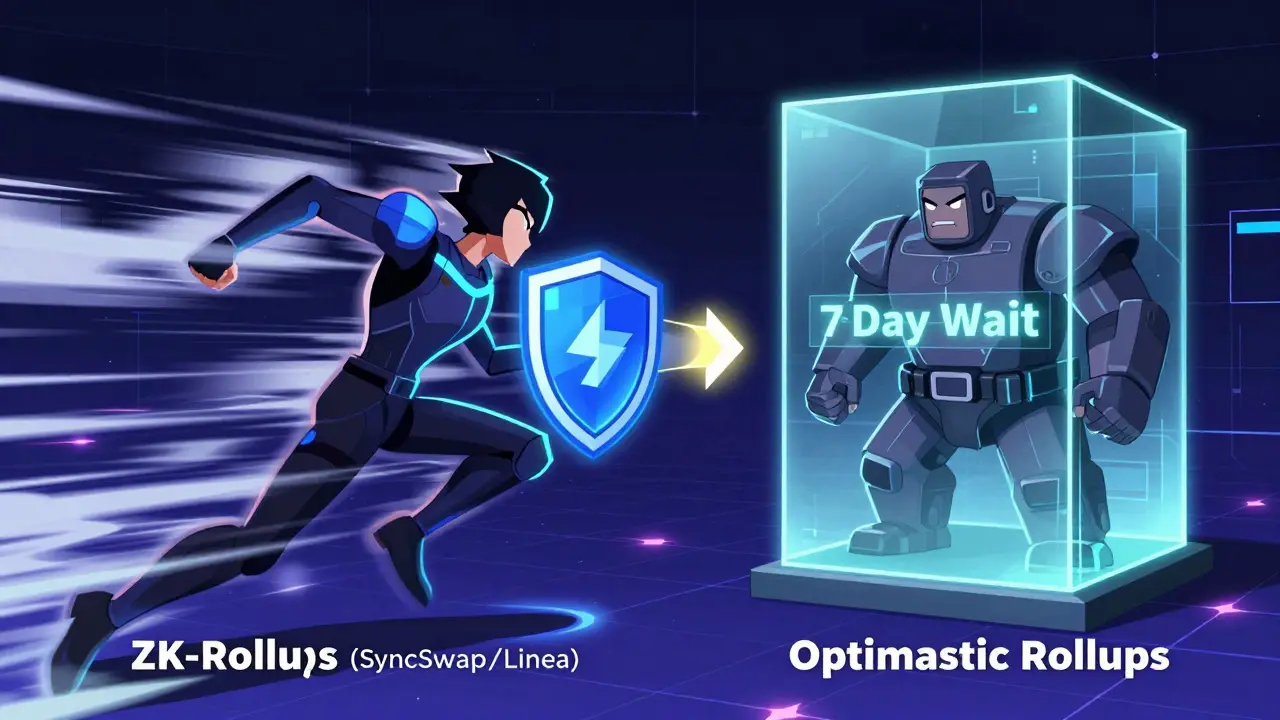
So, if the volume is low, why bother? The answer lies in the technology. SyncSwap leverages the inherent advantages of zero-knowledge rollups. To understand this, compare ZK-rollups to Optimistic rollups like Arbitrum or Optimism.
Optimistic rollups assume transactions are valid unless someone challenges them, which introduces a seven-day withdrawal period for finality. ZK-rollups, including Linea and SyncSwap’s infrastructure, use cryptographic proofs to verify transactions instantly. This means faster finality and potentially lower long-term costs as the network scales.
| Feature | Optimistic Rollups (Arbitrum/Optimism) | ZK-Rollups (Linea/SyncSwap) |
|---|---|---|
| Verification Method | Fraud Proofs (Challenge Period) | Cryptographic Validity Proofs |
| Finality Time | Up to 7 days for withdrawals | Near-instant |
| Security Model | Economic Security (Bond-based) | Mathematical Security |
| User Experience | Standard L2 UX | Enhanced speed, complex backend |
SyncSwap is optimized to take advantage of this speed. Its interface is designed to minimize gas usage during swaps, which is critical when every byte of data matters on a ZK-chain. Even though current activity is low, the architectural foundation is solid. When Linea’s ecosystem matures-and assuming the anticipated LINEA token launch drives adoption-SyncSwap is positioned to be a key beneficiary.
How SyncSwap (Linea) Compares to Competitors
You aren’t forced to use SyncSwap on Linea. In fact, you probably shouldn’t yet. Let’s compare it to the alternatives available on the Linea network.
The biggest competitor is Uniswap, specifically Uniswap V3 deployed on Linea. Uniswap has massive brand recognition and deeper liquidity across almost all networks. Then there’s Aerodrome, which has gained traction on Base but also appears on Linea, offering incentivized liquidity pools. There’s also Ambient and KyberSwap, which provide alternative routing and liquidity solutions.
Currently, Uniswap likely offers better liquidity for standard pairs like ETH/USDC on Linea. However, SyncSwap differentiates itself through its native integration with the ZK-stack. It often features lower fees for specific stablecoin pairs and better composability with other Linea-native dApps. If you are providing liquidity, SyncSwap might offer higher yields via incentives once their farming programs kick into gear, similar to how they dominated zkSync.
Risks and Considerations for Users
Before you connect your wallet, consider the risks. First, the liquidity risk. With near-zero volume, your funds could be stuck if you decide to exit quickly. Second, smart contract risk. While SyncSwap has a proven track record on zkSync, the Linea deployment is newer. Audits are essential, and while the core protocol is secure, new deployments always carry a slight upgrade risk.
Third, there’s the regulatory uncertainty surrounding Linea itself. Consensys has faced scrutiny regarding the potential issuance of a native LINEA token. Until the tokenomics are clear, the entire ecosystem, including exchanges like SyncSwap, operates in a speculative gray area. If the LINEA token launches with favorable distribution, SyncSwap could see a sudden influx of users. If it doesn’t, the platform may remain dormant.

Who Should Use SyncSwap on Linea Right Now?
Honestly? Not many people. If you are a casual trader looking to move large amounts of capital, stick to Uniswap or bridge to a more mature chain like Arbitrum or Base. SyncSwap (Linea) is currently best suited for:
- DeFi Degens: Users who want to farm early liquidity incentives and are willing to accept high impermanent loss and low volume.
- Developers: Those testing integrations with Linea’s ZK-stack and needing a native DEX interface.
- Ecosystem Supporters: Individuals who believe in the long-term vision of Consensys and want to support the infrastructure before it goes mainstream.
For everyone else, it’s a watchlist item. Keep an eye on the TVL growth and daily volume metrics. When those numbers start climbing, that’s your signal to enter.
The Verdict
SyncSwap on Linea is a premium product in an empty store. The technology is impressive, the security model is superior to optimistic rollups, and the team has a history of success on zkSync. But until liquidity arrives, it remains a theoretical playground rather than a practical tool. Wait for the volume to spike, or use it only for small, experimental swaps while you monitor the broader Linea ecosystem developments.
Is SyncSwap safe to use on Linea?
Yes, the protocol is secure and uses advanced ZK technology. However, safety also depends on liquidity. Low liquidity means you might face high slippage or inability to withdraw funds easily. Always audit contracts yourself or rely on reputable aggregators.
Why is the trading volume on SyncSwap (Linea) so low?
The Linea deployment is relatively new compared to zkSync Era. The broader Linea ecosystem is still maturing, and many users prefer established DEXs like Uniswap for deeper liquidity. Additionally, the lack of a native LINEA token utility has slowed mass adoption.
Can I earn rewards by providing liquidity on SyncSwap Linea?
Potentially. SyncSwap often runs incentive programs for liquidity providers. Check their official announcements for any active farming campaigns on Linea. Early providers usually get higher APYs, but they also bear higher risk due to low trading fees.
How does SyncSwap differ from Uniswap on Linea?
SyncSwap is natively built for ZK-rollups, offering optimized gas efficiency and faster settlement times tailored to Linea’s architecture. Uniswap is a generic DEX deployed across many chains. Uniswap typically has more liquidity, while SyncSwap may offer better integration with Linea-specific apps and lower fees for certain pairs.
Will SyncSwap list the LINEA token?
It is highly likely. As the primary DEX in the ecosystem, SyncSwap would be a natural place for the LINEA token to launch or trade. Monitor official channels for announcements regarding token listings.