
Buying a cryptocurrency with a name like daCAT sounds fun until you try to sell it. You connect your wallet, click swap, and suddenly realize that the gas fees cost more than the coins themselves. This is the harsh reality for most holders of micro-cap meme coins in 2026.
daCAT (ticker: DACAT) is an ERC-20 token on the Ethereum blockchain that started as a community experiment in 2023 and launched publicly in January 2024. It bills itself not just as a joke coin, but as a "movement" with original intellectual property. But when we strip away the marketing language, what are you actually holding?
This guide breaks down the technical specs, the brutal math behind its price, and why experts classify it as an extreme-risk asset. If you are looking at this chart and wondering if it’s too late or too risky, keep reading. The data tells a clear story about liquidity, supply, and survival in the meme coin graveyard.
The Origin Story: From GrumpyCatCoin to daCAT
To understand daCAT, you have to look at where it came from. It didn’t appear out of thin air. The project evolved from GrumpyCatCoin, a community that formed on May 4, 2023. According to official project descriptions, this wasn't a fresh launch based on hope, but a "metamorphosis" born from conviction.
In January 2024, the team rebranded and launched the current daCAT token. Their pitch is ambitious: they claim to be building a full-blown IP brand that blends storytelling, humor, art, and music. They want to rewrite culture in the cryptoverse. That is a tall order for a token with a market cap under $2 million.
Most meme coins die because they have no identity beyond a funny picture. daCAT tries to differentiate itself by claiming "soul" and "purpose." However, in the crypto world, purpose doesn't pay the bills-liquidity does. And that is where things get tricky.
Tokenomics: The Math Behind the Micro Price
If you look at the price of daCAT, you might see a number like $0.000000003109 USD. It looks small, right? But the real story is in the supply. Here is the breakdown of the token economics:
- Total Max Supply: 420 trillion tokens
- Circulating Supply: Approximately 403.08 trillion tokens
- Blockchain: Ethereum (ERC-20)
- Contract Address: 0x814A870726EdB7Dfc4798300ae1ce3E5Da0Ac467
A supply of 403 trillion is massive. For context, Bitcoin has a max supply of 21 million. Even high-supply coins like Shiba Inu have quadrillions, but their market caps support those numbers. With a circulating supply of 403 trillion and a market capitalization hovering around $1.91 million (as of mid-2024 data), each individual token is worth fractions of a penny.
This structure creates a psychological trap. New buyers think, "I can buy millions of these for cheap!" But buying millions of a low-value token requires significant capital if you want any meaningful exposure. Conversely, selling even a modest amount can crash the price because there aren't enough buyers waiting on the other side.
| Metric | daCAT (DACAT) | Dogecoin (DOGE) | Shiba Inu (SHIB) |
|---|---|---|---|
| Market Cap | ~$1.91 Million | ~$21.5 Billion | ~$11.2 Billion |
| 24-Hour Volume | $0 - $2,000 | ~$1.5 Billion | ~$1.2 Billion |
| Holders | 1,150 | 2.3 Million+ | 1.2 Million+ |
| Liquidity Status | Extremely Low | High | High |
The gap between daCAT and giants like Dogecoin isn't just big; it's astronomical. Dogecoin processes billions in daily volume. daCAT often processes zero. This disparity defines the risk profile.
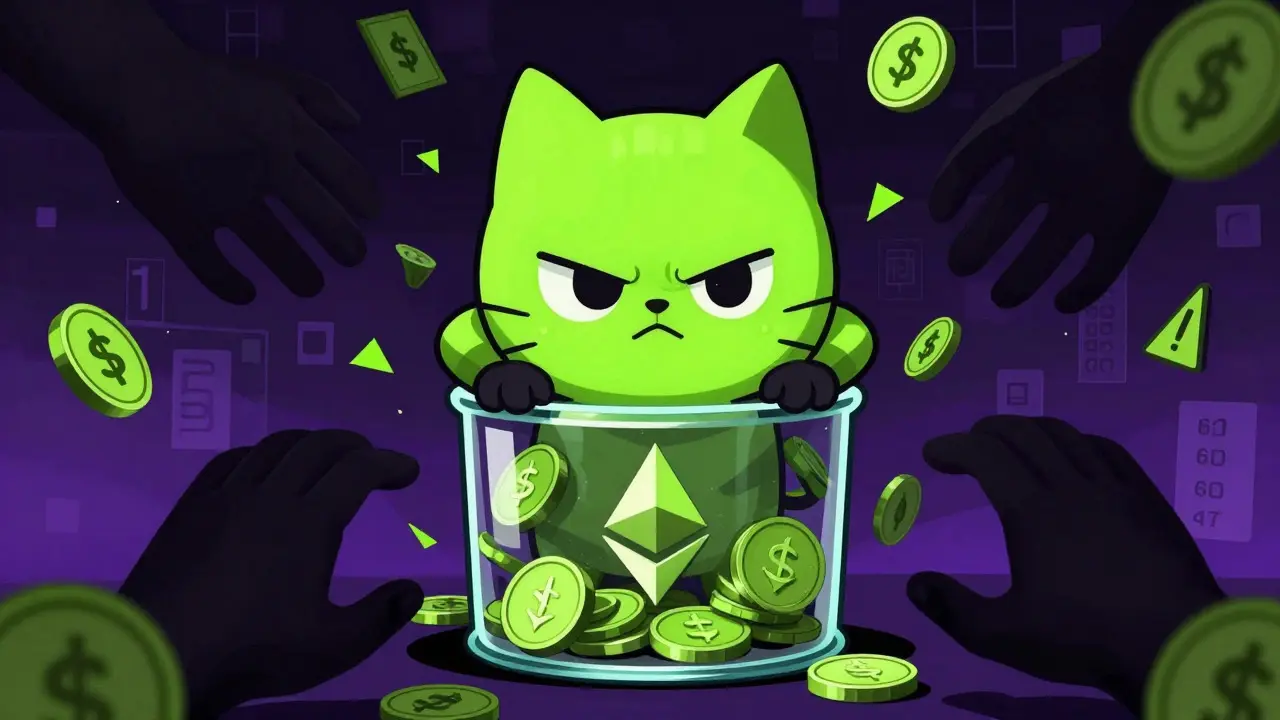
The Liquidity Trap: Why You Can't Sell
Liquidity is the ability to buy or sell an asset without causing a drastic change in its price. For daCAT, liquidity is virtually nonexistent. Most of the trading happens on Uniswap V3, a decentralized exchange on Ethereum.
Here is what that means for you in practice:
- Slippage: Because there are so few tokens in the pool, selling even a small percentage of your holdings pushes the price down sharply. Users report slippage rates over 90%. If you try to sell $100 worth of daCAT, you might only receive $10 after the trade executes.
- Gas Fees: Since it lives on Ethereum, every transaction costs gas. During busy network times, gas fees can exceed $5-$10. If you are trying to move $10 worth of daCAT, the fee eats up half your investment. One user famously complained about paying $50 in gas to buy $10 worth of tokens.
- No Centralized Exchange: daCAT is not listed on Binance, Coinbase, or Kraken. You cannot simply log in and sell. You must use a web3 wallet, manage private keys, and navigate DeFi interfaces. This barrier keeps casual investors out and traps speculative ones in.
Industry analysts point out that tokens with market caps under $5 million and no utility face a 99% chance of becoming worthless within 12 months. daCAT fits this description perfectly. The lack of liquidity means that price charts are often misleading-a single large sale can wipe out days of gains.
Community Sentiment and User Experience
Crypto projects live or die by their communities. daCAT claims to have an "unshakable community," but the data suggests otherwise. As of mid-2024, the project had approximately 1,150 token holders. Compare that to Dogecoin’s 2.3 million. A shrinking holder count is a red flag. Etherscan data showed a decline from 1,254 to 1,150 holders in a single month.
User feedback across platforms like Reddit and CoinGecko is overwhelmingly negative. Common complaints include:
- Failed Transactions: Many users struggle to set the correct slippage tolerance, leading to failed swaps and wasted gas fees.
- Exit Difficulty: Traders describe the experience as "rug pull vibes" because they cannot exit positions without losing most of their value.
- Poor Support: The Telegram group averages only 3-5 messages a day. Response times from moderators average 18 hours, which is slow for a volatile asset.
Sentiment analysis tools show that 87% of mentions on social media were negative in a 30-day period tracked in June 2024. The few positive comments usually come from early believers who say, "I believe in the cat," but these voices are drowned out by frustration over technical hurdles.

Roadmap and Future Viability
Projects need a roadmap to show progress. daCAT’s last major update was in May 2024, announcing an NFT collection "coming soon." As of July 2026, there is little evidence this has materialized into a functional product. The Medium blog, their primary communication channel, has been quiet for months.
Regulatory risks are also rising. The SEC has cracked down on low-liquidity tokens that resemble unregistered securities. While daCAT operates as a standard ERC-20 token, its reliance on community hype rather than utility puts it in a gray area. Experts warn that without merchant adoption or payment integration-which currently stands at zero-the token remains purely speculative.
Long-term viability looks slim. Research firms predict that 75% of tokens with market caps under $5 million will become completely illiquid by early 2025. Given that daCAT has already seen a 56% drop from its all-time high and declining engagement, it is fighting against strong headwinds.
How to Buy daCAT (If You Still Want To)
If you decide to take the risk, here is the step-by-step process. Note that this requires some technical knowledge.
- Set Up a Wallet: Download MetaMask or another Ethereum-compatible wallet. Secure your seed phrase offline.
- Buy ETH: Purchase Ethereum on a centralized exchange like Coinbase or Binance and transfer it to your wallet address. Keep extra ETH for gas fees.
- Go to Uniswap: Navigate to app.uniswap.org and connect your wallet.
- Add the Token: Paste the contract address (
0x814A870726EdB7Dfc4798300ae1ce3E5Da0Ac467) to find daCAT. Do not trust random links; verify the address on CoinMarketCap or CoinGecko. - Adjust Slippage: This is crucial. Set your slippage tolerance to 40-50%. Without this, the transaction will likely fail due to price impact.
- Swap: Confirm the transaction. Be prepared to pay high gas fees depending on network congestion.
Remember, getting the tokens is the easy part. Getting them back out is the challenge.
Is daCAT a scam?
There is no definitive proof that daCAT is a traditional scam where developers stole funds. However, it exhibits many characteristics of high-risk assets: negligible liquidity, declining holder counts, and vague roadmaps. While not necessarily fraudulent, it carries extreme financial risk where losing your entire investment is highly probable due to market dynamics rather than theft.
Where can I buy daCAT?
daCAT is not available on centralized exchanges like Binance or Coinbase. You must buy it on decentralized exchanges (DEXs) like Uniswap V3 using the Ethereum network. You will need an Ethereum wallet and ETH to pay for gas fees.
What is the total supply of daCAT?
The maximum total supply of daCAT is 420 trillion tokens. Approximately 403.08 trillion tokens are currently in circulation. This massive supply contributes to the extremely low price per token.
Why is the slippage so high for daCAT?
Slippage is high because the liquidity pool on Uniswap is very shallow. There are not enough buyer orders to absorb sales without significantly dropping the price. Setting a high slippage tolerance (40-50%) is required to execute trades, but it means you may receive fewer tokens than expected.
Does daCAT have any utility?
Currently, daCAT has no practical utility. It is not accepted by merchants, nor does it offer staking rewards or governance rights. Its value is driven entirely by speculation and community sentiment, making it a pure meme coin.