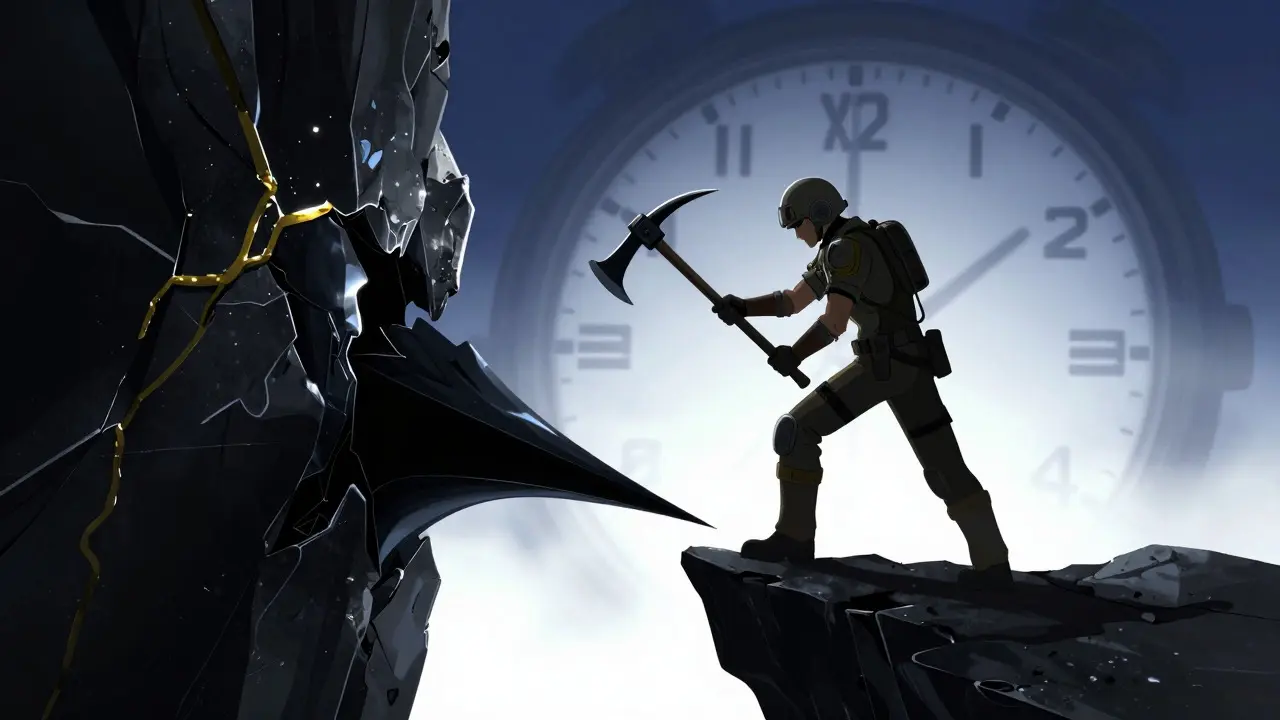
Imagine you are running a gold mine. One day, the veins of gold get thinner and deeper. You have to dig twice as hard, spend twice as much on diesel for your excavators, but the amount of gold you pull out stays exactly the same. That is what happens when mining difficulty rises in the world of cryptocurrency. It is not just a number changing on a dashboard; it is a direct attack on your bottom line.
For anyone involved in Proof-of-Work (PoW) blockchains like Bitcoin, understanding this mechanism is the difference between staying in business and shutting down your rigs. Today, with network difficulty hitting record highs and hardware costs fluctuating, the pressure on miners has never been more intense. Let’s look at how this automatic adjustment system works, why it hurts individual operators, and what the future holds for those trying to earn block rewards in 2026.
The Automatic Brake: How Difficulty Adjusts
To understand the impact, you first need to know the goal. The Bitcoin protocol was designed to produce one new block approximately every 10 minutes. This consistency is crucial for transaction confirmation times and network stability. But what happens if thousands of new miners join the network overnight? They would solve blocks in seconds. Conversely, if half the miners quit, blocks might take an hour to find.
The network fixes this imbalance through an algorithm that recalibrates every 2,016 blocks. Since each block takes about 10 minutes, this cycle occurs roughly every two weeks. The system looks at how long it actually took to mine the previous 2,016 blocks. If it was faster than the target of 20,160 minutes, the difficulty increases. If it was slower, the difficulty decreases.
This creates a feedback loop. When Bitcoin prices rise, new capital floods into mining. The total computational power, known as the Network Hash Rate, spikes. Blocks are found quickly. Two weeks later, the difficulty jumps up to compensate. The result? The reward per unit of effort drops. Your machine is doing the same work, but the network has decided that work is now harder to achieve.
The Profitability Squeeze
The relationship between difficulty and profit is strictly inverse. As difficulty goes up, your probability of finding the next valid block goes down. Since the block reward is fixed (currently 3.125 BTC following the 2024 halving), the pie does not get bigger. It just gets sliced into smaller pieces for more participants.
Consider the math. If difficulty doubles, you need twice the hash power to maintain the same share of rewards. For many miners, they cannot simply "double" their operation. They are constrained by electricity contracts, physical space, and cooling capacity. So, their revenue cuts in half while their operational costs remain flat.
- Electricity Costs: These are usually the largest expense. If your revenue drops due to higher difficulty, your margin shrinks immediately.
- Hardware Depreciation: ASIC miners lose value over time. Higher difficulty accelerates the point where older models become unprofitable.
- Cooling and Maintenance: These fixed costs do not scale down when your earnings drop.
In 2026, with efficiency standards rising, any miner operating equipment older than three generations is likely bleeding money during high-difficulty periods. The break-even point moves constantly, forcing operators to treat mining less like passive income and more like a volatile trading position.
The Hardware Arms Race
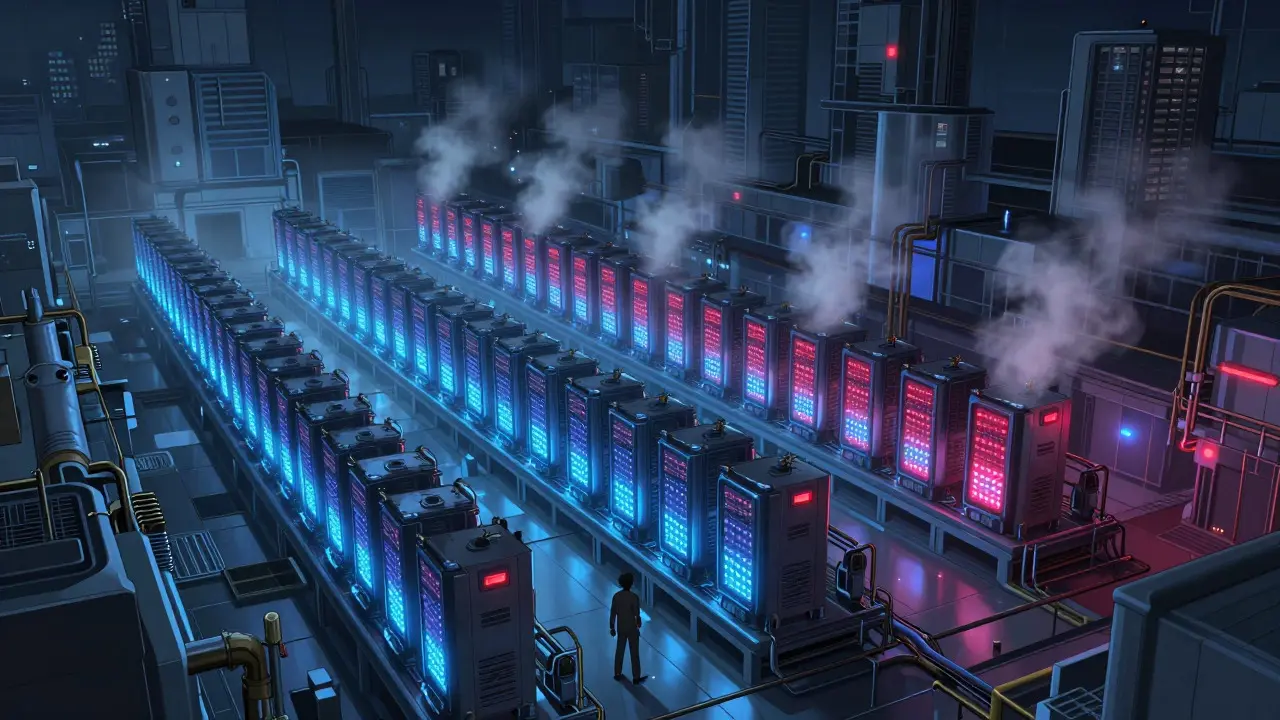
You might think buying better hardware solves the problem. In theory, yes. In practice, it triggers a new round of difficulty adjustments. When efficient Application-Specific Integrated Circuits (ASICs) hit the market, early adopters see a massive boost in hash rate. They mine more blocks. But because the network hash rate increases globally, the difficulty adjusts upward within two weeks.
This neutralizes the advantage of the new hardware for the entire network. The new machines are more efficient, sure, but the puzzle has become harder. This creates an endless technological arms race. Miners must continually upgrade to stay competitive, leading to rapid obsolescence of existing fleets.
| Hardware Generation | Efficiency (J/TH) | Performance at Low Difficulty | Performance at High Difficulty |
|---|---|---|---|
| Legacy (e.g., Antminer S9 era) | >100 J/TH | Marginal Profit | Unprofitable / Shutdown |
| Mid-Tier (Current Standard) | ~20-30 J/TH | Good Profit | Breakeven / Low Margin |
| Cutting Edge (2026 Models) | <15 J/TH | High Profit | Sustainable Profit |
This dynamic favors large industrial farms that can absorb the cost of frequent upgrades. Small-scale miners often find themselves stuck with depreciating assets that no longer generate enough revenue to cover electricity bills after a difficulty spike.
Centralization vs. Decentralization
One of the most significant side effects of rising difficulty is the consolidation of mining power. Large mining operations benefit from economies of scale. They negotiate bulk electricity rates, build specialized cooling infrastructure, and have the capital to deploy the latest ASICs immediately.
Smaller miners or hobbyists face a disproportionate impact. Their fixed costs (rent, internet, basic cooling) do not decrease when difficulty rises. Consequently, many small operators exit the market during bear markets or after major difficulty hikes. This leads to a concentration of hash rate among a few large entities.
While high difficulty makes the network more secure against attacks (requiring immense resources to compromise), excessive centralization poses a different risk. If a handful of pools control the majority of the hash rate, the decentralized ethos of the blockchain is compromised. This tension between security (high difficulty) and decentralization (many small miners) is a core challenge for PoW networks in 2026.
Strategic Survival in 2026
So, how do miners survive this environment? Success requires moving beyond simple "plug and play" thinking. Professional operations use sophisticated forecasting tools. They analyze hash rate trends, predict upcoming difficulty adjustments, and adjust their strategies accordingly.
Key strategies include:
- Energy Arbitrage: Using variable electricity pricing. Some miners shut down during peak price hours and run only when energy is cheap or subsidized.
- Strategic Halting: During extreme difficulty spikes combined with low crypto prices, it may be cheaper to turn off rigs and pay maintenance costs than to burn expensive electricity for negligible returns.
- Diversification: Participating in multiple PoW networks or offering hash rate leasing services to hedge against single-coin volatility.
Tools like Minerstat or similar analytics platforms provide real-time data on difficulty trajectories. Ignoring these metrics is akin to driving without a speedometer. You need to know how fast the road conditions are changing to adjust your speed (hash allocation) appropriately.
Future Outlook: Beyond Proof-of-Work?
The environmental scrutiny surrounding PoW mining continues to grow. While Bitcoin remains dominant, the pressure on its energy consumption drives innovation. We are seeing increased interest in hybrid consensus mechanisms and Layer-2 solutions that reduce the load on the main chain.
However, for pure PoW coins, the trend is clear: difficulty will continue to rise as technology improves and adoption grows. The quadrennial halving events further squeeze margins by reducing block rewards. This suggests a future where mining is exclusively an industrial enterprise, requiring significant capital, engineering expertise, and access to ultra-low-cost energy. The era of the bedroom miner is effectively over, replaced by data-center-scale operations.
How often does Bitcoin mining difficulty adjust?
Bitcoin mining difficulty adjusts automatically every 2,016 blocks. Given that a new block is mined approximately every 10 minutes, this means the difficulty recalibration happens roughly every two weeks.
Does higher mining difficulty mean the network is more secure?
Yes. Higher difficulty implies a higher total network hash rate. To attack the network (such as attempting a 51% attack), an adversary would need to match or exceed this massive computational power, making such attacks prohibitively expensive and difficult.
Can I still mine profitably with old hardware in 2026?
It is highly unlikely. Older ASICs are significantly less energy-efficient. With current difficulty levels and electricity costs, older hardware typically consumes more power than the value of the Bitcoin it mines, resulting in a net loss.
What happens to difficulty if many miners shut down?
If a significant number of miners shut down, the network hash rate drops. Blocks will take longer than 10 minutes to mine. At the next adjustment period (after 2,016 blocks), the difficulty will decrease to bring the block time back to the 10-minute target.
How does the Bitcoin halving affect mining difficulty?
The halving reduces the block reward, which can cause less profitable miners to shut down. This temporarily lowers the hash rate and may lead to a subsequent decrease in difficulty. However, if prices rise and attract new miners, difficulty will climb again regardless of the lower reward.