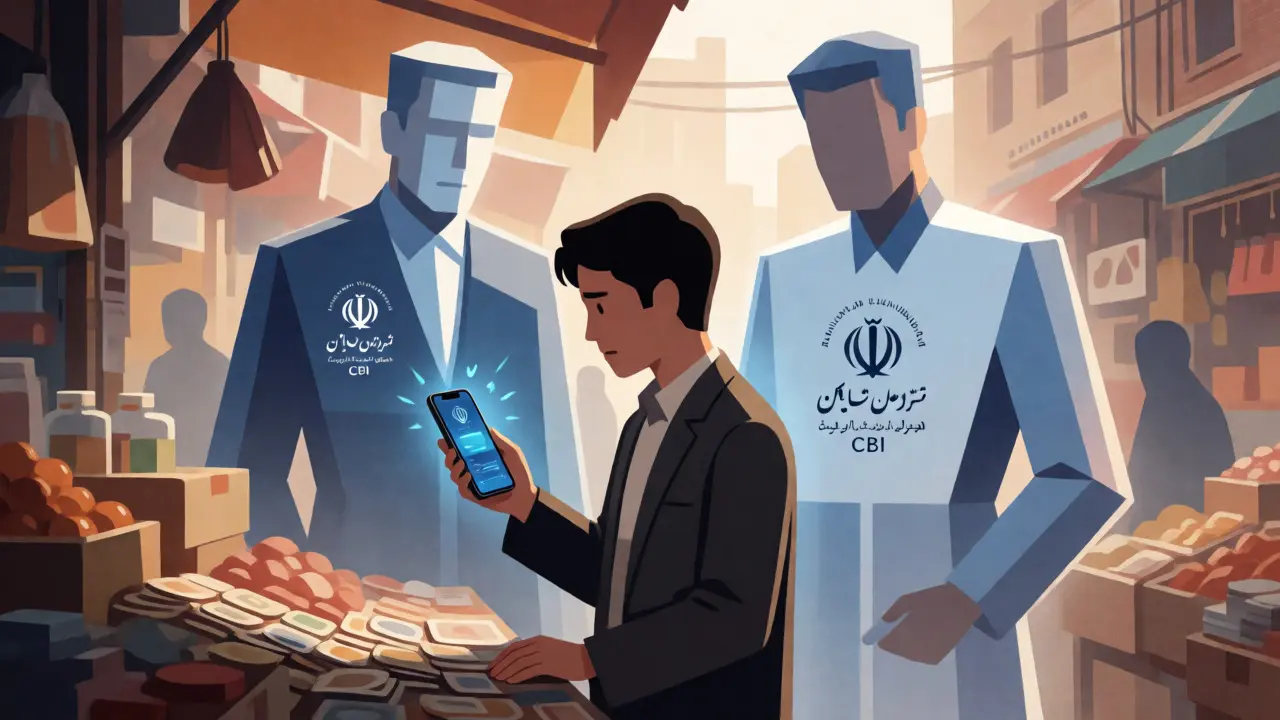
Imagine trying to buy a loaf of bread with a currency that loses value daily, while the government blocks the digital alternative you use to save your wealth. That’s the reality for many Iranians navigating the cryptocurrency landscape today. The short answer to "is crypto regulated in Iran" is yes-but it’s less about freedom and more about control. As of late 2025, the regulatory environment has shifted from ambiguous tolerance to strict state oversight, driven by sanctions, energy crises, and geopolitical pressure.
If you’re an investor, trader, or just curious about how digital assets function under one of the world’s most complex economic regimes, understanding these rules is critical. The Central Bank of Iran (CBI) has tightened its grip significantly since January 2025, creating a closed-loop system where every transaction leaves a digital footprint accessible to authorities. This article breaks down exactly what is allowed, what is banned, and how ordinary citizens are adapting to survive financially.
The Shift from Tolerance to Tight Control
For years, Iran’s approach to crypto was paradoxical. On one hand, the government recognized its utility for bypassing international banking sanctions. On the other, they feared capital flight and money laundering. This tension peaked in late 2024 when the CBI blocked all direct cryptocurrency-to-rial payment channels on December 27, effectively cutting off the main entry point for local users.
By January 2025, President Masoud Pezeshkian formalized this shift. A new directive established the CBI as the sole authority for licensing and oversight. Unlike jurisdictions like Switzerland or Singapore, where regulation aims to foster innovation, Iran’s framework prioritizes surveillance and containment. The goal isn’t to kill the market-trading volumes remain substantial at roughly $143 million daily-but to ensure no coin moves without the state knowing about it.
| Date | Action Taken | Impact on Users |
|---|---|---|
| Dec 2024 | CBI blocks crypto-to-rial payment channels | Immediate liquidity crunch; forced migration to P2P markets |
| Jan 2025 | Pezeshkian directive formalizes CBI oversight | Mandatory licensing for exchanges; API integration required |
| Feb 2025 | Global ban on crypto advertising | Reduced public awareness; harder for new users to onboard |
| Jul 2025 | Tether freezes 42 Iranian-linked addresses | Massive shift from USDT to DAI stablecoins |
| Sep 2025 | Stablecoin holding caps imposed ($10k limit) | Hedging against inflation becomes difficult for large holders |
What You Can and Cannot Do With Crypto
The rules are specific, and breaking them can lead to frozen accounts or fines. Here’s the breakdown of current permissions:
- Trading is legal but restricted: You can trade cryptocurrencies, but only through government-approved platforms. These platforms must integrate with the CBI’s API, ensuring full transparency of your transactions.
- Mining requires a license: Bitcoin mining is permitted if you have a permit from the Ministry of Industry, Mine and Trade. However, miners are legally required to sell their mined coins directly back to the CBI. This prevents them from freely trading profits on the open market.
- Foreign crypto for domestic payments is banned: You cannot pay for groceries or services in Tehran using Bitcoin or Ethereum. Only the national rial is legal tender for domestic transactions.
- International transfers are monitored: Using crypto to send money abroad is common, but it now flows through designated accounts approved by the central bank. This creates a "closed-loop" system designed to track capital outflows.
A major pain point for users is the advertising ban implemented in February 2025. It is illegal to advertise crypto services in physical spaces or on digital platforms within Iran. This makes it harder for legitimate exchanges to compete with informal peer-to-peer (P2P) networks, which often operate in the shadows.
The Stablecoin Crackdown: Why Your USDT Might Be Frozen
If you hold stablecoins, pay attention. In July 2025, Tether froze 42 addresses linked to Iranian entities, citing compliance concerns. More than half of these were connected to Nobitex, Iran’s largest crypto exchange. This event triggered a panic and a rapid strategic pivot among Iranian traders.
To prevent further freezes and comply with new September 2025 regulations, many users switched from USDT (Tether) to DAI, a decentralized stablecoin. The CBI responded by imposing strict caps on stablecoin holdings. Individuals and businesses are now limited to purchasing a maximum of $5,000 worth of stablecoins annually, with a total holding balance cap of $10,000.
This restriction severely impacts the ability to hedge against the declining rial. For someone trying to protect their savings from inflation, a $10,000 cap is negligible. Consequently, we’ve seen a surge in demand for privacy-focused networks and decentralized exchanges (DEXs), where users can bypass some of these centralized controls, albeit with higher fees and technical complexity.

Mining: Energy Crisis Meets State Control
Iran has historically been a hub for cheap energy, making it attractive for Bitcoin mining. But the story has changed. Rolling power outages in late 2024 highlighted the strain unauthorized mining placed on the grid. The government cracked down hard, shutting down thousands of illegal rigs.
Licensed miners face a different set of challenges. They pay high energy tariffs compared to residential rates, and they must sell their output to the CBI at rates that don’t always reflect global market prices. This has driven much of the mining activity underground or into neighboring countries. If you’re looking to start a mining operation in Iran today, the financial sustainability is questionable unless you have access to subsidized industrial power and strong political connections.
Taxation and the New Economic Reality
Gone are the days of tax-free gains. In August 2025, Iran enacted the Law on Taxation of Speculation and Profiteering. For the first time, capital gains from cryptocurrency trading are subject to tax. This move signals that Tehran views crypto not as a fringe experiment, but as a mainstream asset class comparable to gold or real estate.
The Ministry of Economic Affairs and Finance plans to integrate crypto tax collection into existing financial reporting systems by mid-2026. Expect stricter enforcement and audits. If you’re a frequent trader, keeping meticulous records of every transaction via your licensed exchange is no longer optional-it’s essential for survival.

How Ordinary Iranians Are Adapting
Despite the hurdles, the Iranian crypto community remains resilient. With an estimated market size between $30 billion and $50 billion, digital assets play a crucial role in household finance. About 60% of trading volume still occurs through unofficial channels, according to Chainalysis estimates from September 2025. People use VPNs to access foreign exchanges like Binance or Kraken, though they risk account closures due to KYC requirements.
User experiences vary widely. Some appreciate the stability that regulated exchanges offer, noting that while fees are 3-5% higher, arbitrary account freezes are less common. Others complain that the $10,000 stablecoin limit makes it impossible to properly hedge during periods of extreme rial volatility. The consensus? Crypto is still useful, but it’s becoming a tool for the wealthy and tech-savvy rather than the general public.
Looking Ahead: Sanctions and Sovereignty
The future of crypto in Iran is tightly coupled with geopolitics. The reinstatement of UN sanctions via the "snapback mechanism" in September 2025 directly influenced the latest round of restrictions. If nuclear deal negotiations resume, the need for crypto as a sanction-bypass tool could diminish, potentially leading to looser regulations. Conversely, if tensions escalate, expect even tighter controls and possible bans on certain types of transactions.
The CBI also plans to expand its own digital currency, the "Rial Currency," beyond remittances to retail transactions by mid-2026. This state-backed CBDC aims to compete directly with decentralized alternatives, offering a convenient but heavily surveilled option for everyday payments.
Is Bitcoin legal in Iran?
Yes, owning and trading Bitcoin is legal, but it is highly regulated. You cannot use it for domestic payments, and mining requires a license. All transactions must go through government-approved channels to ensure compliance with anti-money laundering laws.
Can I use Tether (USDT) in Iran?
You can hold and trade Tether, but there are strict limits. Since September 2025, individuals are capped at holding $10,000 worth of stablecoins. Additionally, following Tether's freeze of Iranian addresses in July 2025, many users have switched to DAI to avoid similar risks.
Do I have to pay taxes on crypto profits in Iran?
Yes. As of August 2025, capital gains from cryptocurrency trading are taxed under the Law on Taxation of Speculation and Profiteering. The government plans to fully integrate crypto tax reporting into standard financial systems by 2026.
Why did the Central Bank block crypto-to-rial payments?
The CBI blocked these channels in December 2024 to curb capital flight and increase visibility over money flows. By forcing transactions through licensed intermediaries, the state can monitor and control the movement of wealth more effectively.
Is mining profitable in Iran right now?
It is challenging. Licensed miners must sell their coins to the CBI and pay high energy tariffs. Unauthorized mining faces crackdowns and power outages. Most small-scale operations have shut down or moved abroad.