
Most blockchains force you to choose between speed and privacy. You can have fast transactions like on Ethereum, but your data is public. Or you can use a private chain, but it’s slow and centralized. Partisia Blockchain tries to break this rule.
Partisia Blockchain is a privacy-focused platform that uses advanced cryptography to keep data private even while it’s being processed. It doesn’t just hide data when it’s stored; it hides the calculation itself. This makes it useful for industries like healthcare and finance where sharing data is necessary, but revealing details is risky. The native currency of this network is the MPC token.
What Makes Partisia Different?
The core technology behind Partisia is Multiparty Computation (MPC). In simple terms, MPC allows multiple parties to compute a result together without revealing their individual inputs. Imagine three companies wanting to know the average salary in their industry without showing each other their exact payrolls. MPC lets them do exactly that. The math works out, but the raw data stays secret.
This differs from standard encryption, which only protects data at rest or in transit. Once data is decrypted for processing, it’s vulnerable. MPC keeps the data encrypted during the entire computation process. Partisia combines this with Zero-Knowledge Proofs (ZKPs), which allow one party to prove to another that a statement is true without revealing any underlying information. Together, these technologies create a system where you can verify transactions and computations without exposing sensitive details.
How the MPC Token Works
The MPC token is the fuel for the Partisia network. It has a hard cap of one billion tokens, meaning no more will ever be created. This fixed supply helps prevent inflation and creates scarcity over time. But its main job isn’t just speculation; it’s functional. You need MPC tokens to participate in securing the network.
Unlike many blockchains where anyone can validate blocks with minimal effort, Partisia uses a tiered staking model. Your role depends on how many tokens you stake:
- Baker Nodes: Require a minimum stake of 25,000 MPC. These nodes sign and produce blocks.
- ZK Nodes: Require a minimum stake of 100,000 MPC. These handle complex zero-knowledge computations in addition to block production.
- Cross-chain (BYOC) Nodes: Require a minimum stake of 250,000 MPC. These act as oracles, tracking deposits and withdrawals from other networks.
This structure ensures that the most resource-intensive tasks are handled by those with significant skin in the game, enhancing network security.
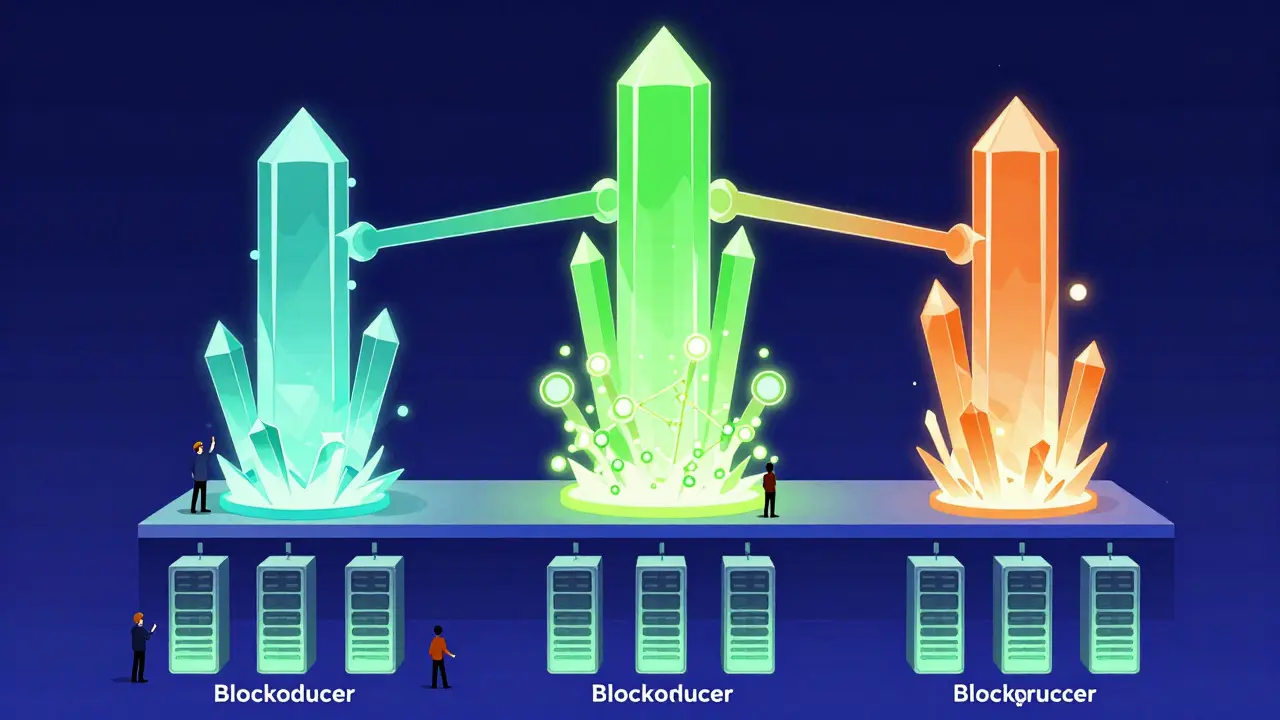
Consensus: Eager FastTrack
Partisia doesn’t use traditional Proof-of-Work or standard Proof-of-Stake. Instead, it employs a consensus mechanism called Eager FastTrack. This model operates on a “trust but verify” principle. Transactions are added to the ledger immediately after signing. A peer-to-peer network aggregates signatures, and once a node receives signatures from at least two-thirds of all nodes, it registers a proof-of-justification (PoJ).
This approach aims for lightning-fast finality. While traditional blockchains might take minutes to confirm a transaction, Partisia’s design prioritizes immediate execution. This speed is crucial for real-world applications like financial trading or supply chain tracking, where delays cost money.
Interoperability via BYOC
One of the biggest hurdles in crypto is interoperability-making different blockchains talk to each other. Partisia addresses this with a feature called Bring Your Own Coin (BYOC). This is a collateralized token bridge that allows users to transact using assets from other chains, such as Ethereum or stablecoins, directly within the Partisia ecosystem.
Here’s how it works: When you bring an external asset onto Partisia, it gets locked in a smart contract on the original chain. In return, a mirrored version is issued on Partisia. This follows a double-bookkeeping principle, ensuring that the total value remains balanced across both networks. To secure this bridge, a select group of oracle nodes, known as the Small Oracle, holds sufficient MPC tokens as collateral. If fraud occurs, any MPC holder can stake tokens to initiate a dispute, protecting the integrity of the bridge.
Real-World Applications: MOCCA
Technology is only useful if people use it. One notable application developed by the Partisia team is MOCCA (MPC On-Chain Custody Advanced solution). Unveiled at the World Economic Forum in Davos in January 2024, MOCCA is a cross-chain custody system designed for institutions. It uses MPC to secure assets on their native chains while allowing programmable rules via smart contracts.
For example, a bank could use MOCCA to manage digital assets with configurable privacy levels. They can set conditions for specific transaction categories or integrate NFTs with special permissions. This demonstrates how MPC technology moves beyond theoretical cryptography into practical institutional tools, addressing regulatory compliance and security needs simultaneously.

Tokenomics and Distribution
Understanding the supply dynamics is key to evaluating the MPC token. With a maximum supply of 1 billion tokens, the distribution is structured to incentivize long-term holding and network participation. Presale participants and team allocations follow a detailed unlocking schedule. This prevents massive dumps on the market early on, promoting stability. The gradual release aligns incentives so that early backers remain committed to the network’s success rather than just cashing out quickly.
| Node Type | Minimum Stake (MPC) | Primary Function |
|---|---|---|
| Baker Node | 25,000 | Signs and produces blocks |
| ZK Node | 100,000 | Performs Zero-Knowledge computations |
| Cross-chain (BYOC) Node | 250,000 | Acts as oracle for cross-chain transfers |
Why Privacy Matters in 2026
As regulations tighten globally, the ability to share data without exposing it becomes a competitive advantage. Healthcare providers need to share patient records for research without violating HIPAA-style privacy laws. Financial firms need to audit transactions without revealing client identities to competitors. Partisia’s architecture solves these problems by making privacy a default feature, not an add-on. The integration of ZK smart contracts means developers can build applications where privacy is baked into the code logic, reducing the risk of human error or malicious leaks.
Frequently Asked Questions
Is the MPC token deflationary?
The MPC token has a hard cap of one billion tokens, making it non-inflationary in terms of new issuance. Whether it becomes deflationary depends on burn mechanisms and demand for staking rewards versus selling pressure. Currently, the primary driver of value is utility and staking demand rather than active burning.
Can I use Ethereum on Partisia Blockchain?
Yes, through the Bring Your Own Coin (BYOC) bridge. You can lock your Ethereum on the Ethereum mainnet and receive a mirrored version on Partisia. This allows you to pay fees or interact with dApps on Partisia using your existing crypto assets.
What is the minimum stake to run a node?
The minimum stake varies by node type. Baker nodes require 25,000 MPC, ZK nodes require 100,000 MPC, and Cross-chain nodes require 250,000 MPC. Each organization can typically operate only one node per category to ensure decentralization.
How does MPC differ from standard encryption?
Standard encryption protects data only when it is stored or transmitted. Once decrypted for processing, the data is exposed. Multiparty Computation (MPC) keeps data encrypted during the entire computation process, allowing calculations to be performed without revealing the input values.
Who developed Partisia Blockchain?
Partisia Blockchain was developed by a team focused on applied cryptography, particularly in the field of multiparty computation. The project gained significant attention with the launch of MOCCA, their institutional custody solution, presented at the World Economic Forum in 2024.