
Imagine trying to send money to a friend abroad, but every bank account you touch gets frozen within hours. That is the reality for many people in China today. In September 2021, the People's Bank of China (PBOC) slammed the door on cryptocurrency. They banned mining, shut down exchanges, and labeled crypto transactions as illegal financial activities. On paper, crypto should be dead there. In practice? It’s alive, hiding in plain sight through peer-to-peer (P2P) trading.
You might wonder how this works if the government is watching so closely. The answer lies in a legal loophole that has kept the underground market breathing. While buying and selling through formal exchanges is banned, Chinese courts have consistently ruled that citizens still own their crypto as "virtual property." This distinction allows individuals to trade directly with each other, bypassing centralized platforms entirely. It’s a high-stakes game of cat and mouse, where traders use encrypted apps, stablecoins, and split transactions to move value across borders without triggering alarms.
The Legal Gray Area: Ownership vs. Transaction
To understand why P2P trading persists, you first need to grasp the legal nuance that keeps it going. When the PBOC issued its comprehensive ban in 2021, they targeted intermediaries-exchanges like Binance or Huobi-and mining operations. They did not explicitly confiscate the coins sitting in your wallet. Court rulings from major cities like Shenzhen, Hangzhou, and Shanghai dating back to 2018 established that cryptocurrencies are protected as virtual property under civil law.
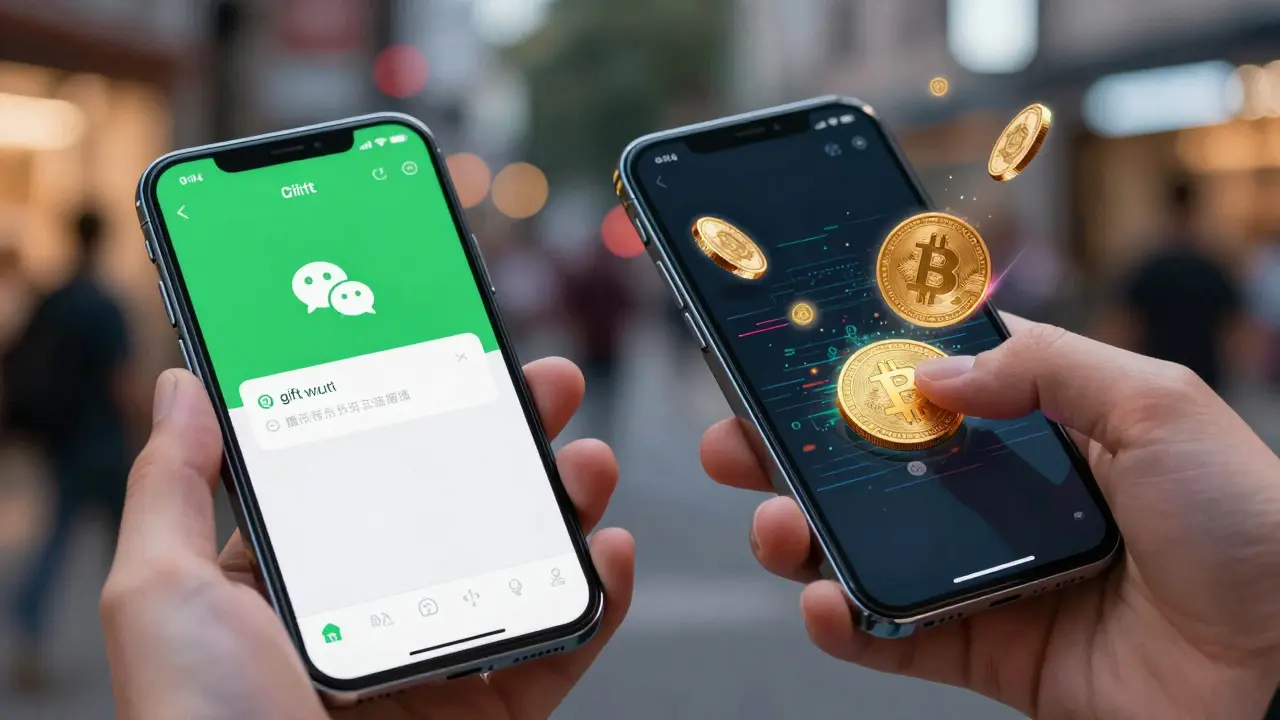
This creates a strange paradox. You can legally own Bitcoin, but you cannot legally buy it from a registered business. So, what do people do? They go direct. Peer-to-peer trading removes the middleman. Instead of an exchange holding your funds, you transfer cash via Alipay or WeChat Pay to another individual, who then releases crypto from their personal wallet to yours. Because no corporate entity is facilitating the trade, regulators find it much harder to classify these interactions as illegal financial services. It’s essentially barter, just with digital assets instead of chickens or grain.
| Activity | Pre-2021 Status | Post-2021 Status |
|---|---|---|
| Crypto Mining | Licensed/Regulated | Banned nationwide |
| Centralized Exchanges | Operational (with restrictions) | Shut down or forced out |
| Personal Ownership | Protected as property | Still protected as property |
| P2P Trading | Gray area | Tolerated but monitored heavily |
The risk isn’t necessarily jail time for simple ownership; it’s the collateral damage. If the state deems your transaction suspicious, they don’t arrest you-they freeze your bank account. And in China, your bank account is your life. It pays for groceries, rent, and transport. Losing access to it is a powerful deterrent, yet thousands still take the risk daily.
How Traders Actually Move Money Today
If you were to sit down with a seasoned trader in Shanghai today, they wouldn’t talk about buying Bitcoin on an app. They would talk about operational security. The ecosystem has evolved into a sophisticated network of trust-based interactions. Most trading happens on international platforms like Paxful, LocalBitcoins, or decentralized exchanges like Bisq, accessed via Virtual Private Networks (VPNs) to bypass the Great Firewall.
The currency of choice has shifted dramatically. Volatile assets like Bitcoin are less popular for daily P2P trades because the price swings make pricing difficult. Instead, traders flock to stablecoins, particularly USDT (Tether). Tether holds its value against the US dollar, making it perfect for preserving wealth or moving capital out of the country without worrying about market crashes during the transfer window.
Here is how a typical transaction looks in 2026:
- Find a Counterparty: Users browse P2P platforms for sellers offering competitive rates. They look for merchants with high completion rates and long histories.
- Negotiate Terms: Communication often moves off-platform to encrypted messaging apps like Telegram or Signal to avoid keyword detection by platform algorithms.
- Execute Payment: The buyer sends fiat currency (RMB) via Alipay or WeChat Pay. Crucially, they avoid using keywords like "crypto" or "Bitcoin" in the payment memo. Many use Alipay’s "friend transfer" feature, which appears as a casual gift rather than a commercial transaction.
- Release Assets: Once the seller confirms receipt of funds, they release the USDT from their escrowed wallet to the buyer’s address.
Speed is essential. Traders know that banking systems monitor for unusual patterns. A large transfer at an odd hour can trigger an automatic flag. To combat this, users employ "transaction splitting." If you need to move $50,000 worth of crypto, you don’t do it in one go. You break it into ten $5,000 transactions across different days or even different bank accounts. This stays below the threshold that triggers immediate manual review by banks.
The Risks: Frozen Accounts and Scams
Let’s be clear: this is not a safe environment. The convenience comes with severe risks. The most common threat is the "frozen account." According to surveys from 2022, nearly 39% of P2P traders experienced a temporary freeze on their bank cards. This usually happens when a counterparty receives "dirty money"-funds linked to fraud or gambling elsewhere. When the victim of that original fraud reports the loss, the police trace the money flow. If your account touched those funds, even indirectly, the bank freezes it pending investigation.
Then there are the scams. Without a central authority to dispute claims, fraud is rampant. One documented case involved a user losing $25,000 after a seller sent fake screenshots of a bank transfer. By the time the buyer realized the money wasn’t actually in the account, the seller had vanished. Trustpilot ratings for major P2P platforms dropped significantly between 2021 and 2022, reflecting the rise in fraudulent incidents involving Chinese users.
To mitigate these risks, the community has developed its own rules. New users are advised to start small-transactions under 50,000 RMB are safer. Experienced traders use "burner phones" dedicated solely to crypto communication and maintain separate bank accounts that hold only disposable income. Some even use trusted intermediaries, known as "bridges," who hold funds temporarily to verify legitimacy before finalizing the trade. These bridges charge a premium, pushing average transaction fees from less than 1% pre-ban to 3-5% today.
Why Demand Remains High Despite the Ban
If the risks are this high, why do people keep doing it? The short answer is capital flight. China maintains strict capital controls, limiting how much money citizens can move overseas. For businesses importing goods, families sending remittances abroad, or investors diversifying portfolios, these limits are frustrating. Crypto offers a way around them.
Data from Chainalysis shows that despite the ban, China still accounted for roughly 4-7% of global P2P crypto volume in recent years. That’s significant. The demand is driven by necessity, not speculation. Urban professionals aged 25 to 45, particularly those with international connections, form the core user base. They see crypto not as a gamble, but as a tool for financial sovereignty.
Furthermore, the cultural familiarity with digital payments makes adoption easier. With smartphone penetration exceeding 90%, Chinese users are already comfortable managing finances digitally. Transitioning to P2P crypto trading requires learning new tools, but the underlying behavior-sending money instantly via phone-is second nature.
The Future: Can the Government Stop It?
The Chinese government is not idle. In early 2023, authorities issued new guidelines targeting "any form of decentralized transaction." They are investing heavily in blockchain surveillance technology to track wallet addresses and link them to real-world identities. Banks are getting smarter at detecting P2P patterns, leading to more frequent freezes.
Yet, experts argue that total elimination is impossible. Dr. Camilla Russo, a blockchain specialist, noted that China’s ban proved that decentralized networks cannot be fully extinguished by nation-state intervention. As long as there is a desire to move value across borders, and as long as the internet remains accessible, P2P trading will adapt. Traders are already experimenting with "crypto barter" systems, exchanging digital assets for physical goods like gold or electronics, which are then sold abroad. Others are using Non-Fungible Tokens (NFTs) as vehicles for value transfer.
The International Monetary Fund concluded in 2022 that while China successfully killed formal crypto markets, the persistence of P2P trading highlights a fundamental challenge for all nations: regulating borderless technology. The ban hasn’t stopped the flow; it has just pushed it deeper underground, making it harder to measure but no less active.
Is owning cryptocurrency illegal in China in 2026?
No, owning cryptocurrency is not strictly illegal. Chinese courts recognize crypto as "virtual property." However, trading it through formal financial institutions is banned, and engaging in P2P trading carries significant regulatory risks, including potential bank account freezes.
What is the safest way to do P2P trading in China?
There is no perfectly safe method, but risks can be reduced by using reputable P2P platforms, verifying counterparties thoroughly, keeping transactions small (under 50,000 RMB), avoiding crypto-related keywords in payment memos, and using separate bank accounts for these activities.
Why do traders prefer USDT over Bitcoin?
Traders prefer USDT (Tether) because it is a stablecoin pegged to the US dollar. This eliminates volatility risk during the transaction process, making it ideal for preserving value and moving capital across borders without worrying about price swings.
Can my bank account be frozen for P2P trading?
Yes, this is a common risk. If you receive money from a source linked to fraud or if your transaction pattern triggers anti-money laundering alerts, banks may freeze your account pending investigation. This can last from days to months.
Do I need a VPN to trade crypto in China?
Yes, most international P2P platforms and crypto websites are blocked by the Great Firewall. A reliable VPN is necessary to access these services, though using a VPN itself can carry minor legal risks depending on current enforcement levels.
Heather Austin
July 20, 2026 AT 13:17the op is spot on about the usdt preference. volatility kills margins in p2p. i've seen too many trades fail because btc dipped 2% during the escrow window. tether is boring but it works. also splitting transactions is key. banks have algos that flag anything over a certain threshold instantly. keep it small and frequent.
Tawny Holmes
July 21, 2026 AT 03:46It's not a loophole. It's negligence.
Jessie Smith
July 22, 2026 AT 18:19one must consider the ontological status of the frozen account. is it merely a financial inconvenience or a metaphysical purgatory for the modern chinese citizen? the state does not arrest the body; it arrests the soul via alipay. this is kafkaesque bureaucracy weaponized through blockchain surveillance. the 'virtual property' ruling is a cruel joke, a spectral ownership with no material substance. we are trading ghosts for other ghosts while the dragon watches from the cloud. the ban did not stop the flow; it merely turned the river into a sewer. dark, murky, and full of unseen currents. yet life persists. the hydra grows two heads for every one cut off. decentralization is not just tech; it is an act of rebellion against the centralized ego of the nation-state. fascinatingly tragic.
Lisa Chong
July 23, 2026 AT 12:49They want you to think its freedom but its actually a trap!!! The government allows P2P so they can track EVERYTHING. Its all part of the great reset. They freeze your account when they need you to behave. It is not about money, it is about control. You are being watched by the algorithmic overlords. Do not trust the digital ledger. Trust only gold and silence. The system is rigged from day one. Wake up sheeple!!!
Tuan Nguyen
July 23, 2026 AT 21:48The inefficiency of this entire ecosystem is staggering. Relying on 'trust-based interactions' in a market defined by adversarial conditions is amateur hour. The transaction costs alone-3-5% fees plus the opportunity cost of frozen capital-render this method obsolete for any serious economic actor. It is a parasite feeding on the desperation of those who refuse to adapt to legitimate financial structures. The 'sophisticated network' mentioned in the article is merely a chaotic mess of unregulated risk. True analysts know that without institutional backing, value is subjective and fragile. This is not finance; it is gambling with extra steps.
Josephine Finlayson
July 24, 2026 AT 01:45It is truly remarkable how resilient these communities are. Despite the heavy hand of regulation, people find ways to connect and support each other. The use of stablecoins shows a practical approach to preserving wealth. One hopes that everyone stays safe and follows the best practices outlined. Communication and caution are vital. Let us hope for more openness in the future.
Ella Collinson
July 24, 2026 AT 02:17The liquidity fragmentation inherent in decentralized P2P markets creates significant slippage and counterparty risk exposure. The reliance on fiat on-ramps like Alipay introduces systemic vulnerability due to regulatory arbitrage enforcement. Essentially, the delta-neutral hedging strategies employed by retail traders are undermined by the binary nature of account freezes. The signal-to-noise ratio in these channels is abysmal. Market microstructure theory suggests that such opaque venues will inevitably suffer from adverse selection. The spread widens as trust metrics degrade. It is a classic example of market failure under regulatory stress.
Ran Tao
July 25, 2026 AT 15:21You guys are missing the BIG picture! 🚀 This isn't just about money, it's about FREEDOM! 😡 The elites want you broke and scared. But look at China! They tried to ban it and failed! 💪 Crypto is the ultimate rebel tool. Don't listen to the haters. Just buy the dip and hold forever! 🌕 The matrix is cracking! #CryptoFreedom #ToTheMoon 🚀🚀🚀
Deep Rahman
July 27, 2026 AT 08:57When we look at the human condition, we see that the desire to exchange value is as old as time itself. The Chinese government has tried to put a lid on a boiling pot, but the steam must escape somewhere. It is interesting to think about how technology changes our relationship with trust. We used to trust neighbors, now we trust code, even if the code is hidden behind a VPN. The fear of the frozen account is real, yes, but the fear of stagnation is greater. People will always find a way to move their assets, just as water finds a crack in the dam. It is a slow process, but it is inevitable. The future belongs to those who can navigate the gray areas with wisdom and patience.
Melissa Beckwith
July 28, 2026 AT 19:26I have been observing the P2P landscape in Southeast Asia for years, and the parallels are striking. The mechanisms described here are nearly identical to what we saw in Vietnam before the crackdown tightened further. The shift to USDT is universal because volatility is the enemy of remittance. What fascinates me is the psychological aspect: the willingness to endure the anxiety of potential account freezes in exchange for the autonomy of borderless transfer. It suggests a deep-seated distrust of local banking institutions that goes beyond mere convenience. The data points to a sustained demand that regulators seem to underestimate repeatedly.
Drew M
July 29, 2026 AT 03:32Absolutely brilliant analysis! 🌟 The resilience of the P2P market is truly inspiring. It shows that innovation cannot be contained by borders or bans. The use of stablecoins is a game-changer for everyday users. Keep up the great work sharing this info! 👏💎
Kristine Lawson
July 30, 2026 AT 18:10One must question the moral implications of circumventing national financial sovereignty. While individual liberty is paramount, the stability of the broader economic system relies on regulated frameworks. The 'gray area' is not a virtue; it is a symptom of regulatory failure that invites fraud and illicit activity. To suggest that P2P trading is a noble pursuit ignores the collateral damage inflicted on victims of fraud whose funds are laundered through these very channels. Order requires sacrifice.
Autumn Story
July 31, 2026 AT 03:24Its really important to stay safe out there!! I know its scary but dont give up. There are good people helping others. Just be careful with your info. Take it one step at a time. You got this!! 💖
Mark Tuason
July 31, 2026 AT 16:22It appears that the operational security measures described are quite rigorous. The separation of bank accounts and the use of burner phones demonstrate a high level of diligence among participants. This structured approach likely mitigates some of the risks associated with regulatory scrutiny. A well-reasoned perspective on the current landscape.
Hazel Fruitman
August 1, 2026 AT 18:51People should just follow the rules. Why make it hard on yourself? The gov knows best. If you do something wrong you get punished. Simple as that. Stop trying to cheat the system. Its dishonest.