Finding a free token distribution is exciting, but the real challenge is figuring out if the project has actual legs or if it's just noise. The WagyuSwap is a decentralized exchange (DEX) built on the Velas Network, designed to offer high-speed trading by leveraging Solana's codebase. Also known as WAG Swap, it aims to bring the efficiency of a high-performance blockchain to the world of automated market makers. While the WagyuSwap airdrop is the hook for many new users, understanding the ecosystem's mechanics is the only way to manage your risk effectively.
Quick Summary of WAG and the Airdrop
If you're looking for the bottom line, here is what you need to know about the current state of the project:
- Central Network: Operates on the Velas Network, which is EVM-compatible.
- Token Utility: WAG tokens are used for staking, liquidity rewards, and governance within the DEX.
- Airdrop Purpose: Primarily used during the IDO launch phase to bootstrap liquidity and attract early adopters.
- Supply Cap: Total supply is limited to 500 million WAG tokens.
- Current Status: The project has faced significant price volatility, with a current trading range around $0.00015 USD.
How the WagyuSwap IDO Airdrop Works
Most IDO (Initial DEX Offering) airdrops aren't just "click a button and get money." They are strategic moves to ensure a project has enough users to create a functional market. For WagyuSwap, the airdrop was integrated into its launch strategy to distribute tokens to early community members.
To participate in these types of distributions on the Velas chain, you generally need a compatible wallet that supports VEP20 tokens. Because the platform doesn't require KYC (Know Your Customer) verification, the onboarding process is fast-you just connect your wallet and interact with the smart contract.
The core goal of this airdrop is to encourage users to move from simply holding the token to actually using the DEX for swapping and providing liquidity. By putting WAG tokens into the hands of thousands of users, WagyuSwap attempts to create the "network effect" necessary for a decentralized exchange to survive against giants like Uniswap.
Using the DEX: Swapping, Staking, and Farming
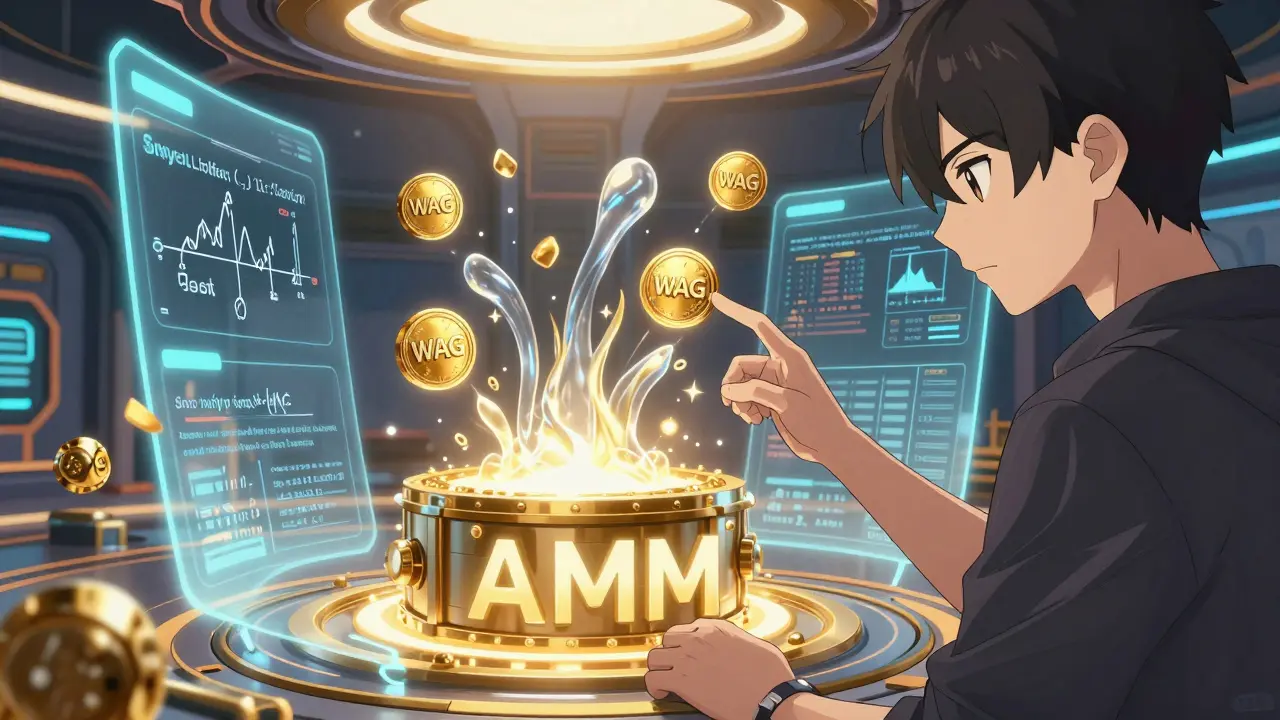
Getting the airdrop is only the first step. To make those tokens grow, you have to understand the platform's primary functions. WagyuSwap operates as an Automated Market Maker (or AMM), meaning it uses mathematical formulas to price assets in liquidity pools rather than a traditional order book.
Liquidity Provision
When you provide liquidity, you deposit a pair of tokens (like WAG and another asset) into a pool. In exchange, you receive LP (Liquidity Provider) tokens. These tokens act as a receipt of your share of the pool. The real trick here is that you can stake these LP tokens in the WagyuSwap vault to earn additional WAG rewards. This is specifically designed to help offset impermanent loss, which happens when the price of your deposited assets changes relative to each other.
Yield Farming
Yield farming on WagyuSwap is essentially the process of moving your assets between different pools to find the highest possible return. Since the platform is built on the Velas Network, transaction fees are significantly lower than on Ethereum, making it viable for smaller investors to farm without their profits being eaten by gas fees.
| Feature | WagyuSwap (WAG) | Standard Ethereum DEX | Solana-based DEX |
|---|---|---|---|
| Blockchain | Velas (Solana Codebase) | Ethereum | Solana |
| Token Standard | VEP20 | ERC-20 | SPL |
| Gas Fees | Very Low | High/Variable | Ultra Low |
| KYC Required | No | No | No |
Analyzing the Market Performance of WAG
Let's be honest: the price charts for WAG haven't been pretty lately. After hitting an all-time high of $0.00435, the token has seen a drop of over 90%. If you are holding airdropped tokens, you're looking at a market cap that fluctuates between $9,000 and $16,000, which is extremely small in the crypto world.
This low market cap means the token is highly volatile. A single "whale" (a large holder) selling their position can crash the price, while a small amount of buying pressure can send it spiking. Current technical indicators, such as the 200-day Simple Moving Average (SMA) sitting at $0.000422, show that the token is currently in a long-term downtrend.
However, the Total Value Locked (TVL) of around $182,150 indicates that there is still a core group of users providing liquidity. The health of a DEX is often measured by the ratio of its market cap to its TVL. For WagyuSwap, this ratio is quite low (around 0.05), which suggests that the tokens are currently undervalued relative to the actual capital locked in the system.
Risks and Rewards: Should You Hold?
The biggest draw of WagyuSwap is its technical foundation. By using the Solana codebase but remaining EVM-compatible, it tries to offer the best of both worlds: the speed of a modern chain and the accessibility of Ethereum tools. If the Velas Network gains mainstream adoption, WagyuSwap as the first DEX on that chain could see a massive resurgence.
On the flip side, the competition is brutal. You aren't just competing with other small DEXs; you're competing with giants like PancakeSwap and Uniswap. These platforms have billions in liquidity and massive marketing budgets. For WAG to recover, it needs more than just a fast blockchain-it needs a unique reason for users to switch.

Step-by-Step Guide to Managing Your WAG Tokens
- Wallet Setup: Install a wallet that supports the Velas Network (like MetaMask with the Velas RPC settings added).
- Network Configuration: Ensure your wallet is switched to the Velas mainnet to see your VEP20 tokens.
- Connecting to the DEX: Go to the official WagyuSwap portal and connect your wallet. Avoid clicking links from random social media profiles to prevent phishing.
- Evaluating Liquidity: If you plan to stake, check the current APY (Annual Percentage Yield) for the WAG/VELAS or WAG/USDT pools.
- Claiming Rewards: Regularly harvest your farming rewards to avoid them sitting in a smart contract during high volatility.
Is the WagyuSwap airdrop still active?
Most IDO airdrops are time-limited events tied to the launch phase. While the tokens may still be in your wallet, the initial distribution phase usually concludes shortly after the IDO. You should check the official WagyuSwap community channels to see if there are any ongoing promotional snapshots.
What is the risk of providing liquidity on WagyuSwap?
The main risk is impermanent loss. This happens if the price of WAG changes significantly compared to the other token in your pair. While staking LP tokens for WAG rewards helps mitigate this, it doesn't eliminate the risk entirely. Additionally, there is always the smart contract risk associated with any DEX.
Why is the WAG token price so low?
WAG has experienced a significant decline from its all-time high, which is common for many IDO projects after the initial hype dies down. Low trading volume and heavy competition from larger DEXs have put downward pressure on the price.
Do I need to provide KYC to use WagyuSwap?
No, WagyuSwap is a non-custodial decentralized exchange. You only need a compatible crypto wallet to trade and stake. No personal identification or registration is required.
How do I move WAG tokens to another exchange?
Since WAG is a VEP20 token on the Velas Network, you can send it to any wallet or exchange that explicitly supports the Velas Network and the WAG token. Always send a small test amount first to ensure the address is correct.
Troubleshooting and Next Steps
If you've claimed your tokens but they aren't appearing in your wallet, the most common culprit is a missing contract address. You'll need to manually "Import Token" in your wallet and paste the WAG contract address for the Velas Network. Without this, the wallet doesn't know how to read the balance on the blockchain.
For those looking to move beyond just holding, the next logical step is exploring the Velas ecosystem. Because WagyuSwap is integrated into this network, keeping an eye on Velas's overall adoption is the best way to predict if WAG will ever return to its peak values. If you're an aggressive trader, keep a close eye on the 24-hour volume; a sudden spike in volume often precedes a price move.
Larry Yang
April 23, 2026 AT 17:07imagining that a low market cap to TVL ratio actually means its undervalued is just peak copium. its a ghost town with zero utility beyond being a textbook example of a pump and dump
Greg Reynolds
April 25, 2026 AT 08:39The Solana codebase claim is a bit of a red flag. Just because you copy a codebase doesn't mean you inherit the throughput or the ecosystem. It's a common marketing ploy for low-tier DEXs to sound more legitimate than they are.
Kathleen Bergin
April 25, 2026 AT 18:28Impermanent loss is why most people lose money on these pools. You aren't actually earning profit if the token price crashes while you're providing liquidity
Findlay Duncan Lyon
April 27, 2026 AT 02:30Absolute shambles of a chart.
Mike Krasner
April 27, 2026 AT 12:19who cares about the codebase when the price is basically zero anyway lol just another rug pull in the making
Alex Wan
April 27, 2026 AT 18:01I truly believe we can all learn from these market volitility cycles! It is such a drammatic reminder that due diligence is paramount in the crypto space and we must support each other in larning the ropes of VEP20 tokens properly!
Sarah Fisher
April 28, 2026 AT 09:56It's interesting how we chase these airdrops as a way to find a shortcut to wealth, but the real value usually lies in the infrastructure. If Velas actually succeeds, then WAG becomes a secondary thought to the network itself.
Guy Bianco
April 28, 2026 AT 20:47Please remember to keep your private keys secure while configuring your RPC settings. It is a common mistake for beginners to leak their seeds during the setup process. 🛡️
Charlie Queen
April 29, 2026 AT 07:23Love seeing new projects popping up on different chains! 🚀 Always great to explore the wild west of DEXs, just gotta stay safe out there guys! ✨
Keith Garcia
April 30, 2026 AT 18:16The sheer audacity of calling this a "strategic move" to bootstrap liquidity is breathtakingly naive. It's a desperate attempt to lure in retail sheep with the promise of free tokens while the founders exit through the back door. 🙄 Honestly, the lack of a unique value proposition is simply galling. Why would any rational actor move liquidity from a proven giant to this digital wasteland? The asymmetry of risk here is profoundly absurd. 🤡
Clair Geary
May 1, 2026 AT 18:56totally get the hype but honestly the vibes on the chart are just spooky right now. maybe wait for a real signal before jumping into the liquidity pools lol
Jagdish Sutar
May 2, 2026 AT 06:13It is wonderful to see such a detailed breakdown. For those of us coming from different backgrounds, these guides make the complex world of DeFi much more welcoming!
praveen subbiah
May 3, 2026 AT 13:34This is the kind of innovation we need! I am absolutely thrilled to see these opportunities expanding. Imagine the glory when our local communities start dominating these decentralized networks! It will be a total revolution in the financial world and we will be the ones leading the charge with such bold projects! Jai Hind!
Alex Hunter
May 3, 2026 AT 18:40For anyone struggling with the MetaMask part, just remember to double check the chain ID. A lot of people get stuck because they use the wrong network parameters and then panic when they can't see their balance. Just take it slow.
Sara Ellis
May 4, 2026 AT 04:50money is just a number and tokens are just codes in the wind anyway so just take the free stuff and vibe