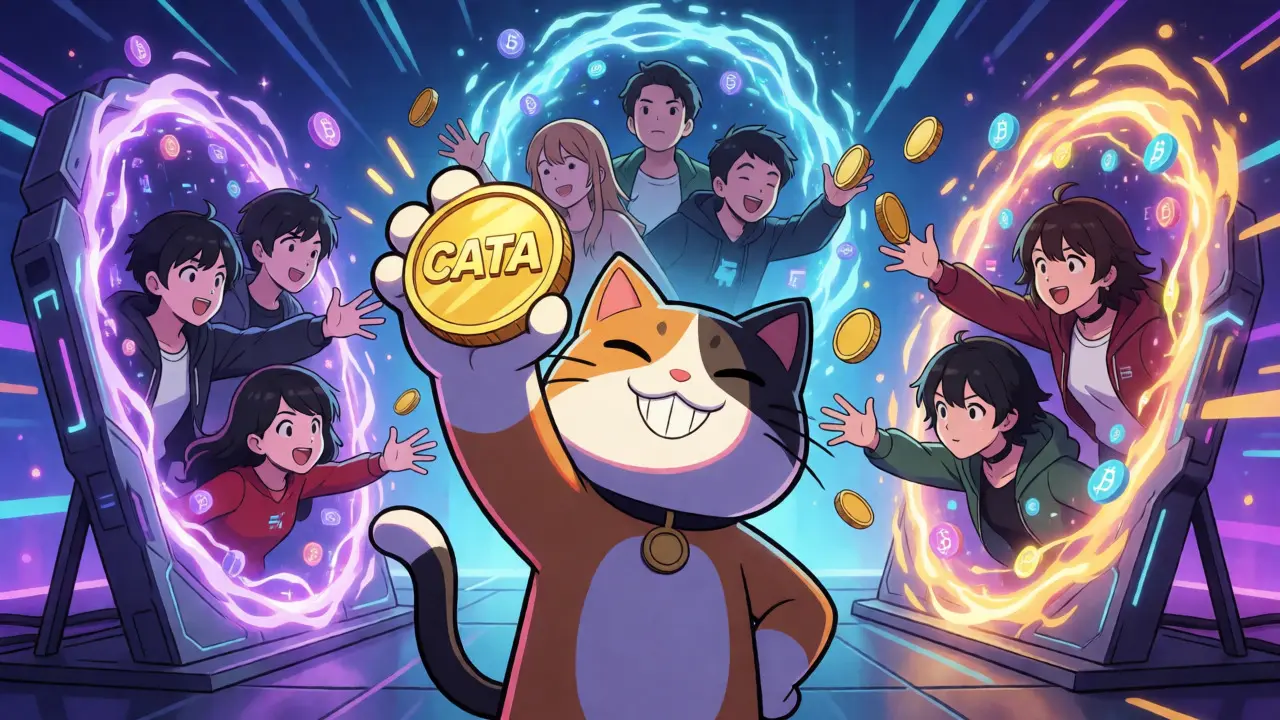
You’ve probably seen a ticker like CATA pop up in your wallet or on a decentralized exchange and wondered, "What exactly is this?" It’s easy to get lost in the sea of thousands of new tokens launching every week. Most are fleeting experiments; some try to build actual utility. CATAMOTO falls somewhere in between: it’s a community-driven meme coin that claims to offer more than just jokes by using complex smart contracts to manage its own liquidity. But with a price hovering near zero and trading volumes measured in single digits, is it worth your attention?
This guide breaks down what CATAMOTO actually is, how its unique "fair launch" worked, and why its market cap remains tiny despite ambitious technical claims. We’ll look at the hard data from late 2026, examine the risks of buying such a low-liquidity asset, and help you decide if CATA belongs in your speculative portfolio.
The Core Concept: More Than Just a Joke?
CATAMOTO is a cryptocurrency token with the ticker CATA. It operates primarily on the BNB Chain as a BEP-20 token, though a version also exists on Solana. Launched in April 2024, it positions itself not just as a meme coin, but as an experiment in community governance and automated liquidity management. The project markets itself as having "the world’s first experimental fair launch," aiming to distribute tokens evenly across multiple initial DEX offering (IDO) platforms rather than favoring insiders.
Unlike Bitcoin, which relies on proof-of-work, or Ethereum, which powers decentralized applications, CATAMOTO’s primary function is currently speculative trading and community engagement. Its branding leans heavily into humor-think cat memes and internet culture-but its backend logic attempts something serious: sustaining price stability through automated buybacks. Whether this technical complexity translates to real value for holders is the big question.
How CATAMOTO Was Launched: The Multi-Launchpad Experiment
Most meme coins launch on a single platform, often leading to uneven distribution where early bots snipe the supply. CATAMOTO tried a different approach. In April 2024, the team orchestrated launches across three separate IDO platforms: Ape Terminal, Tenset, and Kommunitas. This strategy was designed to spread access among different user bases.
- Ape Terminal Launchpad: Ran from April 9-12, 2024.
- Tenset Launchpad: Followed immediately from April 12-15, 2024.
- Kommunitas Launchpad: Concluded the series on April 15, 2024.
The initial price during these sales was set at 1 CATA = 0.000587 USDC. If fully subscribed, this would have valued the entire project at roughly $11.7 million. Today, however, the reality is starkly different. As of September 2026, trackers show a market capitalization in the low thousands of dollars. This massive drop highlights the volatility inherent in micro-cap meme coins, where initial hype rarely sustains long-term value without continuous marketing investment.
Tokenomics: Supply, Fees, and Buybacks
Understanding the numbers behind CATA helps explain its behavior. The token has a fixed maximum supply of 20,000,000,000 (20 billion) units. By mid-2026, approximately 97% of these tokens were already in circulation, meaning there is very little future inflation to worry about. The remaining supply is negligible compared to the circulating amount.
| Metric | Value / Status |
|---|---|
| Maximum Supply | 20,000,000,000 CATA |
| Circulating Supply | ~19.38 Billion CATA (~97%) |
| Network | BNB Chain (Primary), Solana (Secondary) |
| Transaction Fee | 1% per trade (split for liquidity/buyback) |
| Market Cap | $3,400 - $22,000 USD (varies by tracker) |
The most distinct feature of CATA’s design is its fee structure. Every transaction incurs a 1% tax. This isn’t going into a developer’s pocket directly; instead, the smart contract automatically splits this fee to enhance liquidity pools and execute buybacks. The theory is simple: constant small buybacks should theoretically support the price floor. However, with daily trading volumes often under $100, these buybacks are microscopic. They exist, but their impact on a multi-billion dollar supply is nearly invisible.

Technical Architecture: Ten Smart Contracts?
CATAMOTO claims to use "ten smart contracts managing liquidity." For a casual investor, this sounds impressive. But what does it actually mean? In standard DeFi terms, a single token contract handles transfers. Complex projects might add staking or farming contracts. CATAMOTO’s architecture likely separates functions like fee collection, liquidity locking, and buyback execution into individual modules.
This modular approach can improve security-if one module fails, others might survive. However, it also increases gas costs for users and adds complexity for audits. As of 2026, there is no widely publicized, independent audit from a top-tier firm like CertiK or Hacken available in public summaries. Without this verification, the claim of "advanced architecture" remains a marketing point rather than a proven security feature. Always assume higher risk when dealing with unaudited, multi-contract systems.
Where to Buy and Sell CATA
If you want to interact with CATAMOTO, you won’t find it on Binance, Coinbase, or Kraken. These major centralized exchanges track the price but do not list it for trading. You need to go on-chain.
- Set Up a Wallet: Install MetaMask or Trust Wallet and configure it for BNB Chain.
- Fund Your Wallet: Buy BNB (Binance Coin) on any major exchange and send it to your wallet address. You need BNB for gas fees.
- Connect to PancakeSwap: Go to the PancakeSwap v2 interface and connect your wallet.
- Find the Pair: Search for the WBNB/CATA pair. Be careful to verify the correct contract address, as many fake tokens copy names.
- Execute Trade: Swap BNB for CATA. Remember to account for the 1% tax and potentially set a higher slippage tolerance (e.g., 2-3%) to ensure your transaction goes through on thin liquidity.
For the Solana version, you’d use Phantom Wallet and swap via Raydium or Jupiter. Note that the Solana and BNB versions are distinct assets. Do not confuse them; they do not move freely between chains without a bridge, and bridges for micro-caps can be risky or non-existent.
Risks: Liquidity and Volatility
The biggest danger with CATAMOTO is liquidity. On many days, the total volume traded in 24 hours is less than $10. Imagine trying to sell $500 worth of CATA when only $10 trades hands each day. You might crash the price just by selling. This is known as "price impact," and it’s severe in micro-cap tokens.
Furthermore, the price history shows a steep decline. From the IDO price of $0.000587, the token has dropped over 99%. While some investors hope for a rebound, the lack of significant news, partnerships, or product development since 2024 suggests the hype cycle has largely passed. Investing here is akin to buying a lottery ticket: the potential upside exists if the community suddenly rallies, but the probability of holding onto your capital is low.
Community and Development Status
CATAMOTO describes itself as a "community memecoin project." There is no corporate headquarters or listed CEO in traditional financial filings. Support comes from social media channels like Telegram and Twitter (X). If you’re looking for customer service tickets or detailed whitepapers with technical diagrams, you might be disappointed. The documentation is sparse, focusing more on vibe and meme culture than rigorous engineering specs.
The team allocated 99% of raised funds to "massive lifelong buybacks," leaving almost nothing for operational budgets or development salaries. This implies a lean operation where the community drives growth. If the community stays active, the token survives. If they leave, the token becomes a ghost chain asset with no activity.
Frequently Asked Questions
Is CATAMOTO a good investment?
It depends on your risk tolerance. As a micro-cap meme coin with low liquidity and high volatility, it is considered a highly speculative, high-risk asset. It lacks the institutional backing or broad adoption of major cryptocurrencies. Only invest money you can afford to lose completely.
Can I buy CATAMOTO on Coinbase or Binance?
No, CATAMOTO is not listed for direct trading on major centralized exchanges like Coinbase or Binance. You must purchase it on decentralized exchanges (DEXs) such as PancakeSwap on BNB Chain or Raydium on Solana.
What is the difference between CATA on BNB Chain and Solana?
They are separate tokens. The BNB Chain version is the original launch from April 2024. The Solana version appears to be a derivative or bridged asset. They have different contract addresses and liquidity pools. Ensure you are buying the specific version intended for your wallet ecosystem.
Why does CATA have a 1% transaction fee?
The 1% fee is programmed into the smart contract to fund automatic liquidity additions and token buybacks. The goal is to reduce circulating supply over time and stabilize the price, though the effect is minimal due to low trading volumes.
Has CATAMOTO been audited?
Public records as of late 2026 do not show a comprehensive, third-party audit from a leading security firm. Investors should exercise caution and review the smart contract code themselves or rely on community trust, acknowledging the inherent risks of unaudited DeFi protocols.