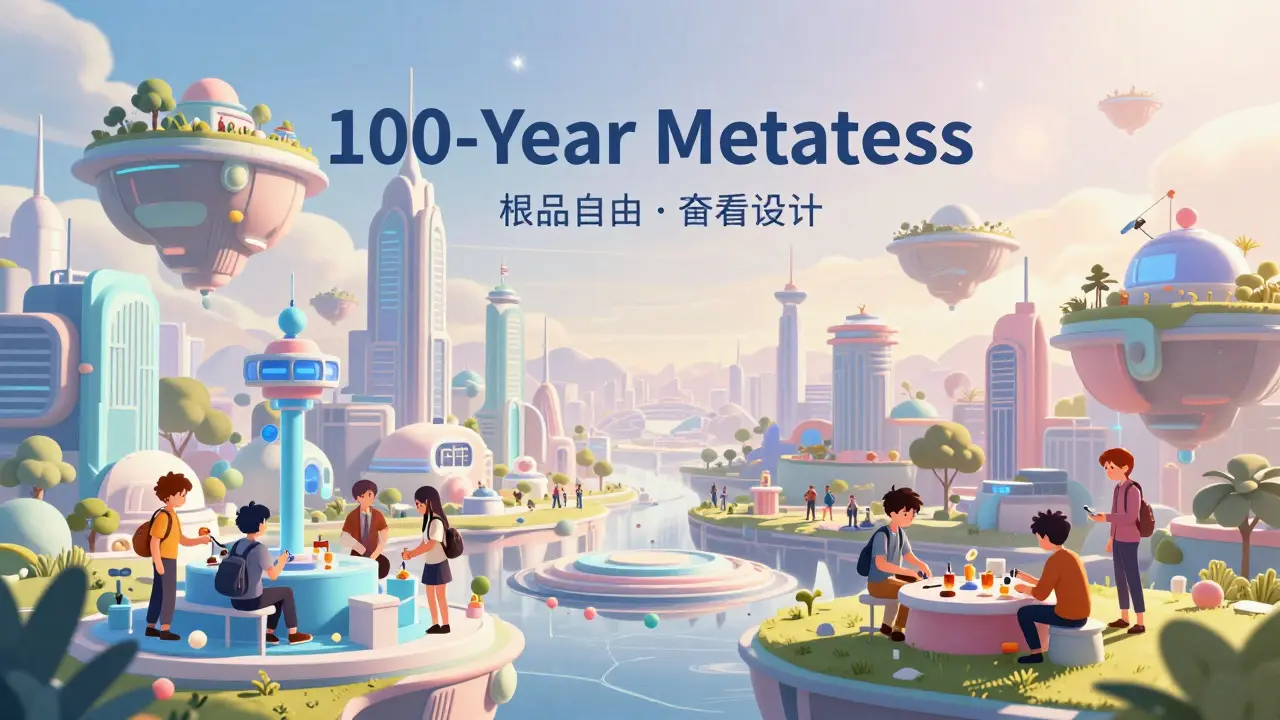
Imagine a virtual world designed to last for a century. That is the promise of Genesis Worlds, a project built around the GENESIS cryptocurrency token. But when you look past the ambitious marketing and dig into the data, a very different picture emerges. As of mid-2026, this token sits in a precarious position within the crypto market. It boasts a lofty vision but struggles with near-zero liquidity and minimal trading activity.
If you are wondering whether GENESIS is a hidden gem or a red flag, you need to understand how it works, who runs it, and why the numbers tell a cautionary tale. This guide breaks down the reality of the Genesis Worlds ecosystem, separating the hype from the hard facts.
The Vision: A Nonprofit Metaverse?
Genesis Worlds positions itself as something unique in the crowded metaverse sector. Most projects like Decentraland or The Sandbox are driven by profit motives for investors and developers. Genesis Worlds claims to be different. It is managed by the Genesis Foundation, which operates as a nonprofit entity.
The core idea is simple: create a "100-Year Metaverse." The goal is to build a platform that evolves over decades, not just quarters. According to their whitepaper, the platform relies on community creation. Users don't just play games; they craft worlds, design quests, and build experiences. The theory is that by removing the pressure for immediate financial returns, the community can focus on long-term sustainability.
In this model, the GENESIS token acts as the fuel. You use it to buy virtual land, trade goods, and participate in governance. However, the nonprofit structure raises questions. How does a nonprofit sustain development costs? The answer lies in reinvesting all revenue back into the platform. While noble in theory, this approach has struggled to attract the massive capital inflows seen in competitor projects.
Token Utility: What Can You Actually Do With GENESIS?
To evaluate any crypto coin, you must ask: what does it do? For GENESIS, the utility is defined by three main pillars:
- Virtual Economy Transactions: The token is used to purchase virtual real estate and digital assets within the Genesis Worlds environment. If you want to own a piece of land in one of the user-created worlds, you pay in GENESIS.
- Governance via DAOs: Holders can participate in Decentralized Autonomous Organizations (DAOs). This means you have a say in how the platform evolves, which features get prioritized, and how funds are allocated. This aligns with the community-driven ethos of the project.
- Access to Exclusive Events: Certain high-profile events or limited-editem digital goods require GENESIS tokens for entry or purchase.
On paper, these utilities mirror those of successful metaverse tokens. In practice, however, utility requires users. Without a large active user base buying land or voting on proposals, the token's demand remains theoretical rather than actual.
The Hard Numbers: Liquidity Crisis
This is where the story gets complicated. Let's look at the market data available through late 2024 and early 2025, which sets the stage for the current 2026 landscape.
| Metric | Value / Status | Context |
|---|---|---|
| Total Supply | 222.08 Million | Fixed supply cap |
| Circulating Supply | ~181.27 Million | High percentage already in circulation |
| Market Cap | ~$32,000 - $44,000 | Extremely low compared to industry standards |
| 24-Hour Volume | $0 | Reported across major aggregators like CoinMarketCap and Binance |
| Holder Count | ~2,230 | Limited distribution base |
A market capitalization of roughly $40,000 places Genesis Worlds far outside the mainstream crypto ecosystem. For context, the total cryptocurrency market often exceeds $1.5 trillion. GENESIS represents less than 0.0002% of that total. More alarmingly, the 24-hour trading volume frequently hits zero. When volume is zero, it means no trades are happening. You might hold the token, but you cannot easily sell it without crashing the price, because there are no buyers waiting in the order book.
This lack of liquidity is a critical risk. In crypto, liquidity is life. Without it, a token becomes illiquid. Even if the project succeeds technically, you may find yourself holding an asset that you cannot convert to cash or stablecoins.
Comparison: Genesis Worlds vs. Major Metaverse Tokens
To understand GENESIS's position, compare it to established players. The gap is not just about size; it is about adoption and infrastructure.
| Feature | Genesis Worlds (GENESIS) | Decentraland (MANA) | The Sandbox (SAND) |
|---|---|---|---|
| Structure | Nonprofit Foundation | For-Profit Corporation | For-Profit Corporation |
| Market Rank | #3000+ (Micro-cap) | Top 100 | Top 100 |
| Liquidity | Negligible ($0 volume) | High (Millions daily) | High (Millions daily) |
| Primary Focus | Long-term community building | User-generated content & VR | Gaming & Brand Partnerships |
| Risk Level | Extreme | Moderate | Moderate |
Decentraland and The Sandbox have spent years securing partnerships with major brands like Adidas, Atari, and Samsung. They have robust developer ecosystems and millions of monthly active users. Genesis Worlds lacks these corporate ties. Its reliance on pure community effort is admirable but has not yet translated into measurable growth. The disparity in market cap-millions versus tens of thousands-highlights the challenge GENESIS faces in gaining traction.
Community Sentiment and Development Activity
A healthy crypto project thrives on community engagement. Look at Reddit, Twitter, or Discord. For Genesis Worlds, the silence is deafening. Searches for "Genesis Worlds" on major crypto forums yield fewer than ten relevant mentions per month. There are no viral memes, no heated debates about roadmap updates, and no influencer endorsements.
The official website shows a showcase of "Worlds," but there are no visible metrics for active users or transactions. The holder count of 2,230 suggests that most participants are early adopters who bought in during the initial phases. Are they still active? Or are they dormant wallets? Without transparent on-chain analytics showing daily active addresses, we can only guess. The absence of recent version releases or roadmap milestones on their hub further fuels skepticism. In the fast-moving crypto world, silence often signals stagnation.

Is GENESIS a Good Investment in 2026?
Let's be direct. Based on the available data, GENESIS carries extreme risk. Here is why:
- Liquidity Trap: With $0 trading volume, exiting your position is nearly impossible without significant slippage. You could be stuck holding the bag indefinitely.
- Adoption Gap: The metaverse sector is consolidating around a few leaders. New entrants need a killer feature or massive funding to break through. Genesis Worlds has neither.
- Data Deficiency: Analytical platforms like CoinCodex cannot even generate price predictions because there isn't enough historical trading data. This indicates the token is effectively dormant in terms of market activity.
However, if you believe strongly in the nonprofit model and the concept of a slow-burn, community-owned metaverse, you might view GENESIS as a speculative bet. Just know that you are betting on a vision that has failed to materialize in market terms so far. It is not an investment for stability or short-term gains. It is a high-risk, low-probability experiment.
How to Buy GENESIS (If You Still Want To)
If you decide to proceed despite the risks, here is how you can acquire the token. Note that options are limited due to the low market cap.
- Check Decentralized Exchanges (DEXs): Since centralized exchanges report $0 volume, you may need to look at DEXs on the blockchain network where GENESIS resides. Ensure you have the correct contract address to avoid scams.
- Use P2P Platforms: Some smaller platforms like Tapbit allow peer-to-peer trading without strict KYC. This can be a way to find individual sellers, but beware of fraud.
- Monitor Official Channels: Keep an eye on the Genesis Foundation announcements for any new exchange listings. Sometimes, a listing on a larger exchange can suddenly inject liquidity, though this is rare for micro-caps.
Always start with a small amount. Never invest money you cannot afford to lose entirely. In the case of micro-cap tokens with zero volume, losing 100% of your investment is a realistic outcome.
Future Outlook: The 100-Year Challenge
The name "Genesis" implies a beginning. The tagline "100-Year Metaverse" implies endurance. These two concepts are currently at odds. Crypto projects typically live or die within 18 to 24 months. To survive a decade, let alone a century, a project needs constant innovation, funding, and user retention.
As of 2026, Genesis Worlds has not demonstrated the momentum required for such longevity. The nonprofit structure helps avoid predatory monetization, but it doesn't solve the problem of visibility. Unless the Genesis Foundation secures a major partnership or launches a breakthrough feature that goes viral, the token will likely remain on the fringes of the crypto ecosystem. For now, it serves as a case study in the difficulties of building a decentralized world from scratch without traditional venture capital backing.
What is the primary use of the GENESIS token?
The GENESIS token is primarily used for purchasing virtual land and goods within the Genesis Worlds metaverse, participating in governance decisions via DAOs, and accessing exclusive community events. It acts as the internal currency for the platform's economy.
Why is the trading volume for GENESIS so low?
The trading volume is extremely low, often reported as $0, because the token has a very small market capitalization (around $40,000) and limited exchange listings. There are few buyers and sellers, resulting in a lack of liquidity. This makes it difficult to trade large amounts without affecting the price significantly.
Is Genesis Worlds a safe investment?
No, Genesis Worlds is considered a high-risk investment. Due to its micro-cap status, negligible liquidity, and lack of widespread adoption, there is a significant chance that the token could lose value or become untradeable. It is not suitable for conservative investors.
Who manages the Genesis Worlds project?
The project is managed by the Genesis Foundation, which operates as a nonprofit organization. Unlike many other crypto projects run by for-profit corporations, the foundation states that all revenue is reinvested into the long-term development of the platform.
How does Genesis Worlds compare to Decentraland?
Decentraland is a top-tier metaverse project with high liquidity, major brand partnerships, and a large user base. Genesis Worlds is a micro-cap project with almost no liquidity, no major partnerships, and a much smaller community. Decentraland is focused on commercial viability, while Genesis Worlds focuses on a nonprofit, community-driven model.
Can I mine GENESIS tokens?
No, GENESIS tokens are not mined like Bitcoin. They are issued based on a fixed supply model. You can only acquire them by purchasing them on supported exchanges or through peer-to-peer transactions, assuming liquidity is available.
What is the total supply of GENESIS?
The total supply of GENESIS tokens is capped at 222.08 million. As of late 2024, approximately 181.27 million tokens were in circulation, meaning a significant portion of the supply is already distributed among holders.
KEITH WONG
July 4, 2026 AT 14:17lol another dead coin trying to pretend its special 🤡 the liquidity is basically zero so good luck selling that shit u holdin bags for life now
Curtis Johnson
July 6, 2026 AT 03:02I honestly think people are too harsh on the concept itself. The idea of a nonprofit metaverse is actually quite beautiful and could foster genuine community if given time. We should support projects that try to do things differently rather than just tearing them down because they aren't profitable yet. It takes courage to build something meant to last 100 years in an industry obsessed with quarterly gains. Let's give them a chance to prove their model works.
Hamza k
July 6, 2026 AT 14:56Ah, the sweet scent of a rug pull waiting to happen! 🎭 You call it 'courage,' I call it financial suicide. There is no volume, no users, and no hope. It's a ghost town wrapped in a whitepaper.
Kim Kay
July 7, 2026 AT 02:28i mean maybe they just need more marketing? sometimes small projects get overlooked even if they have good tech. i saw some cool world designs on their site actually. dont be so quick to judge tho
Brad Semp
July 7, 2026 AT 05:10The notion that 'marketing' can salvage a project with a market capitalization of forty thousand dollars is laughably naive. One does not simply market one's way out of fundamental structural failure. The absence of liquidity is not a temporary oversight; it is a terminal diagnosis. To suggest otherwise is to ignore basic economic principles governing asset valuation and exchange dynamics. This is not a hidden gem; it is a digital relic.
Korn Arrieta
July 7, 2026 AT 17:46You are all missing the point entirely. The data doesn't lie. Zero volume means zero interest. If you cannot exit your position, you do not own an asset; you own a liability. Stop romanticizing failure and start reading the charts. It is pathetic how many people cling to these zombie coins hoping for a miracle that will never come. Wake up.
Russ Fincham
July 9, 2026 AT 11:00Look, I get why people hate on it but let's keep it civil. The article says it's high risk and most of us know that. But saying it's worthless ignores the potential of the DAO structure. Maybe in five years it'll take off who knows. Just don't bet the farm on it.
Linda Hilliard
July 11, 2026 AT 06:54Civil? Please. Discussing the inevitable collapse of a fundamentally broken token requires precision, not politeness. 📉 The term 'potential' is merely a euphemism for unproven speculation. In the realm of institutional-grade analysis, we look for tangible metrics: active addresses, transaction frequency, and developer commit rates. Genesis Worlds exhibits none. It is a speculative mirage, nothing more. Do not confuse hope with strategy.
Winston Lacewing
July 12, 2026 AT 12:53OMG stop being so negative guys 😭😭😭 Some of us actually believe in the dream! It's about community not just money!! Why can't you see the beauty in a slow growth model?? You're all so toxic and ruining the vibe for everyone else 🙄💔
Kristine Lawson
July 13, 2026 AT 06:12Your emotional outburst demonstrates a profound misunderstanding of financial markets. Markets are not driven by 'vibes' or 'dreams'; they are driven by supply, demand, and liquidity. To suggest that toxicity is the primary issue here is to trivialize the actual problem: the complete lack of economic viability. Furthermore, your use of emojis undermines any credibility you might have possessed, which was negligible to begin with. Please educate yourself before commenting.
Tawny Holmes
July 14, 2026 AT 04:02It's dead. Move on.
Jessie Smith
July 14, 2026 AT 08:33the tragedy of genesis worlds is not its failure but its existence as a testament to human delusion. we build castles in the sky while the ground beneath us crumbles into dust. it is a philosophical statement on the futility of seeking permanence in a transient digital landscape. perhaps the true utility is teaching us humility.
Drew M
July 15, 2026 AT 02:04Bro really said 'philosophical statement' 💀🤣 This isn't poetry club, it's crypto. If there's no money flowing, there's no game. Sad but true. RIP GENESIS 🕯️📉
Deep Rahman
July 16, 2026 AT 17:17I have been thinking about this for a long time and I feel like the problem is that we expect everything to grow fast but nature grows slow. A tree takes many years to become strong and maybe this project is like a seed that needs patience. People today want instant results and they forget that real value takes time to build up over many seasons. If we could learn to wait and watch without judging too quickly we might see something beautiful emerge from the silence. The foundation is doing work even if we cannot see it every day.
Melissa Beckwith
July 16, 2026 AT 19:32While your analogy is poetic, it fails to account for the competitive landscape of the metaverse sector where speed to market and network effects are paramount. Decentraland and The Sandbox did not wait for 'seasons'; they aggressively captured market share through partnerships and development. Genesis Worlds has had years to establish a foothold and has failed to do so. Patience is a virtue in gardening, but in cryptocurrency, it is often a prelude to obsolescence. The silence you interpret as growth is more accurately described as stagnation.