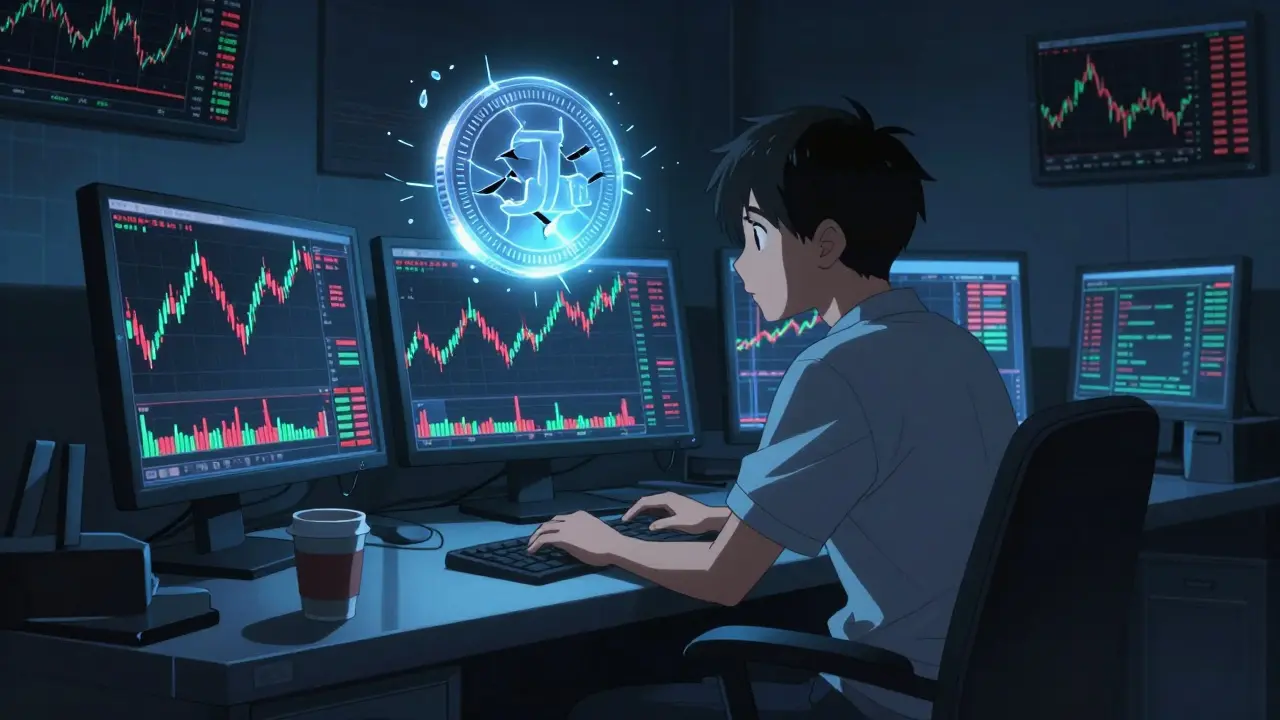
You’ve probably seen a flash of green on your screen or heard a whisper in a Telegram group about a coin called Janet. It sounds like a name you’d trust-friendly, familiar, maybe even nostalgic. But when it comes to digital assets, familiarity can be a trap. The question isn’t just "what is Janet (JANET)?" but rather, "should you care about it?" The short answer for most people is no. The long answer involves understanding why this token exists, how it operates, and why it carries extreme risk.
Janet (JANET) is a cryptocurrency token that trades on the Ethereum blockchain. It is an ERC-20 token, which means it follows the same technical standards as thousands of other utility tokens, stablecoins, and governance tokens built on Ethereum. However, unlike tokens with clear use cases-like Chainlink providing data feeds or Uniswap enabling decentralized trading-Janet lacks any verifiable real-world application. It was launched with a total supply of exactly 1 billion tokens, all of which were pre-mined at genesis. There is no mining mechanism, no staking infrastructure built into the protocol itself, and no ongoing issuance schedule. This makes it a finite asset, but finiteness alone does not create value.
The Reality Behind the Numbers
Let’s look at the hard data. As of recent market records, Janet trades at a fraction of a cent-hovering around $0.000087 to $0.000093 USD. Its market capitalization sits near $87,000 to $104,000. To put that in perspective, Bitcoin’s daily trading volume exceeds billions of dollars. Janet’s entire market cap could be moved by a single large trade. On Binance, its 24-hour trading volume often stays below $17,000. This is not a liquid market. It is a thin, fragile pool of capital where price swings are exaggerated and manipulation is easy.
When you buy Janet, you aren’t buying into a growing ecosystem. You’re entering a speculative arena where liquidity dries up quickly. If you try to sell a significant amount, say $500 worth, you might face slippage of 15% or more. That means you get far less than the listed price because there aren’t enough buyers waiting on the other side. This is a hallmark of micro-cap cryptocurrencies ranked in the bottom 0.5% of all tracked assets.
| Metric | Value | Context |
|---|---|---|
| Total Supply | 1,000,000,000 JANET | Fixed, pre-mined |
| Current Price Range | $0.000087 - $0.000093 | Highly volatile |
| Market Cap | ~$87,000 - $104,000 | Micro-cap tier |
| Daily Volume | ~$17,000 | Low liquidity |
| All-Time High | $0.020274 (Feb 2023) | 98% decline from peak |
Why Does Janet Exist?
If Janet has no utility, why does it exist? The honest answer is speculation. Many micro-cap tokens are created with the hope-or promise-that their price will rise due to hype, marketing, or coordinated buying groups. Bitget, one of the exchanges listing Janet, describes it as having "innovative technology and unique use cases." But if you dig into the documentation, those claims are vague. The official website features a whitepaper filled with placeholder text and no technical details. There is no roadmap with specific dates, no developer activity on GitHub, and no partnerships with established companies.
This pattern is common in the lower tiers of the crypto market. Tokens like Janet rely on community sentiment and social media buzz rather than fundamental value. They thrive on the idea that someone else will pay more later. This is known as a "greater fool theory" dynamic. When the music stops-and it always does-the last person holding the token takes the loss.
The Risks You Can’t Ignore
Investing in Janet isn’t just risky; it’s potentially catastrophic for your portfolio. Here’s what you need to know before considering even a small position:
- Liquidity Traps: With such low trading volume, exiting your position can be difficult. During periods of panic selling, prices can drop vertically with no buyers to catch them. Users have reported being unable to sell without accepting massive discounts.
- Manipulation Vulnerability: Small market caps are easy targets for whales-large holders who can move the price significantly with minimal capital. One wallet controlling a portion of the supply can pump the price artificially, then dump it on retail investors.
- No Regulatory Protection: Janet is not registered as a security in most jurisdictions. If the project disappears or the team abandons it, you have no legal recourse. The SEC has warned repeatedly about unregistered digital assets that resemble securities.
- Zero Utility: Without a product, service, or governance function, Janet has no intrinsic reason to hold value. Unlike stablecoins pegged to fiat currency or utility tokens used within active platforms, Janet serves no purpose beyond speculation.
A study by the University of Cambridge Centre for Alternative Finance found that 78% of similar micro-cap tokens fail within 18 months of launch. Janet fits this profile perfectly. Delphi Digital’s Micro-Cap Token Report suggests only a 4.3% probability that tokens with these characteristics survive beyond 2025. These aren’t opinions-they’re statistical realities based on historical data.

How People Get Burned
User feedback paints a grim picture. On Reddit, traders report losing 80% of their investment in weeks. One user tracked Etherscan transactions and noticed a single wallet manipulating the order book. On Trustpilot, complaints focus on high slippage and undelivered promises like airdrops. The Janet subreddit has fewer than 150 members, and activity is sparse. Most posts complain about disappearing liquidity or confusion over how to exit positions.
There are occasional success stories-someone claiming a 200x return from an early entry-but these are outliers. For every person who gets lucky, dozens lose everything. And luck isn’t a strategy. It’s gambling dressed up as investing.
Should You Buy Janet?
Here’s the blunt truth: unless you’re prepared to lose 100% of whatever you put in, Janet is not a wise choice. It doesn’t offer diversification, income, or growth potential backed by fundamentals. It offers exposure to volatility and manipulation. If you’re curious about crypto, start with established assets like Bitcoin or Ethereum. If you want higher risk-reward ratios, explore mid-cap projects with transparent teams, active development, and real users.
Janet represents the dark underbelly of the crypto space-a place where hype outweighs substance and losses are guaranteed for the majority. Don’t let the low price trick you into thinking it’s cheap. In finance, price and value are different things. Janet may be cheap, but it’s also worthless in terms of utility and long-term viability.
Is Janet (JANET) a good investment?
No. Janet lacks utility, has extremely low liquidity, and carries a high risk of total capital loss. It is considered a speculative micro-cap token with no fundamental value proposition.
Where can I buy Janet (JANET)?
Janet trades on exchanges like Bitget and Bybit. However, due to low liquidity, buying or selling large amounts can result in significant slippage and price impact.
Does Janet have any real-world use?
No. There is no evidence of merchant adoption, enterprise integration, or functional utility. The project’s documentation provides no concrete implementation scenarios.
What is the all-time high of Janet?
Janet reached an all-time high of $0.020274 in February 2023. Since then, it has declined by over 98%, reflecting its highly volatile nature.
Is Janet safe to store in a wallet?
Technically, yes, as it is an ERC-20 token compatible with wallets like MetaMask. However, the safety of the asset itself is questionable due to lack of utility and high failure probability.
Mélanie Boulay
June 30, 2026 AT 05:35I have been following the cryptocurrency space for quite some time now, and it is always fascinating to see how these micro-cap tokens come and go with such rapidity. The article you posted provides a very thorough breakdown of the Janet token, and I appreciate the effort taken to explain the liquidity issues in such detail. It is important for people to understand that just because something has a low price tag, it does not necessarily mean it is a good investment opportunity. Many newcomers to the market often fall into this trap, thinking they can buy thousands of coins for pennies and make a fortune. However, as you correctly pointed out, the lack of utility and the pre-mined nature of the supply are significant red flags that should not be ignored by anyone looking to preserve their capital. I also found the section on slippage particularly enlightening, as many retail investors do not realize how much value they lose when trying to exit positions in illiquid markets. It serves as a gentle reminder that patience and due diligence are far more valuable than chasing hype or listening to whispers in Telegram groups. Thank you for sharing this realistic perspective, as it helps to ground the conversation in facts rather than speculation.
Maurice Flynn
July 1, 2026 AT 12:47It's funny how we chase these things like moths to a flame, isn't it? We want the easy win, the quick flip, but the universe usually has other plans. This Janet thing seems like another lesson in humility for all of us. Keep your head down and watch the market.
nancy jarecki
July 3, 2026 AT 08:56The sheer intellectual poverty displayed by those who even consider allocating capital to JANET is staggering. One must question the fundamental economic literacy of individuals who fall prey to such blatant pump-and-dump schemes disguised as 'innovative technology.' The tokenomics are abysmal, lacking any semblance of sustainable yield generation or deflationary mechanisms that would justify its existence in a mature portfolio. It is essentially a digital pebble thrown into the vast ocean of Ethereum, creating ripples only because someone pushed it hard enough. The whitepaper is a masterpiece of obfuscation, utilizing buzzwords without any substantive technical architecture to back them up. It is a classic example of a vaporware project designed solely to extract liquidity from the uninformed masses. To engage with such an asset is to admit a complete disregard for risk management principles.
Robert Hundley
July 4, 2026 AT 01:35Hey everyone! Just wanted to drop by and say that while this looks risky, there's always hope right? :) But seriously, read the comments below before doing anything dumb!
Melissa L
July 4, 2026 AT 08:36i dont get why ppl keep buying this stuff lol. its basically worthless. i tried selling once and lost half my money just cause no one was buying. stupid coin. stay away if u want to keep ur cash.
Rob Morton
July 5, 2026 AT 21:44What is the underlying philosophy that drives people to invest in assets with zero utility? Is it greed, fear of missing out, or simply a misunderstanding of how value is created in financial markets? Perhaps we need to look deeper into the psychological aspects of trading. When we strip away the noise and the hype, what remains is often a hollow shell. This token seems to be a perfect case study for behavioral economics. Why do we ignore the warnings? Why do we listen to influencers instead of data? These are questions worth pondering for anyone involved in crypto.
Routh Middaugh
July 7, 2026 AT 13:09Well; I suppose we could argue both sides here; but honestly; the data speaks for itself. The volatility is extreme; the volume is nonexistent; and the risk is astronomical. It really makes you wonder about the state of our financial systems; doesn't it? Maybe we need more regulation; or maybe we just need better education. Either way; jumping into this pool seems like a bad idea.
Ryan Peters
July 7, 2026 AT 16:28This is exactly what happens when unregulated foreign entities flood our markets with garbage tokens. It’s a disgrace to American innovation. While real tech companies are building infrastructure, these scammers are printing fake coins and dumping them on naive retail investors. We need strict SEC enforcement to clean up this mess. Don’t let these offshore grifters steal your retirement savings. Support legitimate US-based blockchain projects instead of this international trash.
ross harris
July 8, 2026 AT 00:05Oh, the sweet, succulent rot of JANET. It smells like desperation and cheap code. A digital carcass picked clean by whales, leaving nothing but bones for the little guys to gnaw on. You think you're buying a future? No, darling, you're buying a funeral shroud. The charts don't lie, they just scream in silence until you're too deafened by your own greed to hear them. Dive in if you must, but don't expect to surface with anything but scars.
John Curry
July 9, 2026 AT 08:34I feel a profound sense of sadness reading about this. It is tragic that so many people are losing their life savings to such obvious traps. The human spirit seeks connection and meaning, and unfortunately, sometimes that search leads us to dark places like this token. Let us learn from this collective pain and move forward with greater wisdom and compassion for one another.
Jon Milton
July 10, 2026 AT 06:32As someone who travels frequently, I've seen how different cultures approach risk. In some places, gambling is a social activity, while in others, it is frowned upon. This token seems to appeal to the former mindset. However, regardless of where you are from, the math remains the same. Losses are losses. Let's focus on building wealth through sustainable means rather than chasing these fleeting trends.
Rebecca Shoniker
July 10, 2026 AT 21:56You really need to educate yourself before posting nonsense like this. The market dynamics are complex; and clearly; you do not understand them. Your analysis is superficial at best. Stop wasting everyone's time with your amateur opinions. Real investors know better than to touch this junk. Do better.
Jay Sharma
July 11, 2026 AT 13:18Wake up sheeple! This isn't just a bad token, it's part of a larger agenda to control the global economy. They want you to lose money so you'll accept CBDCs. The government is behind these crashes. Trust no one. The matrix is feeding you lies about Janet. Stay vigilant and protect your sovereignty.
Scott Miller
July 13, 2026 AT 07:34Listen up! If you aren't willing to take risks, you'll never succeed! But hey, maybe pick a better horse next time. Don't let this setback stop you. Get back in the game, but smarter! You got this! Just don't cry about it later.
Abby Martin
July 13, 2026 AT 09:24I am absolutely appalled by the lack of moral compass in this community. How can people justify investing in something that is clearly designed to fail? It is unethical. It is predatory. And yet, here we are, discussing it as if it's a normal part of finance. We need to hold ourselves to a higher standard. Stop enabling these scams. It's disgusting.
Carl Belgrave
July 13, 2026 AT 16:10This is weak stuff. Only losers buy tokens like this. If you can't handle the heat, get out of the kitchen. But seriously, this is pathetic. Real men invest in gold and stocks. Not this digital garbage. Pathetic.