
Remember the days when every new crypto project promised to bridge the gap between Wall Street and decentralized finance? Joltify (JOLT) is one of those projects. It launched with a bold mission: to connect real-world assets to the world of decentralized finance (DeFi). But years later, what actually happened to this token?
If you are looking at the charts today, the picture is stark. The price has dropped significantly from its peak, trading volumes are thin, and it sits outside the top 1000 cryptocurrencies by market cap. So, is Joltify dead, or is it just sleeping? Let’s break down exactly what Joltify is, how it works, and whether it still holds any value for investors in 2026.
The Core Concept: Bridging Real-World Assets
At its heart, Joltify isn't just another meme coin or a simple utility token. It was built as a bridge protocol. The goal was ambitious: take traditional financial assets-like stocks, bonds, or commodities-and tokenize them so they could be traded on the blockchain.
This concept falls under the broader category of Real World Asset (RWA) tokenization. Imagine owning a fraction of a building or a corporate bond, but instead of dealing with paper certificates and slow bank transfers, you hold a digital token that moves instantly on the blockchain. Joltify aimed to create seamless synergies between these conventional markets and the high-speed liquidity of crypto.
To achieve this, the project leveraged the Cosmos ecosystem. Cosmos is known for its "Internet of Blockchains" vision, allowing different blockchains to communicate with each other. This interoperability is crucial for a bridge project because it needs to talk to multiple networks simultaneously. However, despite the strong technical foundation, the execution and market adoption have been the sticking points.
Tokenomics: Supply, Distribution, and Standards
Understanding the numbers behind the token is essential before you consider buying or holding. Here is the breakdown of Joltify’s economic model:
- Maximum Supply: 500,000,000 JOLT tokens. This hard cap means no more tokens can ever be created beyond this number, which theoretically prevents inflation.
- Circulating Supply: Approximately 348,750,054 tokens are currently in circulation.
- Mining Status: Non-mineable. You cannot earn JOLT by running mining hardware. This distinguishes it from proof-of-work coins like Bitcoin.
- Pre-mine: No pre-mine. The project claimed a fair distribution model, meaning early insiders didn’t hoard a massive percentage of supply before public sale.
- Token Standard: BEP-20. This means it operates on the Binance Smart Chain (BSC), now often referred to as BNB Chain. This allows users to store it in wallets like Trust Wallet or MetaMask and trade it on decentralized exchanges like PancakeSwap.
The contract address for JOLT on BSC is 0x7Db21353A0c4659B6A9a0519066aa8D52639Dfa5. Always double-check this address if you plan to transfer funds, as sending tokens to the wrong network results in permanent loss.
Price History: From Hype to Reality Check
Let’s look at the cold hard data. When Joltify held its Initial Exchange Offering (IEO) in February 2022, the token sold for $0.20 per unit. At that time, the crypto market was still riding the post-2021 bull run wave. Investors were optimistic about DeFi bridges.
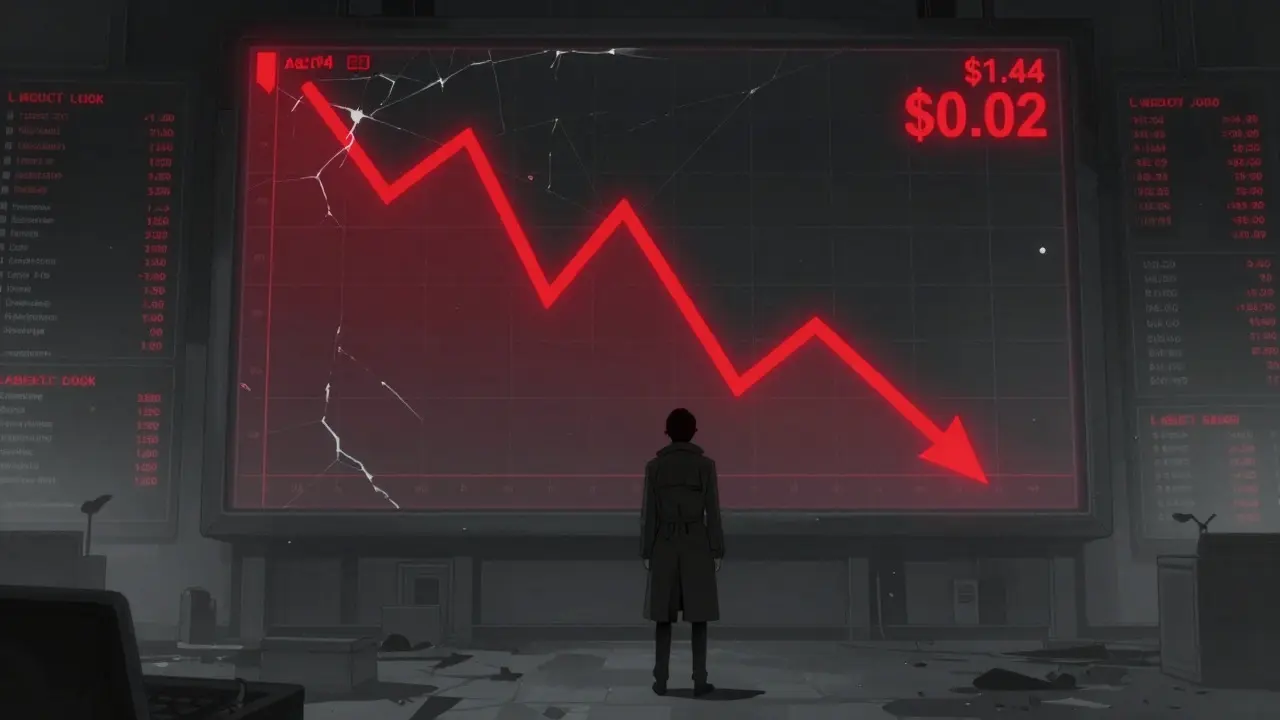
Since then, the journey has been brutal. According to historical data, JOLT reached an all-time high (ATH) of roughly $1.44. That was a moment of peak enthusiasm. Fast forward to mid-2026, and the price hovers around the $0.015 to $0.022 range. Depending on which exchange you check, you might see slight variations due to low liquidity, but the trend is clear: a decline of over 98% from its peak.
| Metric | Value / Status |
|---|---|
| All-Time High | $1.44 (Historical Peak) |
| Current Price Range | $0.015 - $0.022 (High Volatility) |
| Market Cap | ~$6.6 Million |
| 24h Volume | $7,400 - $54,500 (Inconsistent Data) |
| Exchange Listings | Limited (Only 2 major exchanges) |
This drop places Joltify firmly in the "micro-cap" category. For context, a market cap of $6.6 million is tiny compared to giants like Ethereum or even mid-tier DeFi protocols. This small size makes the token highly susceptible to manipulation and extreme volatility. A single large sell order can crash the price by 10-20% in minutes.
Technical Analysis and Market Outlook
So, where is it going next? Technical analysts have largely painted a bearish picture for JOLT. Predictive models from platforms like CoinCheckup suggest further downward pressure, forecasting potential drops toward the $0.013 mark in late 2025 and into 2026.
Why the pessimism? Several factors contribute to this outlook:
- Liquidity Crisis: With only two major exchanges listing the token, getting in and out of positions is difficult. Low volume means wide spreads, costing traders more money on every transaction.
- Competition: The RWA sector has evolved. Larger, better-funded projects like Ondo Finance or MakerDAO have entered the space, offering more robust security and regulatory compliance. Joltify struggles to compete against these institutional-grade players.
- Development Activity: Public updates from the Joltify team have become sparse. In crypto, silence is often interpreted as abandonment. Without regular roadmaps, partnerships, or product launches, investor confidence erodes.
However, crypto markets are unpredictable. We have seen monthly recoveries of over 85% in the past, driven by short-term speculation rather than fundamental improvements. These spikes are dangerous traps for new buyers who mistake momentum for value.
Risks and Challenges for Investors
If you are considering adding JOLT to your portfolio, you need to understand the risks. This is not an investment for the faint of heart.
1. Counterparty Risk: Since Joltify acts as a bridge, it relies on the security of its underlying smart contracts. Any bug or exploit could drain the liquidity pools. Unlike established protocols with millions in audit fees, smaller projects often lack rigorous third-party security checks.
2. Regulatory Uncertainty: Bridging real-world assets involves securities laws. If regulators decide that tokenized stocks or bonds are unregistered securities, projects like Joltify could face legal hurdles that larger companies can afford to fight.
3. Opportunity Cost: Money tied up in a stagnant micro-cap coin could potentially earn higher returns in blue-chip assets or stablecoin yield farms. The negative ROI of over 90% since launch highlights this opportunity cost.

How to Buy and Store JOLT Safely
Despite the risks, some traders still want exposure to JOLT. Here is how to do it safely:
First, ensure you have a non-custodial wallet that supports BEP-20 tokens. Trust Wallet and MetaMask are popular choices. Make sure you add the Binance Smart Chain network to your wallet settings.
Next, locate an exchange that lists JOLT. Due to limited availability, you may need to use decentralized exchanges (DEXs) like PancakeSwap. Connect your wallet, find the JOLT/BNB pair, and swap your BNB for JOLT. Always verify the contract address again before confirming the transaction.
Be cautious of fake tokens. Scammers often copy legitimate contract addresses with slight variations. Only trust sources from official Joltify channels or reputable aggregators like CoinGecko or CoinMarketCap.
Conclusion: Is Joltify Worth It?
Joltify represents a fascinating experiment in bridging traditional finance and DeFi. Its technology stack, built on Cosmos and operating via BEP-20, is sound in theory. However, the practical reality is harsh. The token has lost most of its value, suffers from low liquidity, and faces stiff competition from better-funded rivals.
For experienced traders who enjoy high-risk, high-reward speculative plays, JOLT might offer occasional volatility-based opportunities. For long-term investors seeking stability or growth, the current metrics suggest there are better options in the crypto market. Always do your own research (DYOR) and never invest more than you can afford to lose.
Is Joltify (JOLT) a scam?
There is no definitive evidence labeling Joltify as a outright scam. It has a functional token, a published contract address, and a history of trading. However, the lack of recent development updates and significant price decline raise red flags about the project's active status. Treat it as a high-risk, abandoned, or dormant project rather than a guaranteed fraud.
Where can I buy JOLT tokens?
JOLT is primarily available on decentralized exchanges (DEXs) within the Binance Smart Chain ecosystem, such as PancakeSwap. You will need to hold BNB to pay for gas fees and swap for JOLT. Availability on centralized exchanges is extremely limited, often restricted to just one or two smaller platforms.
What is the maximum supply of JOLT?
The maximum supply of Joltify (JOLT) is capped at 500,000,000 tokens. Currently, approximately 348,750,054 tokens are in circulation. This fixed supply model is designed to prevent inflationary pressure on the token price.
Does Joltify use Ethereum or Binance Smart Chain?
While the Joltify protocol architecture is based on the Cosmos ecosystem for interoperability, the JOLT token itself operates as a BEP-20 token on the Binance Smart Chain (BNB Chain). This means you interact with it using BSC-compatible wallets and exchanges.
What is the purpose of the Joltify bridge?
The Joltify bridge aims to tokenize real-world assets (RWAs) such as stocks, bonds, or commodities, allowing them to be traded on decentralized finance (DeFi) platforms. This creates liquidity for traditional assets and provides crypto users with access to diversified investment products.
Zothana Pachuau
August 15, 2026 AT 10:15Oh, look at us, analyzing a dead token like it’s the next Bitcoin. Classic.
Dina Lazarova
August 15, 2026 AT 10:38The sheer audacity of calling this a 'bridge' when it barely connects to reality is quite something. One must wonder if the developers even understood the term 'liquidity' or if they just threw buzzwords together until it sounded expensive. It is truly a testament to human gullibility that anyone still holds this. The market cap is smaller than my monthly grocery bill, yet here we are, discussing its 'potential.' How quaint.
Hicham Mounir
August 17, 2026 AT 01:43I mean, can we blame them? Everyone wants a piece of the RWA pie. But yeah, looking at those charts... it hurts my soul a little. Poor JOLT. 😔
Alexander Scheel
August 17, 2026 AT 05:46It is morally reprehensible how these projects prey on the hopeful. A 98% drop is not an investment strategy; it is a charity case for the desperate. One should feel ashamed for holding such garbage.
manish jha
August 17, 2026 AT 19:20You people lack vision. This is not over. It is merely resting before the great awakening. Those who sell now are fools who do not understand the cosmic alignment of blockchain interoperability. Wake up sheeple.
Ashley Snyder
August 18, 2026 AT 12:46I guess we all have our own ways of learning. Maybe some folks just really believe in the tech behind Cosmos. No need to be so harsh about it though.
Sarah Hafner
August 20, 2026 AT 06:06Hey everyone! Just a quick tip if you're still holding: make sure your wallet is actually set to BSC network. I see so many people losing tokens because they send them to Ethereum by accident. Trust me, I've been there :( Always double check that contract address!
Sonia Gomez Gomez
August 21, 2026 AT 19:12Why are you guys even reading this? You should be out there working hard instead of wasting time on crypto trash. And don't think I don't know who's holding bags. I see you. 👀
Daniel Brown
August 22, 2026 AT 12:02The grammatical structure of the original post was adequate, but the financial advice is nonexistent. One might argue that the silence from the team is louder than any whitepaper could ever be. It is precisely this lack of communication that defines the modern crypto landscape.
Marco Maldonado
August 22, 2026 AT 23:03This is why America needs to regulate this crap harder. Foreign scams and lazy devs ruining our economy. Joltify is probably run by bots anyway. WAKE UP PEOPLE!!
Darren Moon
August 23, 2026 AT 07:25Let us deconstruct the inherent failure of the Joltify paradigm. The liquidity crisis is not merely a symptom but the disease itself. One observes a profound disconnect between the theoretical utility of RWA tokenization and the practical execution of the protocol. It is a tragedy of epic proportions, really. Truly pathetic.
Kate Staab
August 23, 2026 AT 16:28I just find it exhausting that people keep coming back to these zombie coins. It’s like watching a car crash in slow motion. Why bother?
OLIVER CHRISTIAN
August 24, 2026 AT 11:00Look, I get the frustration. But let's remember that every big project had rough patches. Maybe Joltify is just waiting for the right partner. Don't give up on the dream of decentralized finance just because one coin struggled. Keep learning, keep growing! 🚀
Kelsey Anne
August 26, 2026 AT 02:19Stop dreaming. Sell it. Move on.
Mike Baca
August 26, 2026 AT 09:37Is it possible that the narrative shifted too fast? Like, maybe the market just didn't care about bridges anymore? I feel like we missed the boat on understanding what people actually wanted. It's wild how quickly hype dies. 😩
Rod Sidoroff
August 27, 2026 AT 20:26The masses are blind. They chase the shiny new thing while ignoring the foundational work being done here. Joltify is a victim of its own timing, not its technology. Only the enlightened will recognize its value later. Most will perish in their ignorance.
Niall O'Rourke
August 28, 2026 AT 01:53oh please. it's not timing. it's just bad code and worse marketing. nobody cares about cosmos bridges unless they're making money. and joltify isn't making money. simple as that. stop pretending it's deep philosophy.
Jennifer Ulmer
August 29, 2026 AT 03:12I think we can all agree that transparency is key. If the team talked more, maybe trust would be higher. It's sad to see projects fail because of silence.
Nikki keller
August 30, 2026 AT 00:00On one hand, the tech sounds cool. On the other hand, the price action is ugly. It's a tough spot to be in. I suppose we'll just have to wait and see if anything changes.
miranda gamboa
August 31, 2026 AT 23:12We need to focus on the fundamentals! Tokenomics are solid with the hard cap. The issue is purely adoption. Let's rally behind the community and push for more listings! We can do this! 💪
Kiran Jayaram
September 1, 2026 AT 11:38it's a rug job plain and simple. the dev wallets are likely empty now. why are you guys defending it? are you paid shills? get out while you can losers.
Patrick Quairoli
September 3, 2026 AT 01:02They're hiding the real ledger! The government doesn't want you to know about the hidden supply. Joltify is being suppressed by the central banks. Wake up!!!
Sarah Campbell
September 4, 2026 AT 23:18This is so typical of these shady foreign projects. Come to America, take our money, and disappear! 🇺🇸💔 I hate this stuff.
Walker Perry
September 6, 2026 AT 17:48Deep state agents are manipulating the order books to keep the price down. They fear the power of decentralized RWA. Do not fall for their propaganda. Hold strong patriots!!