Imagine sending money to someone across the world and seeing it arrive before you’ve even finished typing your message. For years, that speed was only possible with credit cards or centralized payment apps like Venmo. In the crypto world, speed usually meant sacrificing security or decentralization. That changed with Kaspa.
If you’ve been watching Bitcoin struggle with slow transaction times or Ethereum battle high gas fees, you’ve probably heard whispers of a new contender. Kaspa (KAS) isn’t just another altcoin trying to copy Bitcoin’s model. It’s a complete reimagining of how proof-of-work blockchains can function. Launched in November 2021, Kaspa has quickly become one of the most talked-about projects in the space because it solves a problem that has plagued blockchain technology since day one: the scalability trilemma.
The Core Problem: Why Blockchains Are Slow
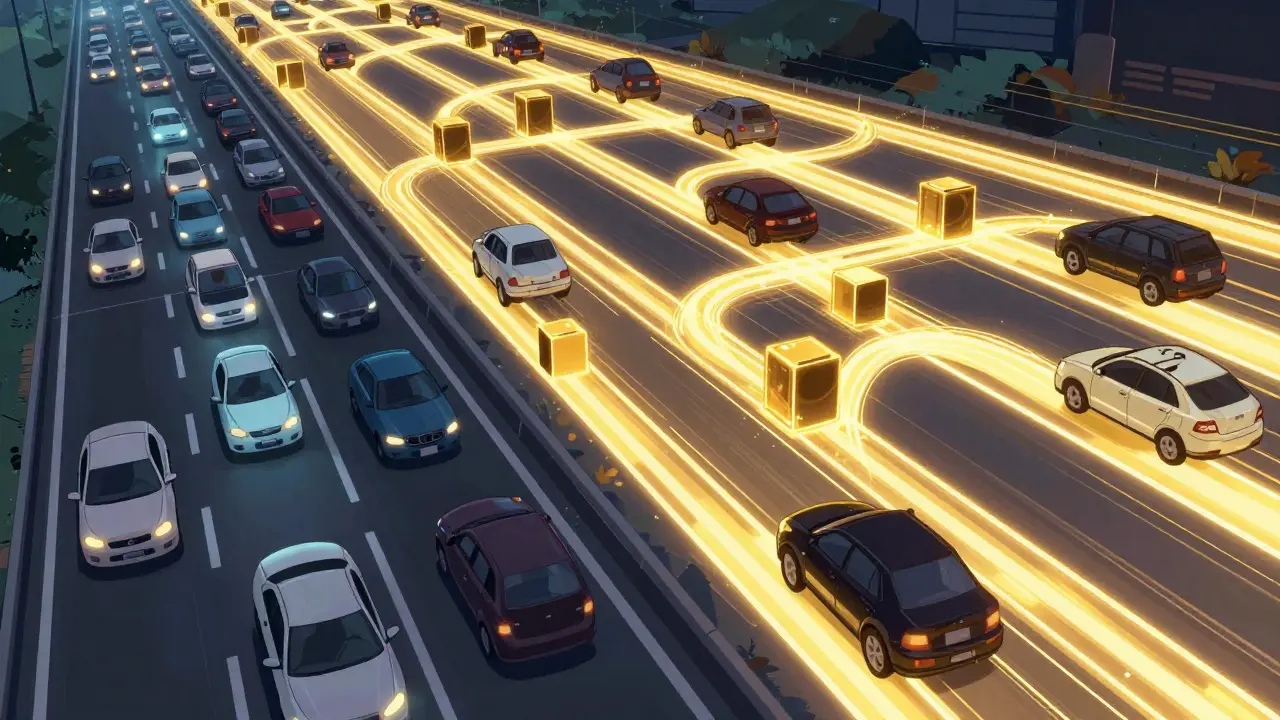
To understand why Kaspa matters, you first need to understand why traditional blockchains are so sluggish. Think of a standard blockchain like Bitcoin as a single-lane highway. Only one car (block) can move forward at a time. If two cars try to enter the lane at the exact same second, one gets stuck. The network discards the "loser" block to keep everyone on the same page. This process, known as orphaning, wastes computational power and limits how fast the network can grow.
Bitcoin produces one block every ten minutes. That’s fine for settling large, infrequent value transfers. But it’s terrible for buying coffee. Ethereum moved faster with fifteen-second blocks, but when the network gets crowded, fees skyrocket, and transactions stall. Developers faced a tough choice: make the chain faster and risk centralization (because only big players could afford the hardware), or keep it decentralized and accept the slowness.
Kaspa says, "Why choose?" By changing the fundamental structure from a linear chain to a graph, it allows multiple blocks to exist simultaneously without conflict. This is where things get interesting.
GHOSTDAG and the BlockDAG Revolution
The secret sauce behind Kaspa is a protocol called GHOSTDAG. Created by Dr. Yonatan Sompolinsky, a leading researcher in distributed systems, GHOSTDAG turns the traditional blockchain on its head. Instead of a single line of blocks, Kaspa uses a Directed Acyclic Graph (DAG). Specifically, it’s a blockDAG.
In simple terms, imagine a family tree instead of a straight line. When two miners solve a puzzle at the same time, both blocks are accepted into the network. They reference each other, creating a web of connections rather than a discarded loser. This means no mining power is wasted. Every bit of computational effort strengthens the network.
This architecture allows Kaspa to handle high throughput while maintaining the robust security of proof-of-work. You don’t have to trust a small group of validators (like in Proof-of-Stake networks); you still rely on the mathematical difficulty of hashing, just like Bitcoin. But unlike Bitcoin, you don’t have to wait ten minutes for confirmation.
| Feature | Bitcoin (Linear Chain) | Ethereum (Linear Chain) | Kaspa (BlockDAG) |
|---|---|---|---|
| Consensus Mechanism | Proof-of-Work (SHA-256) | Proof-of-Stake | Proof-of-Work (kHeavyHash) |
| Block Time | ~10 minutes | ~12 seconds | 0.1 seconds (10 BPS) |
| Transaction Visibility | Minutes | Seconds to Minutes | ~1 second |
| Orphaned Blocks | Yes (Wasted Work) | N/A | No (All Blocks Count) |
| Scalability Approach | Limited (Layer 2 needed) | Sharding / Layer 2 | Parallel Block Creation |
Speed That Actually Feels Instant
Numbers on a spreadsheet look good, but what does this mean for you as a user? On Kaspa’s mainnet, the current block rate is 10 blocks per second (BPS). This was achieved through the "Crescendo" upgrade, a hard fork that successfully doubled the previous speed without breaking the network.
When you send a KAS transaction, it becomes visible to the network in about one second. Full confirmation-meaning the transaction is practically irreversible-takes roughly ten seconds. Compare that to Bitcoin’s average confirmation time of an hour for high certainty, and the difference is night and day. For everyday payments, this feels like using cash. You hand over the value, and it’s done.
The team isn’t stopping there. The roadmap includes a migration from the Go programming language to Rust. This technical shift is crucial because Rust offers better memory safety and performance. Once completed, Kaspa aims to hit 100 blocks per second. At that speed, transaction delays will be virtually non-existent, making it viable for microtransactions and high-frequency trading scenarios.

Fair Launch and Community Ownership
One of the biggest complaints in crypto is insider allocation. Many projects sell tokens to venture capitalists before the public ever sees them, giving early investors an unfair advantage. Kaspa did the opposite. It had a fair launch. There was no pre-mine, no ICO, and no team allocation. Every single KAS coin has been mined by the community since day one.
This approach builds immense trust. Because no entity holds a massive stash of coins that could dump on the market, the price action is driven purely by supply and demand among real users. As of late 2023, over 26 billion KAS were in circulation, with a steady emission schedule that mimics Bitcoin’s halving events but happens much more frequently. This ensures a predictable, transparent monetary policy that rewards long-term holders and miners alike.
Mining Kaspa: Accessible to Everyone
Bitcoin mining has become an industrial behemoth, dominated by massive farms in Texas and China running specialized ASICs. You can’t compete with a laptop. Kaspa changes that dynamic. While ASICs do exist for Kaspa, the network is designed to be accessible. The kHeavyHash algorithm is optimized for efficiency, meaning you can mine profitably with consumer-grade hardware.
A mid-range CPU like an AMD Ryzen 5 or Intel i7 can generate a decent hash rate. This democratizes participation. You don’t need to invest thousands of dollars in equipment to join the network. You just need a computer and some electricity. This aligns perfectly with Satoshi Nakamoto’s original vision of a decentralized currency where anyone can participate. Plus, running a full node is easy. With just 4GB of RAM and 100GB of storage, you can verify transactions and support the network from your home PC.

Smart Contracts and Future Utility
Critics often point out that Kaspa lacks smart contracts. Unlike Ethereum or Solana, you can’t currently deploy complex decentralized applications (dApps) on Kaspa. This is true, but it’s also a deliberate choice. The developers wanted to perfect the consensus mechanism first. Adding smart contracts too early could introduce vulnerabilities and bloat the system.
However, development is underway. The "KaspaVM" is planned for release, which will bring Turing-complete smart contract functionality to the network. Interestingly, they aim for compatibility with the Ethereum Virtual Machine (EVM). This means developers who already know Solidity can easily port their apps to Kaspa. Once live, this will open the door for DeFi, NFTs, and gaming ecosystems, all running on a lightning-fast, secure, and fair foundation.
Risks and Challenges
No investment is without risk. Kaspa is still relatively young compared to Bitcoin or Ethereum. Its ecosystem is smaller, meaning fewer merchants accept KAS directly. You’ll likely need to swap it for stablecoins or fiat to spend it in daily life, adding a step to the process. Additionally, the transition to Rust and the introduction of smart contracts are complex engineering tasks. If executed poorly, they could introduce bugs or security flaws.
There’s also the competition factor. Other DAG-based projects and high-speed chains like Solana and Avalanche are fighting for the same market share. Kaspa’s unique selling point is its adherence to Proof-of-Work, which appeals to purists who distrust Proof-of-Stake models. Whether this niche is large enough to sustain long-term growth remains to be seen.
Is Kaspa Worth Your Attention?
If you believe in the principles of decentralization, fairness, and security, Kaspa is a project worth studying. It proves that you don’t have to sacrifice speed for security. By leveraging the GHOSTDAG protocol, it offers a glimpse of what blockchain could have been if we hadn’t been limited by linear thinking. While it may not replace Bitcoin as a store of value anytime soon, it positions itself as a superior medium of exchange. Keep an eye on its roadmap, especially the Rust migration and smart contract rollout, as these milestones will define its next phase of growth.
What makes Kaspa different from Bitcoin?
The primary difference is the underlying structure. Bitcoin uses a linear blockchain where only one block can be added at a time, leading to slow speeds and orphaned blocks. Kaspa uses a blockDAG (Directed Acyclic Graph) via the GHOSTDAG protocol, allowing multiple blocks to be created and confirmed in parallel. This results in much faster transaction times (seconds vs. minutes/hours) without compromising the security of proof-of-work.
Can I mine Kaspa with my computer?
Yes. Unlike Bitcoin, which requires expensive ASIC miners, Kaspa can be mined with consumer-grade CPUs. Algorithms like kHeavyHash are designed to be efficient on standard processors like AMD Ryzen or Intel Core series chips, making it accessible to individual miners and promoting decentralization.
Does Kaspa have smart contracts?
Not yet. Currently, Kaspa is focused on being a fast, secure payment network. However, smart contract functionality is planned for the future with the implementation of KaspaVM, which aims to be compatible with existing Ethereum smart contracts. This is expected to enable DeFi and dApp development on the Kaspa network.
Was Kaspa fairly launched?
Yes, Kaspa had a completely fair launch. There was no pre-mine, no initial coin offering (ICO), and no allocation for the development team or venture capitalists. All KAS coins have been generated through public mining since its inception in November 2021.
How fast are Kaspa transactions?
Transactions on Kaspa are visible within approximately one second and fully confirmed in about ten seconds. This is significantly faster than Bitcoin (10-minute blocks) and Ethereum (12-15 second blocks with variable congestion), making Kaspa suitable for instant peer-to-peer payments.