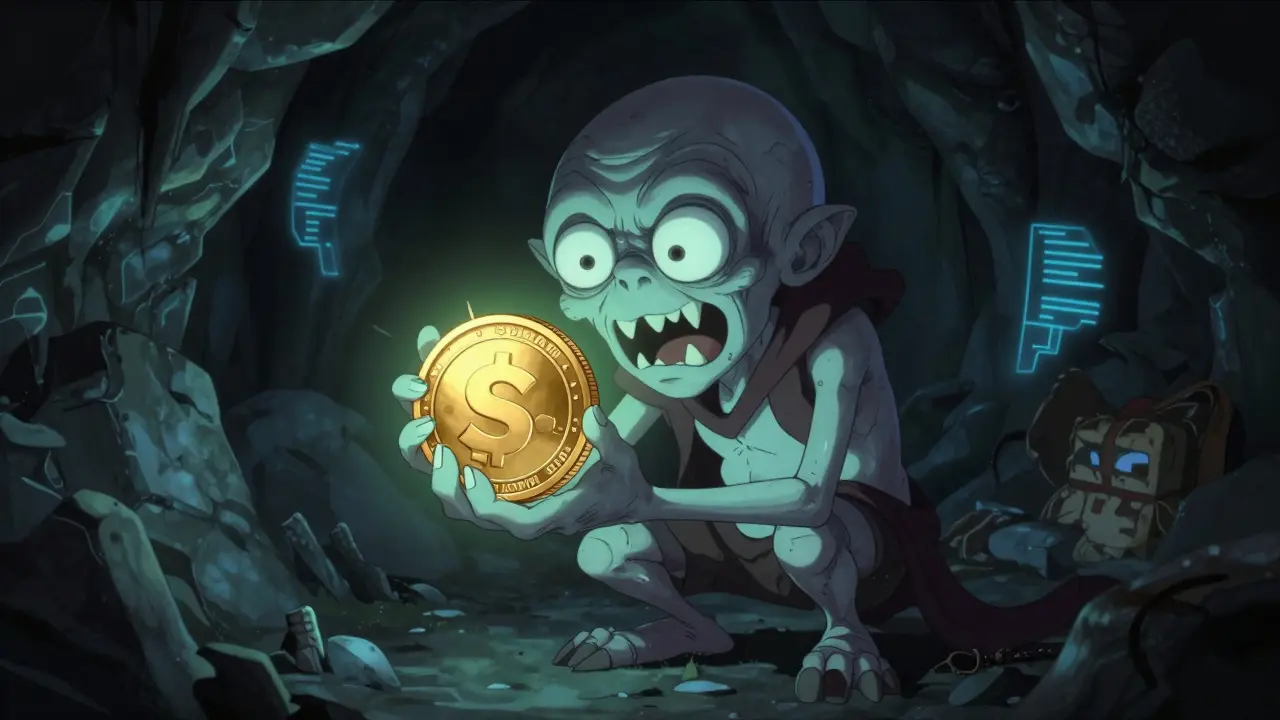
You’ve probably heard of Dogecoin or Shiba Inu. But have you seen a cryptocurrency themed around Gollum? That’s exactly what Lord Of SOL is. It’s a meme token on the Solana blockchain that leans heavily into fantasy lore and internet humor rather than complex technology or real-world utility. If you’re looking at your portfolio and wondering if this tiny, chaotic coin is worth your attention, you need to understand what it actually is before you spend a single dollar. This isn’t just another random ticker; it’s a specific type of asset with very specific risks. Here is everything you need to know about LOS, from its supply mechanics to why its price data looks so messy across different exchanges.
The Basics: What Exactly Is Lord Of SOL?
At its core, Lord Of SOL is a speculative meme token built on the Solana network, using the character Gollum as its primary marketing hook. It doesn’t have a whitepaper filled with technical jargon about decentralized finance protocols. Instead, it markets itself as "the craziest meme coin in earth." Technically, LOS is not a native coin like Bitcoin or even SOL. It is an SPL token, which stands for Solana Program Library. Think of it like an app running on top of the Solana operating system. It relies entirely on Solana’s infrastructure for security, speed, and transaction processing. You can’t mine LOS. There are no miners solving complex math problems to secure it. All tokens were created at once during the launch, and that’s it.
Tokenomics: Supply, Scarcity, and The Numbers Game
When evaluating any crypto, especially a meme coin, you have to look at the supply. For LOS, the numbers are fixed and transparent.
- Total Supply: 9,999,999,665 LOS (essentially 10 billion).
- Max Supply: Same as total supply. No more will ever be minted.
- Circulating Supply: Most aggregators report nearly the entire supply is in circulation.
Price History and Market Cap: Why The Data Looks Weird
If you check the price of LOS on three different websites, you might see three different prices. Don’t panic-this is normal for micro-cap coins. Because trading volume is so low, small trades can swing the price significantly on one exchange but not another.
| Metric | CoinMarketCap | CoinGecko | CoinLore |
|---|---|---|---|
| Current Price Range | $0.000011 - $0.000024 | ~$0.000010 | Data feed inactive since Nov 2025 |
| All-Time High (ATH) | $0.0006249 (May 2024) | Similar range | $0.000498 |
| Market Cap Estimate | ~$119,000 USD | Varies by snapshot | ~$349,000 USD (when active) |
| 24-Hour Volume | Often $0 or negligible | Low single digits | Inconsistent |
Security and Audits: Is Your Money Safe?
Safety in crypto comes in two layers: the blockchain layer and the contract layer. On the blockchain level, LOS is safe because it lives on Solana. Solana uses a hybrid consensus mechanism called Proof-of-History (PoH) combined with Proof-of-Stake (PoS). This allows for incredibly fast transactions-up to 710,000 per second theoretically-and low fees. So, your transaction won’t get stuck, and you won’t pay $50 in gas fees to buy $1 worth of LOS. On the contract level, things are trickier. Bitget lists a link to a GitHub audit by SolidProof, a known auditing firm. This suggests someone checked the code for obvious hacks. However, audits aren’t guarantees. They don’t protect against market manipulation, rug pulls (where developers remove liquidity), or simple poor management. Since the team behind LOS remains anonymous and hasn’t published a detailed roadmap, you are trusting the code alone. Always verify the contract address yourself before buying anything on a decentralized exchange.
How To Buy and Hold LOS
If you decide to take the plunge, you can’t just go to Coinbase and click "Buy" like you would with Bitcoin. Here is the practical workflow:
- Get a Solana Wallet: You’ll need a wallet like Phantom or Solflare. These handle SPL tokens natively.
- Fund with SOL: Buy SOL on a major exchange and send it to your wallet. You need SOL to pay for transaction fees.
- Use a DEX: Go to a decentralized exchange like Raydium or Jupiter. Connect your wallet.
- Swap for LOS: Paste the correct LOS contract address. Double-check it. Swapping wrong tokens is a common mistake.
- Store Safely: Keep your private keys offline. Never share them.
Who Is This For? And Who Should Stay Away?
Let’s be honest. LOS is not an investment vehicle in the traditional sense. It is a speculative bet on community sentiment. It might be for you if:
- You enjoy the culture of meme coins and understand they are high-risk entertainment.
- You have disposable income you are fully prepared to lose.
- You are interested in the Solana ecosystem and want to experiment with small-cap assets.
- You are looking for steady returns or dividend-like yields.
- You cannot afford to lose your entire principal.
- You prefer projects with doxxed teams, clear roadmaps, and institutional backing.
Is Lord Of SOL (LOS) a good investment?
LOS is highly speculative and carries significant risk. It has lost over 98% of its value from its all-time high. It should only be considered with money you can afford to lose entirely, similar to buying a lottery ticket rather than investing in a stock.
Can I mine Lord Of SOL?
No. LOS is a non-mineable SPL token on the Solana blockchain. All tokens were pre-mined at launch, and there is no proof-of-work mechanism involved.
Why does the price of LOS vary so much between websites?
Due to extremely low trading volume and liquidity, small trades can drastically change the price on specific exchanges. Different data aggregators pull from different pools, leading to discrepancies in reported prices and market caps.
Is the Lord Of SOL team anonymous?
Yes. Public listings do not identify any named founders or registered corporate entities. The project operates primarily through social media channels like X (Twitter) and an official website.
What is the total supply of LOS?
The total and maximum supply of Lord Of SOL is fixed at 9,999,999,665 tokens, which is approximately 10 billion.