
You’ve probably seen the hype around Node AI. With artificial intelligence demanding more computing power than ever, projects promising to solve the "GPU crunch" are popping up everywhere. But what exactly is this coin, and is it just another buzzword or a legitimate piece of infrastructure?
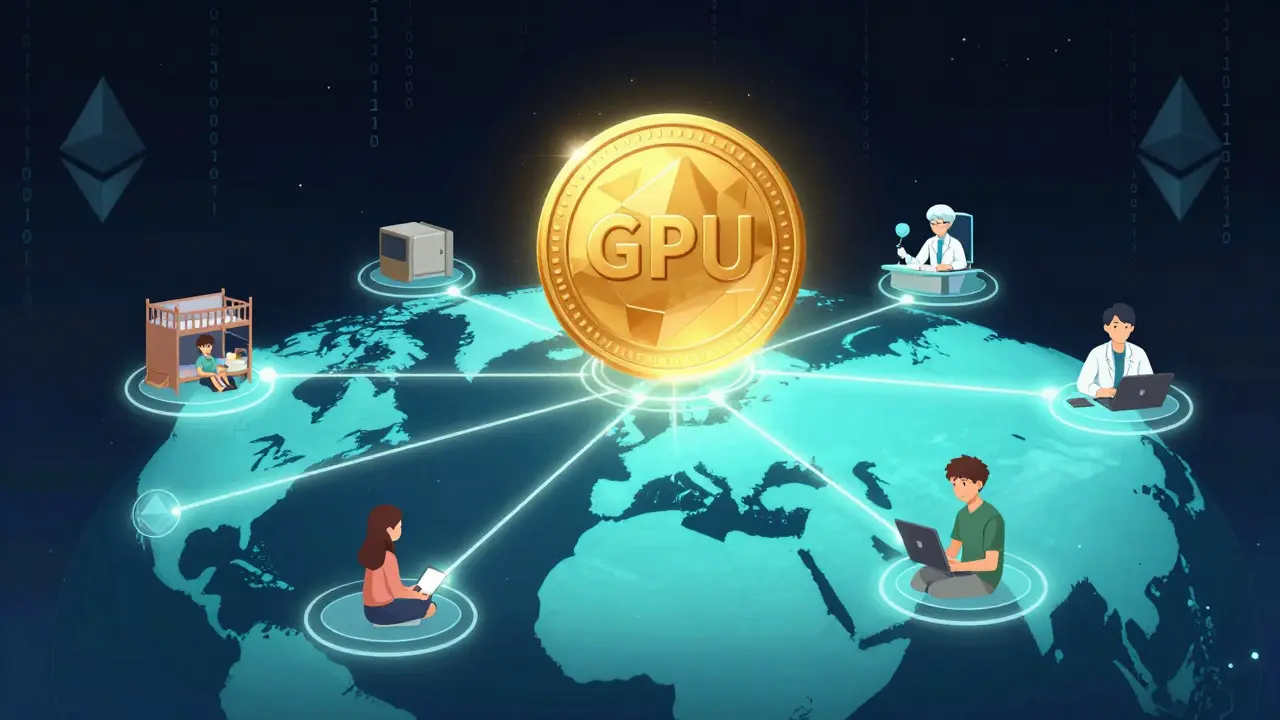
Here is the short version: Node AI is an Ethereum-based platform that turns idle graphics cards into a shared marketplace for AI computing. Its native token, GPU, pays for these services. It’s not a magic money printer; it’s a utility token designed to grease the wheels of a decentralized network.
Is Node AI a scam?
No, Node AI is a legitimate project with real technical architecture, but like all crypto, it carries high risk. It has faced criticism for uptime issues and competition from giants like AWS.
The Core Problem: Why We Need Decentralized GPUs
Let’s talk about why this exists. Training modern AI models-like the ones powering chatbots or image generators-requires massive amounts of processing power. Specifically, it needs Graphics Processing Units (GPUs). For years, three companies dominated this space: NVIDIA, AMD, and Intel. If you wanted to rent powerful GPUs, you went to centralized cloud providers like Amazon Web Services (AWS), Google Cloud, or Microsoft Azure.
This created two big problems:
- Cost: Renting an A100 GPU on AWS can cost over $3 per hour. For indie developers or small research teams, this burns through budgets in days.
- Vendor Lock-in: You’re stuck with their pricing, their availability, and their terms. If they raise prices or limit your access, you have little recourse.
Enter Node AI. Launched in late 2023, the project aims to democratize access to AI infrastructure. Instead of renting from a giant data center, you rent from a global network of individuals and businesses who have spare GPUs sitting idle. This peer-to-peer model drives down costs significantly-independent benchmarks showed savings of 37% to 62% compared to traditional cloud providers.
How the Node AI Network Actually Works
Understanding the tech stack is crucial because it separates real utility from vaporware. Node AI operates on the Ethereum blockchain. Here is the flow:
- Providers Join: Individuals with compatible NVIDIA GPUs (minimum 8GB VRAM, 16GB RAM) install Node AI software. They stake GPU tokens to prove they are serious and secure.
- Developers Request Compute: An AI developer needs to run a task, like fine-tuning a language model. They send a request to the network.
- Task Distribution: The platform’s middleware breaks the task into smaller chunks and distributes them across available GPU nodes.
- Verification: This is the tricky part. How do you know the node didn’t fake the result? Node AI uses zero-knowledge proofs and encryption to verify that the computation was done correctly without revealing the underlying data.
- Payout: Once verified, the provider gets paid in GPU tokens. The developer’s tokens are burned or returned based on the transaction logic.
The system relies on the GPU token, which is an ERC-20 utility token used for transactions, staking, and governance within the Node AI ecosystem. There is a fixed maximum supply of 100 million tokens. As of late 2023, nearly 98 million were already in circulation, meaning inflationary pressure is low, but selling pressure from early holders could be significant.
Token Economics: What Drives the Value?
If you are looking at the price chart, you need to understand what actually creates demand for the token. Unlike meme coins driven by social media trends, Node AI’s value proposition is tied to usage.
Demand comes from:
- Compute Rentals: Developers must hold GPU tokens to pay for processing time.
- Staking Requirements: Node operators must lock up tokens to participate. This removes supply from the market.
- Governance: Token holders vote on protocol upgrades and fee structures.
Supply dynamics include:
- Fixed Cap: No new tokens will ever be minted beyond the 100 million limit.
- Liquidity: Trading volume has been relatively modest (under $100k daily in late 2023), which means large buy or sell orders can cause sharp price swings.
In November 2023, the token traded around $0.085. Predictions vary wildly. Some analysts, citing AI adoption curves, projected growth to $1.59 by 2031. Skeptics argue that if cloud giants lower their prices, the decentralized advantage shrinks, potentially capping the token’s upside. Always remember: these are projections, not guarantees.
Node AI vs. The Competition
Node AI isn’t playing in an empty field. The decentralized compute sector is crowded. Here is how it stacks up against key players:
| Feature | Node AI | Render Network (RNDR) | AWS (Centralized) |
|---|---|---|---|
| Primary Focus | AI Inference & Training | 3D Rendering & AI | General Cloud Computing |
| Cost Efficiency | High (37-62% cheaper) | Moderate | Low (Premium pricing) |
| Uptime Guarantee | ~95.2% | Varies by node | 99.99% SLA |
| Best For | Indie Devs, Researchers | Creative Industries | Enterprise, Mission-Critical Apps |
| Blockchain | Ethereum | Solana/Ethereum | N/A |
Render Network is the biggest name here, but it started with 3D rendering before pivoting to AI. Node AI was built specifically for AI workloads from day one, which gives it a slight edge in optimization for tasks like LLM (Large Language Model) inference. However, AWS offers something Node AI cannot: reliability. If your app goes down, AWS has a dedicated support team on speed dial. On Node AI, you might wait 38 hours for a response from official support, as reported by users in late 2023.
Risks and Real-World Challenges
It’s easy to get excited about the tech, but you need to look at the friction points. Based on user reports from Reddit and Trustpilot, here are the real-world issues:
- Node Instability: Because the network relies on home hardware, nodes can disconnect unexpectedly. One developer reported two manual restarts needed during an 8-hour training session. This is unacceptable for enterprise clients but manageable for hobbyists.
- Latency Variance: Network latency ranged from 150ms to 850ms depending on geography. For real-time AI applications, this jitter can be problematic.
- Documentation Gaps: While basic setup is straightforward, advanced troubleshooting guides are sparse. Users often rely on community forums rather than official docs.
- Regulatory Uncertainty: Like all crypto projects, Node AI faces evolving regulations. It implements KYC/AML for large transactions, but legal risks remain.
Dr. Elena Rodriguez, Chief AI Officer at TechInnovation Labs, noted that while Node AI solves a critical pain point, its long-term success depends on achieving "critical mass." Without enough active nodes, resource availability drops, driving users back to centralized clouds.
Who Should Use Node AI?
Not everyone needs decentralized compute. Here is a quick decision tree:
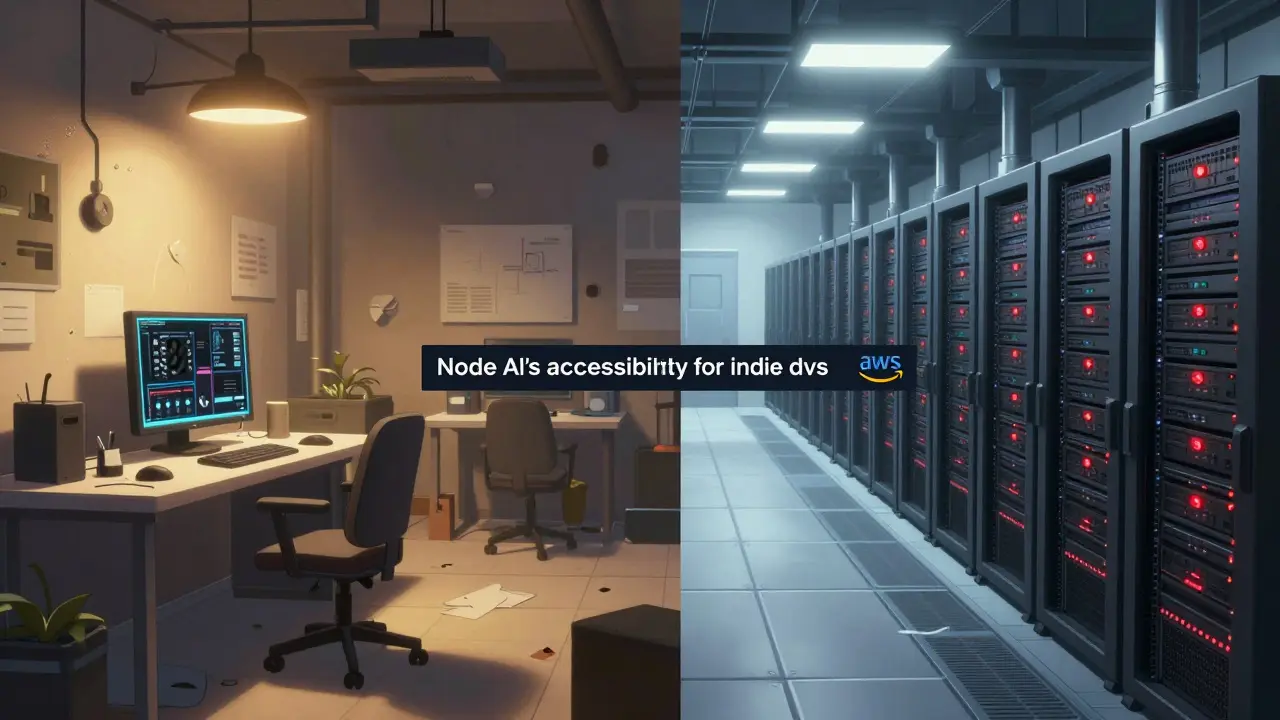
- Use Node AI if: You are an indie developer, a student, or a researcher with a limited budget. You need flexible, pay-as-you-go access to GPUs for training or inference tasks that aren’t mission-critical. You are comfortable with some technical tinkering.
- Avoid Node AI if: You are running a commercial product where downtime costs thousands of dollars per minute. You need guaranteed SLAs, 24/7 human support, and complex enterprise security compliance. In this case, stick with AWS, Google Cloud, or Azure.
Future Outlook: Where Does It Go From Here?
The roadmap for Node AI includes significant upgrades planned for 2024. Key milestones include:
- Reputation System (Jan 2024): To combat unreliable nodes, a scoring system will reward consistent performers and penalize frequent disconnectors.
- Multi-Chain Support (Mar 2024): Expanding beyond Ethereum to reduce gas fees and increase accessibility.
- Enterprise SLAs (Q2 2024): Attempting to bridge the gap with traditional cloud providers by offering higher-tier service guarantees.
The broader market for decentralized AI infrastructure is projected to grow from $3.2 billion in 2023 to $28.7 billion by 2030. Node AI is positioned to capture a slice of this pie, but it must execute flawlessly. If it can onboard 50,000 active nodes, it could become a dominant player. If it fails to solve the reliability issue, it may remain a niche tool for crypto-native developers.
Can I mine Node AI GPU tokens?
Not in the traditional sense. You earn GPU tokens by providing compute power. You need an NVIDIA GPU with at least 8GB VRAM, install the Node AI software, and stake tokens to start hosting jobs. It's more like renting out your hardware than mining.
Is Node AI safe for my data?
Node AI uses AES-256 encryption for data transfers and zero-knowledge proofs to verify computations without exposing raw data. However, because it's a decentralized network using third-party hardware, there is always a theoretical risk compared to isolated enterprise servers. Avoid uploading highly sensitive proprietary data unless you fully trust the encryption layer.
What is the minimum requirement to join as a node operator?
You need an NVIDIA GPU with 8GB+ VRAM, 16GB RAM, and 100 Mbps internet. You also need to stake 500 GPU tokens to become an operator. The setup process takes 2-4 hours according to official docs.
How does Node AI compare to Render Network?
Render Network focuses heavily on 3D rendering and creative workflows, while Node AI is specialized for AI model training and inference. Node AI generally offers lower costs for pure AI tasks, but Render has a larger market cap and broader brand recognition.
Where can I buy GPU tokens?
GPU tokens are traded on various cryptocurrency exchanges. Check platforms like Uniswap (for direct ERC-20 swaps) or centralized exchanges that list the token. Always verify the contract address to avoid scams.