You’ve seen the ticker TITANX pop up on a chart or in a social media group. Maybe someone promised you massive returns from its "28%+ ETH yield." Before you send any money, we need to talk about what this token actually is-and more importantly, why the data surrounding it looks suspicious.
TitanX (TITANX) is a speculative decentralized finance (DeFi) token built on the Ethereum blockchain that claims to offer high yields through buy-and-burn mechanisms but suffers from extreme price discrepancies and low liquidity. It operates as an ERC-20 token, meaning it lives on the Ethereum network, just like USDT or UNI. However, unlike established projects with clear teams and audited code, TitanX sits in the murky world of micro-cap cryptocurrencies where information is scarce and risk is high.
The Core Concept: Mining Time for Your Future Self?
According to listings on platforms like CoinGecko, TitanX markets itself as a DeFi ecosystem that allows users to "mine with ETH and time to pay their future self." This sounds intriguing until you dig into the mechanics. The project claims to use a deflationary model where over 62% of transactions go toward buying back and burning tokens, supposedly generating those advertised yields.
In theory, burn mechanisms reduce supply, which can increase scarcity and value. In practice, for a token with such low trading volume, these mechanics are difficult to verify. There is no independent audit from firms like CertiK or OpenZeppelin confirming that the smart contract actually performs these burns as promised. Without transparency, "buy and burn" remains a marketing term rather than a guaranteed feature.
The Data Problem: Why Prices Don't Match
If you look at TitanX across different exchanges, you will notice something alarming. The price varies wildly depending on where you check. This isn’t normal market fluctuation; it’s a sign of severe liquidity issues.
| Platform | Reported Price | Note |
|---|---|---|
| Coinpedia | $0.0623 | Significantly higher than others | Coinbase | $0.00000021 | Micro-dollar range |
| CoinStats | $0.00000022 | Matches Coinbase closely |
| Uniswap v3 | $0.0613 | High slippage likely |
See that gap? A difference of hundreds of thousands of times between $0.06 and $0.00000021 is not a healthy market. It suggests that one platform might be showing a stale price, while another reflects actual tradeable liquidity. When analyst Benjamin Cowen discussed similar tokens in late 2025, he called them "data artifacts rather than investable assets" when discrepancies exceed 100x. For TitanX, the discrepancy is far worse.
Tokenomics and Supply Confusion
Another red flag is the maximum supply. Different sources report completely different numbers. Coinpedia lists a max supply of roughly 2.3 trillion tokens, while CoinStats reports over 105 trillion. That is a 44-fold difference. If you are calculating your potential return based on the wrong supply number, your math is broken from the start.
The fully diluted valuation (FDV) reported by Coinbase is around $501,740. While that sounds small compared to Bitcoin, for a micro-cap token, it implies there is very little money backing each coin. With only about 1,847 unique wallet addresses holding the token as of late 2025, the holder base is tiny. This makes the price highly susceptible to manipulation by a few large holders.
Liquidity Traps and Slippage
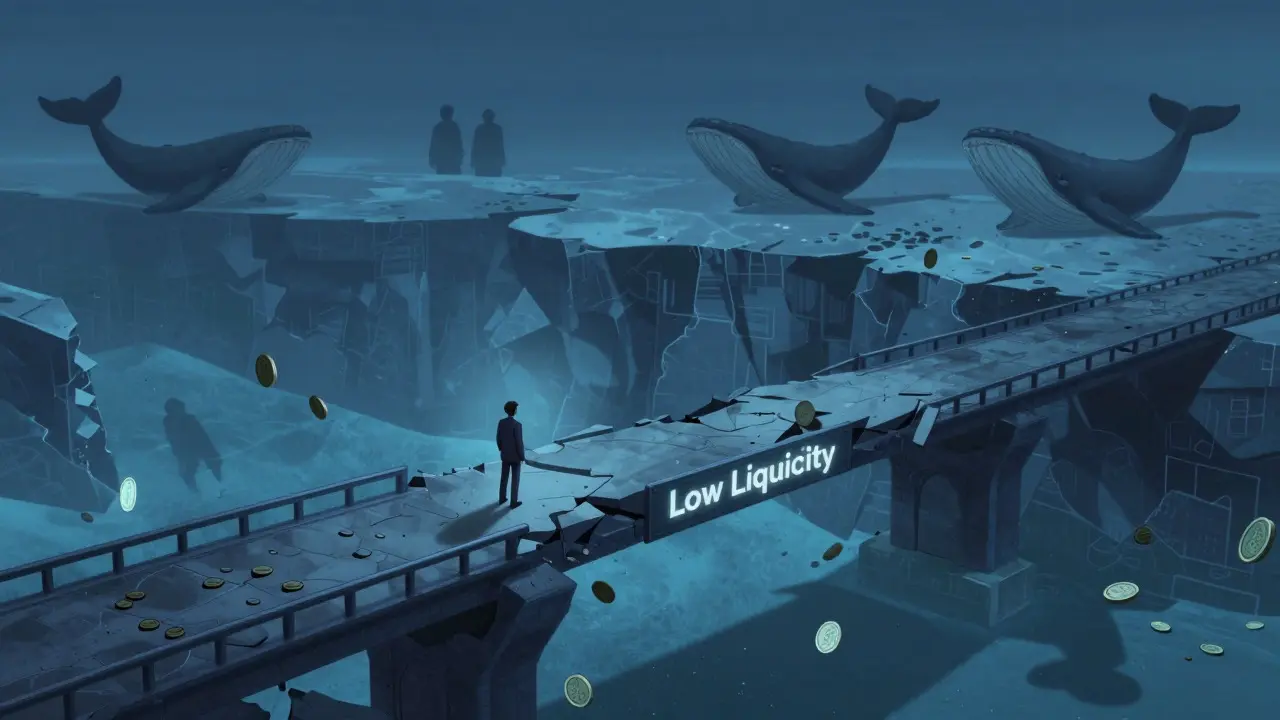
Liquidity is how easily you can buy or sell a token without moving the price. TitanX has extremely low liquidity. Reports from Bitcointalk in November 2025 detail users experiencing failed swaps on Uniswap because they had to accept 15% slippage just to execute a trade. Slippage is the difference between the expected price and the executed price. High slippage means you lose value instantly upon entry or exit.
Imagine trying to sell a house in a neighborhood where only one person lives. You have no choice but to accept whatever price that one buyer offers. That is the reality of trading TitanX. The daily trading volume hovers around $140,000 to $370,000 depending on the source, which is negligible compared to major DeFi protocols like Uniswap, which sees billions in daily volume.
Regulatory and Security Risks
Because TitanX promises specific returns ("28%+ ETH yield"), it may fall under the definition of an investment contract under the Howey Test used by the U.S. Securities and Exchange Commission (SEC). If classified as an unregistered security, the token could face delisting or legal action. Currently, there is no official whitepaper linked from the Ethereum contract page, and the team behind the project remains anonymous.
Anonymity isn’t always bad in crypto, but combined with a lack of audits and inconsistent data, it raises the risk of a "rug pull," where developers abandon the project and take the liquidity. As of mid-2026, the official Twitter handle @TitanXCrypto has been inactive since September 2025, suggesting minimal community engagement or development updates.
How to Verify TitanX Yourself
If you still want to explore TitanX, follow these steps to protect yourself:
- Check the Contract Address: Always verify the address
0xF19308F923582A6f7c465e5CE7a9Dc1BEC6665B1on Etherscan. Scammers often create fake tokens with the same name but different addresses. - Use Multiple Aggregators: Compare prices on DexScreener, Dextools, and CoinGecko. If they don’t match, assume the lower price is closer to reality due to liquidity constraints.
- Set Slippage Carefully: On Uniswap, set your slippage tolerance to a minimum of 10-15% if you must trade, but be prepared to lose that percentage immediately.
- Start Small: Only invest what you can afford to lose entirely. Treat it as entertainment, not an investment.
Is TitanX Worth It in 2026?
For most investors, the answer is no. The combination of data inconsistencies, low liquidity, and lack of transparent governance makes TitanX a high-risk speculative asset. It ranks in the bottom 0.5% of all cryptocurrencies by market significance. While micro-cap tokens can occasionally surge, statistics show that 92% of such tokens lose over 90% of their value within 90 days.
Unless you are an experienced DeFi user comfortable navigating fragmented data and high slippage, sticking to established tokens with verified audits and active communities is a safer bet. TitanX serves as a cautionary tale about the importance of due diligence in the crypto space.
What blockchain is TitanX built on?
TitanX is an ERC-20 token built on the Ethereum blockchain. Its contract address is 0xF19308F923582A6f7c465e5CE7a9Dc1BEC6665B1.
Why does TitanX have different prices on different sites?
The price discrepancies are due to extremely low liquidity and fragmented trading volumes. Some platforms may show stale data, while others reflect real-time trades with high slippage, leading to variations of hundreds of thousands of percent.
Is TitanX a safe investment?
No, TitanX is considered a high-risk speculative asset. It lacks independent audits, has an anonymous team, and suffers from data inconsistencies. Most micro-cap tokens lose significant value quickly.
What is the maximum supply of TITANX?
There is conflicting data regarding the max supply. Sources range from 2.3 trillion to over 105 trillion tokens. This inconsistency makes accurate valuation difficult.
Does TitanX have a whitepaper?
As of mid-2026, no official whitepaper is linked from the Ethereum contract page or verified official channels, indicating poor documentation quality.
Heather Austin
July 23, 2026 AT 02:15honestly i think ppl are overreacting a bit but yeah the data looks sketchy. ive been tracking similar micro caps for years and usually when the supply numbers dont match across platforms its a sign of bad coding or worse. just be careful out there
Ran Tao
July 23, 2026 AT 22:46You guys are missing the forest for the trees 🌲😂 This isn't about 'sketchy data', it's about the sheer audacity of the market! While you lot panic over slippage, the real whales are laughing all the way to the bank 💸🚀 It’s a spectacle, pure and simple, and we are all just ants watching the boot fall 👢✨
Brad Semp
July 24, 2026 AT 17:03The fundamental analysis presented here is rudimentary at best, yet it highlights a critical failure in modern decentralized finance governance. One must consider that liquidity fragmentation is an inherent characteristic of early-stage protocols, not necessarily a defect. However, the lack of a whitepaper is intellectually dishonest and borders on fraudulent. A sophisticated investor would never engage with such an opaque instrument without rigorous due diligence, which clearly has not been performed by the majority of the holders.
Ruth Williams
July 25, 2026 AT 12:04Let us be clear: this token is a testament to the intellectual laziness of the current generation of investors. They chase yield like moths to a flame, ignoring the glaring inconsistencies in supply data. It is pathetic. If one cannot discern between a viable asset and a digital mirage, one deserves whatever financial ruin awaits them. The market corrects itself through pain, and TitanX is merely the latest lesson in humility for the uninitiated masses.
Korn Arrieta
July 25, 2026 AT 19:53The metrics are garbage. Look at the volume. $140k daily volume on a token with a supposed trillion-dollar potential? It is a joke. The burn mechanism is likely a placebo effect coded into the contract to make holders feel safe while the devs drain the pool. I checked the Etherscan transactions myself. Most burns are self-transfers from the dev wallet. Classic rug pull setup. Don't touch it.
Sophie Nakasako
July 27, 2026 AT 05:28I wonder if there is any philosophical merit to the concept of 'mining time' even if the execution is flawed. Is it possible that the community value outweighs the technical deficiencies? Perhaps we should look at the social dynamics rather than just the cold hard numbers. What do you all think about the human element behind these anonymous teams?
Kristy Morrow
July 29, 2026 AT 02:50philosophy is for people who cant read a balance sheet. the reality is simple greed. anon teams mean anon thieves. end of story. stop romanticizing the scam
Jackie D
July 29, 2026 AT 04:52i found this whole situation super weird like why would anyone trust a project that doesnt even have a website link in the contract?? its like buying a house without seeing the inside first. kinda terrifying honestly. i guess some folks just love gambling more than investing tho. wild world we live in
John Harman
July 30, 2026 AT 11:17Listen up, you need to understand how Uniswap v3 works before you cry about slippage. The price discrepancy is because Coinpedia is showing a stale cache or a manipulated order book from a dead exchange. Coinbase and CoinStats are aggregating actual trades. If you're losing money on slippage, you're setting your tolerance wrong. Educate yourself instead of blaming the protocol. It's basic DeFi mechanics.
Antony Lopez
August 1, 2026 AT 10:23This is exactly what happens when we allow foreign entities to flood our markets with unregulated securities. The SEC needs to step in and shut this down immediately. American investors deserve better than these shady offshore schemes. It's a drain on our economy and a threat to national financial security. We need stricter laws for crypto.
Kat Barr
August 1, 2026 AT 14:02Hey everyone!!! 😊 Just wanted to say that even though this looks scary, maybe there is a silver lining somewhere?! 🌈💖 Sometimes these small projects grow into something amazing if the community sticks together! Don't give up hope!! Keep learning and stay positive!! You got this!! ✨🙌