You’ve probably stumbled across TosDis (DIS token) on a price tracker or a social media feed and wondered what it actually is. It’s not Bitcoin. It’s not Ethereum. In fact, if you look at the numbers, it looks like a ghost from the 2021 bull run that somehow survived to tell the tale.
TosDis (DIS) is a micro-cap cryptocurrency token built on the Ethereum network. It started with a lot of hype in early 2021, reached dizzying heights, and then crashed hard. Today, it trades as a high-risk asset with very low liquidity. If you are thinking about buying it, holding it, or just trying to understand why its price swings so wildly, you need to look past the ticker symbol and understand the reality of trading a token this small.
The Origin Story: A 2021 ICO Flash
To understand where TosDis is today, you have to look at where it began. The project launched its initial coin offering (ICO) on January 20, 2021. This was right in the middle of the massive DeFi boom when everyone was looking for the next big thing.
Here are the facts from that launch:
- ICO Date: January 20, 2021
- ICO Price: $57.00 per DIS token
- Funds Raised: Approximately $1.50 million
- Tokens Sold: Roughly 26,315 DIS
Raising $1.5 million in a single day is impressive. But here is the kicker: the price immediately after the ICO skyrocketed. By February 6, 2021, just weeks later, the price hit an all-time high (ATH) of roughly $254.74. That was a 4.47x return on investment for those who bought at the ICO price and sold at the peak.
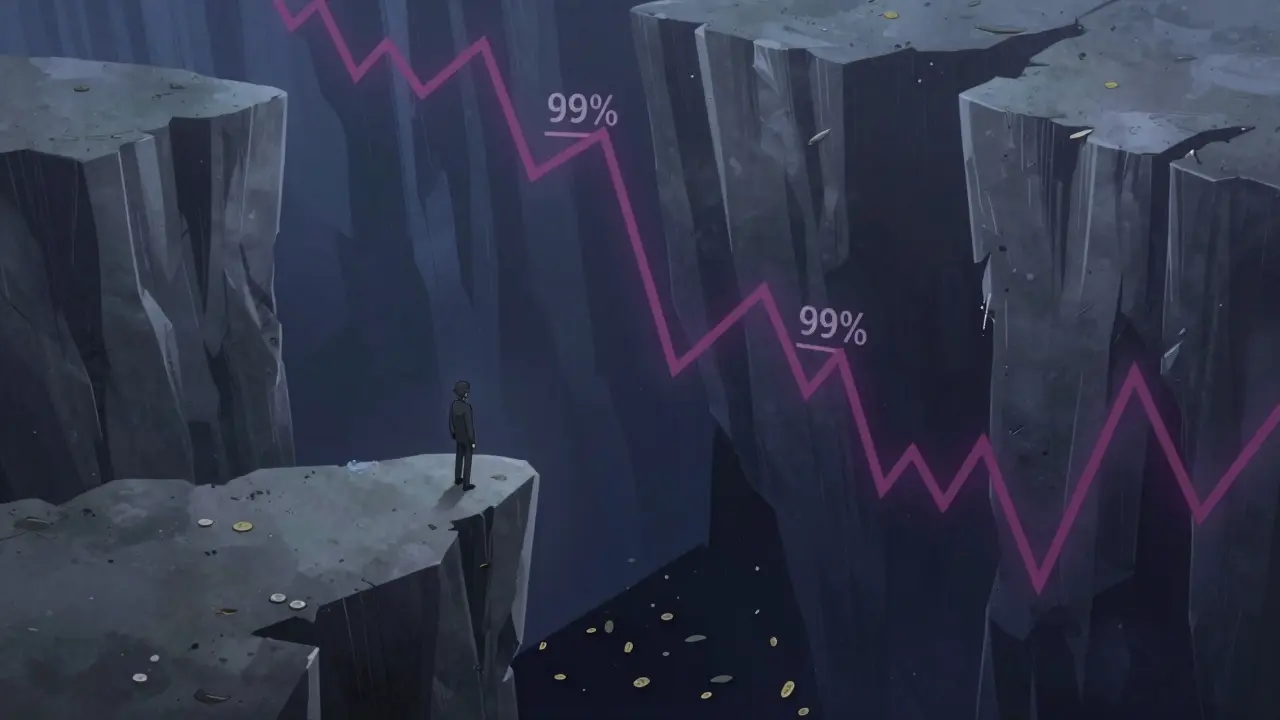
But then, the music stopped. Like many speculative assets from that era, the momentum vanished. The price didn’t just dip; it collapsed. As of mid-2026, the token is trading over 99% below that all-time high. For someone who bought at the $57 ICO price and held on, the loss is staggering-around 98% to 99%. This history tells you one clear thing: TosDis is an extremely volatile asset with a severe drawdown history.
Tokenomics: Supply and Scarcity
When evaluating any crypto, supply dynamics matter. TosDis has a fixed maximum supply, which means no new tokens can be minted out of thin air by the developers. Let’s break down the numbers.
| Metric | Value |
|---|---|
| Maximum Supply | 99,860 DIS |
| Circulating Supply | ~75,000 DIS |
| Supply in Circulation | ~75.1% |
| Locked/Reserved | ~24,860 DIS (~24.9%) |
With about 75% of the total supply already circulating, the token isn’t facing immediate inflationary pressure from new unlocks. However, the remaining ~25% being locked raises questions. Who holds these tokens? Are they team members? Investors? Reserves? Without transparent documentation, this uncertainty adds to the risk profile. In larger projects, vesting schedules are public. For micro-caps like TosDis, this information is often scarce, meaning you have to assume the worst-case scenario regarding potential sell-offs from large holders.
Where Can You Trade DIS?
Liquidity is life in crypto. If you can’t sell your tokens easily, they are essentially worthless paper. TosDis has very limited exchange listings, which concentrates all its trading activity into just two venues.
- Gate.io (Centralized Exchange): This is where the vast majority of volume happens. CoinLore data shows that Gate accounts for nearly 99.5% of daily trading volume. The primary trading pair is DIS/USDT. If you want to trade TosDis, this is likely your only practical option for decent liquidity.
- Uniswap V2 (Decentralized Exchange): Because DIS is an ERC-20 token on Ethereum, it can be traded on Uniswap. However, the liquidity pool is shallow. In recent snapshots, Uniswap saw less than $50 in daily volume compared to tens of thousands on Gate. Trying to sell a large amount here would result in massive slippage-you’d get a terrible price because there aren’t enough buyers in the pool.
This concentration on Gate.io is a double-edged sword. On one hand, it means you don’t need to navigate complex decentralized wallet setups if you use Gate. On the other hand, it means your ability to trade depends entirely on Gate’s listing status. If Gate were to delist DIS tomorrow, the token would effectively become untradeable for most people.
How to Buy TosDis (DIS)
If you decide you want exposure to this micro-cap asset, here is how you actually do it. Remember, this is high-risk. Only invest what you can afford to lose completely.
Option 1: Buying via Gate.io (Recommended for Liquidity)
Since Gate handles almost all the volume, this is the most straightforward path.
- Create an Account: Sign up on Gate.io and complete KYC (Know Your Customer) verification. This usually involves uploading ID documents.
- Fund Your Wallet: Deposit fiat currency (like USD or EUR) using a bank transfer or credit card, or deposit a stablecoin like USDT or ETH.
- Navigate to Spot Trading: Go to the “Trade” section and select “Spot.”
- Find the Pair: Search for “DIS/USDT.”
- Place Order: You can place a market order to buy instantly at the current price, or a limit order to set your desired price. Given the low liquidity, limit orders are often safer to avoid buying at a spiked price.
Option 2: Buying via Uniswap (For Self-Custody Fans)
This route requires more technical know-how and costs more in gas fees.
- Set Up a Wallet: Install MetaMask or another Ethereum-compatible wallet.
- Buy ETH: Purchase Ethereum on a major exchange and send it to your MetaMask wallet. You’ll need ETH to pay for transaction fees (gas).
- Connect to Uniswap: Go to the Uniswap interface and connect your wallet.
- Swap for DIS: Select ETH (or USDC) in the top box and paste the DIS contract address in the bottom box. Warning: Always verify the contract address from official sources to avoid scams.
- Confirm Transaction: Approve the swap in MetaMask. Be aware that slippage might be high due to low liquidity.
The Risk Profile: Why Is It So Cheap Now?
Let’s talk about the elephant in the room. The price of DIS fluctuates between roughly $0.27 and $1.27 depending on the aggregator and time of day. Its market capitalization hovers around $75,000 to $95,000. To put that in perspective, that is less than the value of a single Bitcoin.
Why did it drop 99% from its all-time high?
- Speculative Bubble Burst: Many 2021 tokens were driven by hype rather than utility. When the hype faded, the price followed.
- Lack of Utility: Unlike tokens that power active networks or offer staking rewards with real yield, TosDis lacks widely documented utility. There is little evidence of a growing user base or enterprise adoption.
- Low Liquidity Traps: With such a small market cap, a few large sellers can crash the price instantly. Conversely, a few buyers can spike it. This makes it vulnerable to manipulation.
Data from CoinGecko and CryptoRank shows the token is ranked outside the top 2,500 cryptocurrencies. It has no significant market dominance. This isn’t a store of value; it’s a speculative instrument. Treat it like a lottery ticket, not an investment portfolio cornerstone.

Price Volatility and Market Data
Because TosDis is a micro-cap, price data varies wildly between platforms. One tracker might show $0.27 while another shows $1.27. This discrepancy happens because there isn’t enough trading volume to synchronize prices across exchanges instantly.
Key metrics to watch:
- All-Time High: $254.74 (Feb 6, 2021)
- All-Time Low: $0.0094 (May 13, 2023)
- Current Range: $0.27 - $1.27 (Highly variable)
- 24-Hour Volume: Typically $80,000 - $100,000 (mostly on Gate)
Notice the 24-hour volume is sometimes higher than the entire market cap. This indicates a high turnover rate, meaning traders are flipping positions quickly. While this suggests activity, it also signals instability. Prices can swing 50% in a single day based on a few large orders.
Is TosDis a Good Investment in 2026?
I’m not a financial advisor, but I can give you a framework for decision-making. Ask yourself these questions:
Do you understand the risk? Yes. You could lose 100% of your money. The project has already lost 99% of its peak value. There is no guarantee it will recover.
Is there fundamental value? Look for updates. Check their GitHub for code commits. Check their social media for community growth. If the development is dead and the community is silent, the token is likely going to zero eventually.
Why are you buying? If you’re hoping for a 100x return because it’s cheap, remember that it was once expensive and still fell. Cheap does not mean undervalued; it often means broken.
If you are an experienced trader who understands how to read order books on Gate.io and manage risk tightly, you might find opportunities in the volatility. For the average investor seeking long-term growth, TosDis offers little safety and unclear upside. Stick to assets with proven utility, strong communities, and deep liquidity unless you are specifically speculating on micro-cap rebounds.
What is the current price of TosDis (DIS)?
The price of DIS is highly volatile and varies by exchange. As of mid-2026, it typically trades between $0.27 and $1.27. Due to low liquidity, prices can differ significantly between Gate.io and decentralized trackers like CoinGecko. Always check the live order book on the exchange you intend to use.
Where can I buy TosDis (DIS) tokens?
The primary place to buy DIS is on the centralized exchange Gate.io (using the DIS/USDT pair). It is also available on Uniswap V2 on the Ethereum network, but liquidity there is extremely low, leading to high slippage and poor execution for larger trades.
Why did TosDis drop so much from its all-time high?
TosDis peaked in February 2021 during a broader crypto bull run, reaching ~$254. Like many speculative tokens from that period, it lacked sustained utility or adoption. As market sentiment shifted and liquidity dried up, the price collapsed. It has since stabilized as a micro-cap asset but remains over 99% below its peak.
Is TosDis a scam?
There is no definitive public evidence labeling TosDis as a outright scam, but it exhibits many characteristics of high-risk, abandoned, or zombie projects. These include extremely low market cap, minimal exchange listings, lack of clear utility, and scarce developer activity. Investors should exercise extreme caution and perform their own due diligence.
What is the total supply of DIS tokens?
The maximum supply of TosDis is capped at 99,860 tokens. Approximately 75,000 tokens are currently in circulation, meaning about 75% of the total supply is available in the market, with the remainder locked or reserved.
Can I stake TosDis (DIS) for rewards?
Based on available data, there is no widely recognized staking mechanism or yield-generating protocol associated with TosDis. Most DeFi tokens offer staking, but TosDis appears to function primarily as a tradable asset without additional utility features like governance or staking rewards.
Barclay Chantel
June 3, 2026 AT 14:06It is truly pathetic that people still fall for these digital snake oils. TosDis isn't an investment, it's a charity case for the desperate and the gullible.
Bill Gunn
June 3, 2026 AT 22:57Hey folks! 👋 Just wanted to add a bit of context here. The liquidity situation on Gate.io is actually pretty standard for micro-caps, but you have to watch those order books like a hawk 🦅. If you see a wall disappearing, run don't walk! Also, always double-check contract addresses on Etherscan before swapping on Uniswap because scammers love copying tokens 😬
Edith Mair
June 5, 2026 AT 14:24I need to know who holds that 25% locked supply. It feels like a ticking time bomb waiting to go off. Why isn't this information public? That lack of transparency is unacceptable for any project claiming legitimacy.
Hadleigh Edwards
June 7, 2026 AT 05:26You really have to look at the bigger picture here because while the price action has been absolutely devastating for early holders, there is always a possibility that some dormant community might wake up and create a sudden spike in volume which could theoretically lead to a short term recovery if the broader market sentiment shifts towards high risk assets again and we see a rotation into forgotten gems from the previous cycle.
Diana Morris
June 8, 2026 AT 21:27stop buying trash
Sam Dashti
June 10, 2026 AT 10:32Man, reading about that 99% drop gives me chills. It’s like watching a car crash in slow motion. I remember back in '21 when everything was green and everyone thought they were Warren Buffett. Now it’s just a ghost town with a pulse. Crazy how fast the hype train derailed.
Crystal Davis
June 12, 2026 AT 01:37The tokenomics are fundamentally broken. A max supply under 100k with no clear utility is a recipe for manipulation. Anyone telling you otherwise is either lying or delusional. It's a zombie chain propped up by bots.
Dana Rapoport
June 13, 2026 AT 01:33Let us reflect on the nature of value itself. Is a token valuable only if it has utility, or does the belief of the community sustain its existence? TosDis seems to exist in a limbo between these two states, offering a lesson in impermanence.
mark valmart
June 14, 2026 AT 20:59I get why people are skeptical. It's tough out there. But hey, if you're gonna play the lottery ticket game, at least make sure you understand the odds. Don't let fear stop you from learning, though.
Joshua Alcover
June 16, 2026 AT 11:05The structural integrity of such decentralized financial instruments is inherently compromised by the lack of regulatory oversight and the prevalence of malicious actors within the ecosystem. One must consider the geopolitical implications of capital flight into unregulated micro-assets as a symptom of broader economic instability.
Dianne Wright
June 17, 2026 AT 14:08i feel so drained just looking at these charts why do we even bother with crypto anymore its all just pain and suffering wrapped in blockchain jargon
trisya hazriyana
June 18, 2026 AT 17:06lol yeah another dead coin trying to pretend it matters. the slippage on uniswap is hilarious tho. try moving $100 without losing half your principal.
Debbie Lewis
June 19, 2026 AT 02:47I just sit back and watch. These micro-caps come and go. It's interesting to see what survives the winter. Not much advice to give, just observation.
Eric Grosso
June 19, 2026 AT 05:07whats the deal with gate.io anyway? seems like the only place anyone trades this stuff. kinda sus if u ask me.
Joe Clements
June 20, 2026 AT 19:53Hey there! I know it looks scary, but education is power. Understanding how these low-cap tokens work can help you avoid bad investments in the future. Stay safe out there!
Rosie Morris
June 21, 2026 AT 21:38i rember when i bought some eth in 2020 and now im seeing this mess. its hard not to feel sad for the ppl holding dis. hope they find peace soon.
lorna erni
June 23, 2026 AT 05:10Let's keep this discussion respectful but honest. This token is a disaster. We need to call it out for what it is so newbies don't get burned. No excuses.
stalin brian
June 24, 2026 AT 00:59hey guys, from my perspective in the global market, these tokens are just noise. real value comes from projects with actual adoption. dont get distracted by the shiny objects.
Miss Masquer
June 24, 2026 AT 06:29As someone who has followed the evolution of cryptocurrency through various cultural shifts, I find it fascinating how communities form around such volatile assets. It raises questions about human behavior and our collective desire for quick wealth, which often leads us down paths lined with cautionary tales rather than success stories.
Bill Gunn
June 24, 2026 AT 13:05@Barclay Chantel Easy there tiger! 😤 Not every small cap is a scam, just high risk. You gotta do your own research (DYOR) before jumping to conclusions. Some of these gems bounce back if the team delivers! 🚀💎