
Imagine buying a coin because a world leader says it’s great. Now imagine that same leader sitting in the Oval Office while you hold your breath, watching the price drop by 96%. That is the reality of $TRUMP, officially known as the Official Trump Memecoin. It is not just another digital token; it is one of the most controversial financial experiments in history.
If you are asking "what is TRUMP crypto coin," you are likely looking at a chart that looks like a cliff. Launched on January 17, 2025, this token exploded onto the scene three days before Donald Trump’s second inauguration. It hit $75 per token almost instantly. Today, in mid-2026, it trades around $2.87. For early buyers, it was a gold rush. For latecomers, it has been a cautionary tale about political hype and market volatility.
The Basics: What Is $TRUMP?
To understand $TRUMP, you first need to understand what a memecoin is. Unlike Bitcoin, which aims to be digital gold, or Ethereum, which powers smart contracts, memecoins usually have no technical utility. Their value comes entirely from community sentiment, hype, and attention.
$TRUMP operates on the Solana blockchain. Solana is popular for meme coins because transactions are fast and cheap compared to older networks like Bitcoin or Ethereum. This low cost allows retail investors to buy small amounts easily, fueling rapid trading volumes.
Here is the basic structure of the token:
- Total Supply: 1 billion tokens.
- Circulating Supply: 200 million tokens (available to the public).
- Locked Supply: 800 million tokens held by Trump-affiliated entities.
This distribution is critical. When you see a coin with 80% of its supply locked away by insiders, you are dealing with a high-risk asset. Those 800 million tokens are controlled by two companies: CIC Digital LLC and Fight Fight Fight LLC. The plan is to release these tokens gradually over three years. This means that even if demand stays steady, the increasing supply can push prices down-a concept economists call inflationary pressure.
The Launch: From Zero to $27 Billion
The launch of $TRUMP in January 2025 was unlike anything seen before. There was no whitepaper detailing technology. There was no team of developers listed. There was only one announcement: President-elect Donald Trump confirmed his association with the project on X and Truth Social.
The reaction was instantaneous. Within hours, the market capitalization hit $27 billion. Trump’s retained stake of 800 million tokens was theoretically worth over $20 billion overnight. This surge wasn't driven by code or utility; it was driven by political enthusiasm. Supporters wanted to own a piece of the brand, and speculators wanted to ride the wave.
However, the initial silence surrounding the launch raised red flags. Without a prior public roadmap, many feared it was a scam. Trump’s confirmation legitimized it, but it also set a precedent: a sitting U.S. president directly promoting a personal financial venture.
Why Did the Price Crash?
If you bought $TRUMP at $75, you are likely still holding losses. By April 2026, the price had settled around $2.87. Why did such a hyped asset collapse?
First, let’s look at the math. Memecoins are speculative bubbles. They rise on FOMO (Fear Of Missing Out) and fall when the hype fades. Once the inauguration excitement passed, the fundamental question remained: what does this coin actually do? The answer is nothing. It has no use case beyond being a tradable symbol.
Second, the massive sell-off from early investors played a role. Many who bought during the ICO or the initial spike took profits quickly. With only 200 million tokens circulating, large sales create significant downward pressure on price.
Third, broader market sentiment shifted. In 2026, analysts noted that speculative assets were "very out of favor." Investors became more cautious, pulling money away from high-risk meme coins toward established assets like Bitcoin or stablecoins. David Grider of Finality Capital Partners noted that memecoins had lost their luster as the market matured.
| Date | Price (USD) | Context |
|---|---|---|
| Jan 17, 2025 | $75.00 (Peak) | Launch day, massive hype |
| July 2025 | ~$10.00 (Est.) | Post-hype correction begins |
| April 24, 2026 | $2.87 | Current market rate, ~96% drop |

The Ethical Controversy: Conflict of Interest
The biggest issue with $TRUMP isn’t technical-it’s ethical. Critics argue that Trump’s involvement creates an unprecedented conflict of interest. As President, he has the power to shape regulations affecting the entire cryptocurrency industry. If he promotes his own coin, is he using his office for personal gain?
Ethics experts have condemned the project. They point out that policies benefiting crypto could artificially inflate the value of $TRUMP, enriching Trump and his partners while potentially harming other investors. This dynamic is often described as "pay-to-play" corruption, where access to policy influence is tied to financial support.
The controversy intensified with high-profile events. In April 2026, Trump hosted a gala at Mar-a-Lago for top $TRUMP holders. Guests included celebrities like Mike Tyson and Tony Robbins. While marketed as a business conference, critics saw it as a way to pump the token’s price among wealthy supporters. Trading volumes leading up to the event were high, but they failed to sustain long-term growth.
Who Made Money?
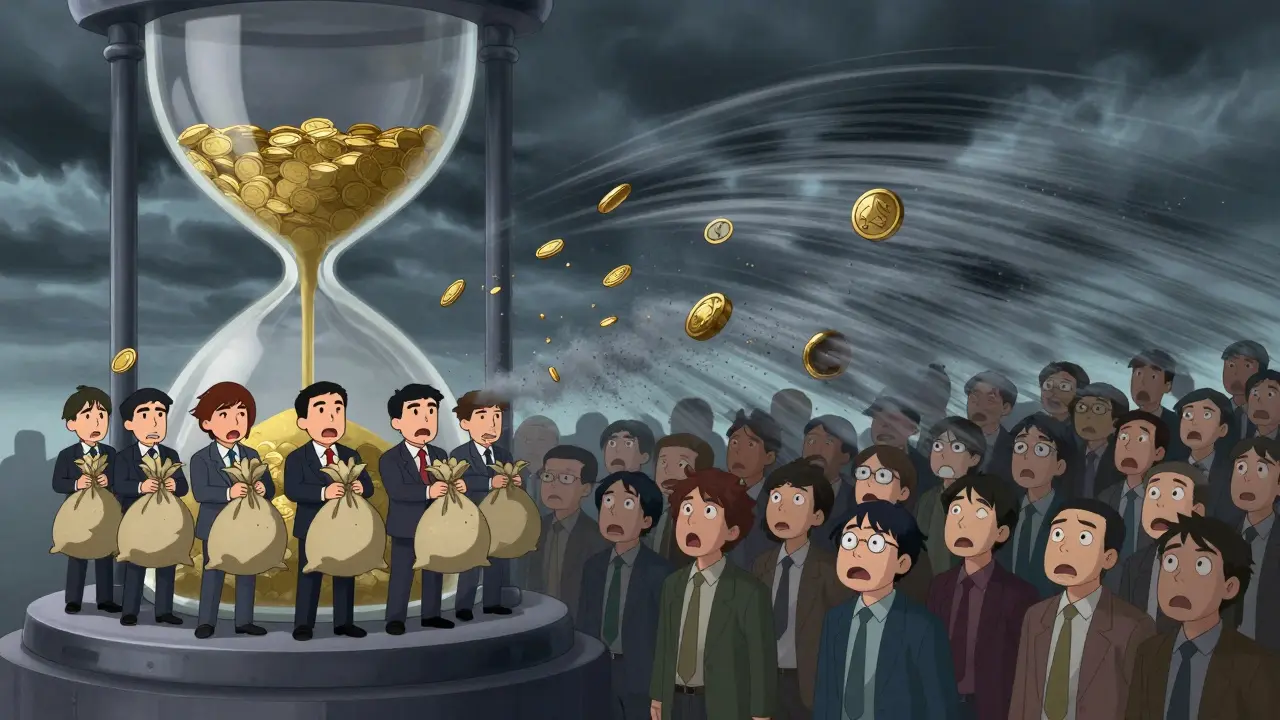
While retail investors suffered losses, the creators profited significantly. According to a Financial Times analysis in March 2025, the project generated at least $350 million in revenue. This included $314 million from token sales and $36 million in trading fees.
By April 2025, reports indicated that Trump and his partners had earned approximately $320 million in trading fees alone. Later estimates from The New Yorker suggested total profits could reach $385 million. Even though the token price dropped, the initial sale and fee structure ensured substantial returns for the insiders.
This disparity highlights a key risk in memecoin investing: the house always wins. The founders and early backers exit with millions, while later buyers are left holding depreciating assets.
Current Market Status in 2026
As of mid-2026, $TRUMP remains tradeable but lacks momentum. It ranks #47 on Coinbase and #69 on CoinGecko, indicating moderate liquidity but declining interest. Daily trading volumes vary wildly between exchanges:
- Coinbase: ~$580 million daily volume.
- CoinMarketCap: ~$130 million daily volume.
- CoinGecko: ~$113 million daily volume.
These discrepancies show fragmented liquidity. You might get a different price depending on where you buy. The fully diluted valuation (FDV)-if all 1 billion tokens were circulating-is roughly 86,644 BTC. However, since 80% of tokens are locked, this number is theoretical. Realizing this valuation would require years of gradual release, during which price pressure could remain high.
Is $TRUMP a Good Investment?
Let’s be direct: $TRUMP is not an investment; it is a gamble. Here is why:
- No Utility: The token does not provide services, governance rights, or dividends. Its value depends solely on whether someone else will pay more for it later.
- High Concentration Risk: With 80% of supply held by insiders, there is constant risk of large sell-offs crashing the price.
- Regulatory Uncertainty: As scrutiny of political conflicts of interest grows, regulators may impose restrictions on such tokens, further depressing value.
- Volatile Sentiment: Political fortunes change. If public opinion shifts against Trump, the token’s primary driver-his popularity-could vanish.
If you are considering buying, treat it like entertainment spending, not wealth building. Only invest what you can afford to lose completely.
Alternatives to Consider
If you want exposure to cryptocurrency without the extreme risks of memecoins, consider these alternatives:
- Bitcoin (BTC): The original cryptocurrency, widely accepted as a store of value.
- Ethereum (ETH): Powers decentralized applications and has real-world utility.
- Solana (SOL): The blockchain hosting $TRUMP, offering faster transactions and lower fees than Ethereum.
These assets have established ecosystems, development teams, and clearer regulatory paths. They still carry risk, but less so than a token tied to a single person’s political career.
Is $TRUMP a scam?
It is not a traditional scam because it is publicly traded and associated with a verified figure. However, its structure favors insiders heavily, and its lack of utility makes it highly speculative. Many investors view it as a risky bet rather than a legitimate investment.
Who owns $TRUMP?
20% of the supply is held by the public. The remaining 80% is owned by CIC Digital LLC and Fight Fight Fight LLC, entities affiliated with Donald Trump. These tokens are scheduled to be released over three years.
Can I buy $TRUMP on Coinbase?
Yes, $TRUMP is listed on major exchanges including Coinbase, Kraken, and Robinhood. Prices may vary slightly between platforms due to liquidity differences.
Why is the price so low now?
The price dropped from its $75 peak due to post-launch hype fading, profit-taking by early investors, and broader market skepticism toward memecoins. It currently trades around $2.87, reflecting a 96% decline.
What happens when the locked tokens are released?
As the 800 million locked tokens enter circulation over three years, supply will increase. If demand does not grow proportionally, this influx could put additional downward pressure on the price.
Tawny Holmes
July 14, 2026 AT 00:06The 80% insider lockup is the only metric that matters here. It’s a classic rug pull structure disguised as political branding.
Jessie Smith
July 15, 2026 AT 02:09one must consider the deeper metaphysical implications of such a venture, really. it is not merely a coin, but a symbol of our collective delusion regarding value in a digital age. the price drop is merely the universe correcting its own absurdity, i suppose. we are all just dancing on the head of a pin, while the pin itself dissolves into thin air. quite poetic, if you ask me.
Drew M
July 16, 2026 AT 01:01This is actually fascinating from a sociological perspective! 🤔 The way the market reacted shows how deeply emotional investment has become. It’s not about code; it’s about identity. I think we’re seeing a new era where personal brands transcend traditional finance. So cool to watch! ✨
Deep Rahman
July 16, 2026 AT 14:19I have been thinking about this for a very long time and I believe that the reason why people buy these things is because they are looking for something more than just money, which is a sad thing to say but true nonetheless. When we look at the history of human behavior, we see that we often attach value to symbols rather than substance, and this token is just another example of that ancient pattern repeating itself over and over again in our modern world. It makes me wonder if we will ever learn to value utility over hype, or if we are doomed to repeat these cycles forever.
Melissa Beckwith
July 17, 2026 AT 06:49I’ve analyzed the tokenomics extensively, and the inflationary pressure from the gradual release of the 800 million locked tokens is going to be catastrophic for any remaining holders. The math doesn’t lie. Even if demand stays static, the supply increase alone guarantees a downward trajectory. Most retail investors don’t understand basic economics, which is why they keep falling for these schemes. It’s a textbook case of asymmetric risk where the insiders win regardless of the outcome.
Josephine Finlayson
July 18, 2026 AT 21:53I think it is important to remain calm and understanding during these times... Everyone has their own reasons for investing... and perhaps there is wisdom in observing without judgment? 😊 Let us hope for better financial literacy in the future...
Andrew Schneider
July 19, 2026 AT 18:52Oh please, everyone acts like they’re so smart now that the bubble burst 🙄 But let’s be real, the ones who made millions are still laughing all the way to the bank. You can cry about your losses, but the game was rigged from the start. It’s not a scam, it’s just capitalism doing what it does best: taking from the many to give to the few. Enjoy the ride down! 📉😂
Eric Braddock
July 20, 2026 AT 21:14You’re missing the bigger picture, clearly. This isn’t just about money; it’s about control. The entities behind CIC Digital LLC are part of a larger network designed to manipulate public sentiment through algorithmic trading bots. They pump the narrative, then dump the assets on the unsuspecting masses. It’s a psyop disguised as a memecoin. Wake up!
Nick G
July 21, 2026 AT 18:53I appreciate the passion in these comments, though I do find myself reflecting on how different cultures approach risk and reward. In my experience, communities that prioritize transparency tend to fare better in the long run. Perhaps we can learn from this situation by fostering more open dialogue about ethical investing practices across borders.
Nick Wengel
July 22, 2026 AT 18:59It seems like a lot of people are upset, but maybe we should just accept that crypto is volatile. I don't know much about it, but it looks like a risky bet either way.
Alicia Hull
July 24, 2026 AT 07:25This entire operation reeks of corruption. How can anyone defend this when the President is actively profiting from his office? It’s unethical, illegal, and dangerous. We need stricter regulations immediately to prevent this kind of abuse of power.
Johan Otto
July 26, 2026 AT 06:29Wow, what a disaster! 😱 But honestly, I’m just here for the drama. The prices are tanking, but the memes are gold. Keep crying, losers! 🤡
Anuj Kashyap
July 26, 2026 AT 16:43One might argue that the concept of 'value' is entirely subjective in this context. 😏 The fact that it traded at $75 and now sits at $2.87 is less a failure of the asset and more a reflection of human irrationality. We project our hopes onto empty shells and call it investment. Quite amusing, really. 🎭