
Imagine trying to buy a coffee or order groceries using cryptocurrency. You pull out your phone, tap a card, and hope the transaction goes through instantly without costing you more in fees than the item itself. That’s the promise of ZoidPay, a fintech platform designed to bridge the gap between traditional commerce and blockchain technology. But does it actually work for everyday users, or is it just another project with big ambitions and small results?
To understand where ZoidPay stands today, we need to look past the marketing hype and examine the actual product, its technical foundation, and its place in the crowded crypto payment market. This isn't just about what the coin *could* be; it's about what it *is* right now.
The Core Concept: Bridging Fiat and Crypto
ZoidPay was founded in 2018 by Eduard Oneci and Vasily Burcin in Cyprus. Their goal was straightforward: make cryptocurrency practical for daily transactions. Most people hold Bitcoin or Ethereum as long-term investments, but spending them is notoriously difficult. Merchants don’t want to deal with price volatility, and consumers hate slow transaction times.
ZoidPay attempts to solve this by offering an end-to-end ecosystem. It’s not just a wallet; it’s a suite of tools including a Chrome extension for online shopping, a marketplace app, a non-custodial mobile wallet, and physical crypto cards. The idea is that you can use your crypto assets to pay at major retailers like Amazon or Walmart, or even in physical stores via NFC-enabled cards, while the platform handles the conversion and settlement behind the scenes.
| Component | Function | User Benefit |
|---|---|---|
| Chrome Extension | Browser-based shopping tool | Shop at any online retailer using connected wallets |
| Marketplace App | Merchant aggregator & DeFi hub | Earn cashback, stake tokens, access loans |
| Wallet App | Non-custodial storage & POS | Manage assets securely; merchants can accept crypto |
| Crypto Cards | NFC-enabled physical/digital cards | Contactless payments in-store and peer-to-peer |
Technical Evolution: From Ethereum to MultiversX
One of the most telling aspects of ZoidPay’s history is its migration path. When it launched in May 2018, it lived on the Ethereum blockchain. While Ethereum is secure and widely adopted, it became infamous for high gas fees during peak usage. For a payment platform aiming for micro-transactions, paying $5-$20 per transaction was a dealbreaker.
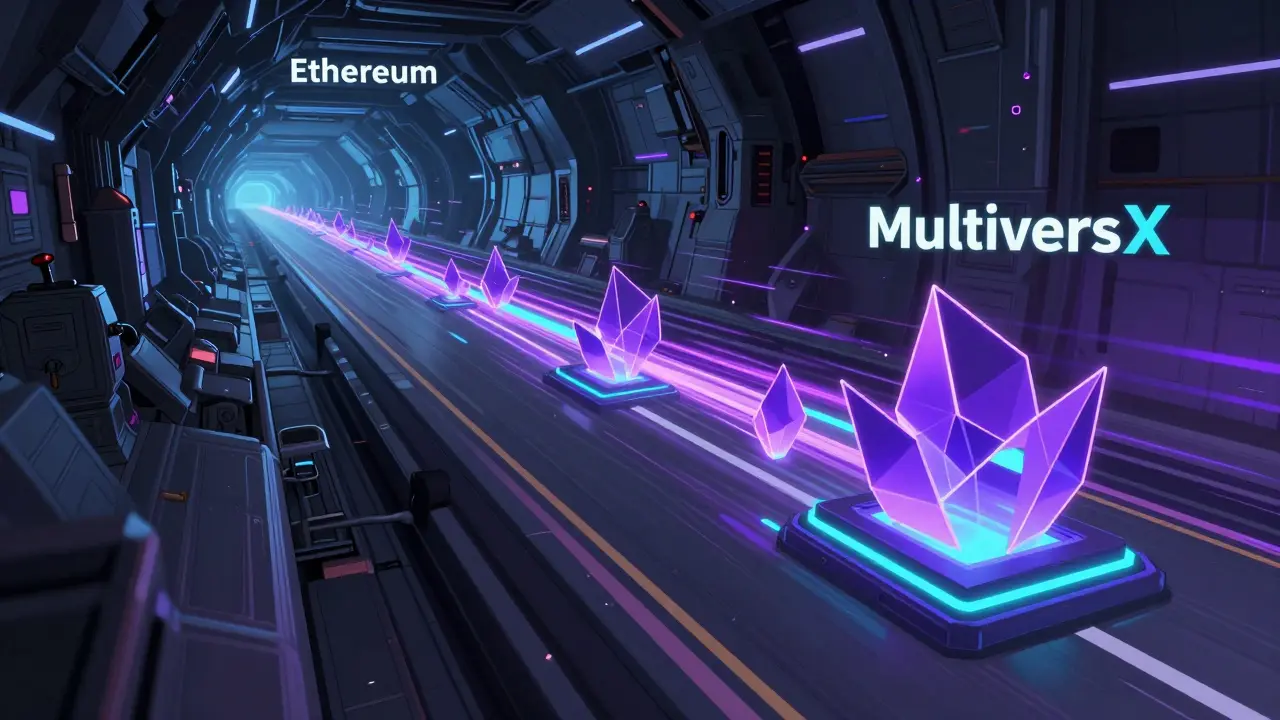
In response, ZoidPay migrated to TomoChain, a sidechain designed for faster, cheaper transactions. However, as the landscape evolved, they moved again-this time to MultiversX (formerly Elrond). This move was strategic. MultiversX offers adaptive state sharding, allowing for thousands of transactions per second (TPS) with negligible fees. This architecture is crucial for a payment processor because speed and cost are the two main barriers to mainstream adoption.
Despite these technical improvements, the native ZPAY token faces a unique challenge. With a total supply of 700 million tokens, reports from major exchanges like Coinbase indicate zero active circulation as of late 2023. This raises questions about liquidity and utility. If no one is holding or trading the token, how does it facilitate the ecosystem’s promised functions like staking or cashback rewards?
Market Reality: Liquidity and Adoption Challenges
Let’s talk numbers, because they tell a stark story. In November 2022, ZoidPay announced a massive $75 million investment from GEM Digital Limited. On paper, this looks like institutional validation. In reality, capital doesn’t equal adoption. As of recent data, the daily trading volume for ZPAY/USDT pairs hovers around $590 across all exchanges. To put that in perspective, major competitors process billions in monthly transactions.
This lack of liquidity creates a vicious cycle. Low volume means wide bid-ask spreads, which discourages traders. Fewer traders mean less interest from merchants. And without merchant acceptance, consumers have little reason to adopt the platform. Compare this to Coinbase Card or Crypto.com Visa Card, which benefit from the immense user bases of their parent companies. ZoidPay operates in relative isolation.
- Social Presence: Only ~57 Twitter followers reported in 2023, indicating minimal community engagement.
- Exchange Listings: Not available on major platforms like Coinbase or Binance, limiting accessibility.
- User Reviews: Virtually nonexistent on Trustpilot, Reddit, or other review aggregators.
For a project claiming to drive "mainstream adoption," these metrics are concerning. Mainstream adoption requires trust, visibility, and ease of use-all areas where ZoidPay currently struggles.
How ZoidPay Compares to Competitors
If you’re looking to spend crypto, you have options. Here’s how ZoidPay stacks up against established players:
| Feature | ZoidPay (ZPAY) | Crypto.com | Binance Pay |
|---|---|---|---|
| Blockchain Base | MultiversX (Elrond) | Proprietary + Multiple Chains | Binance Smart Chain + Others |
| Primary Use Case | Niche e-commerce & DeFi integration | Mainstream retail & travel | P2P transfers & exchange ecosystem |
| Liquidity | Very Low (~$590/day) | Extremely High | Extremely High |
| Card Availability | Limited regional rollout | Global (Visa/Mastercard) | Global (Mastercard/VISA) |
| Community Size | Minimal | Millions of users | Millions of users |
ZoidPay’s differentiator is its "blockchain-agnostic" approach and integrated DeFi features like Shopping Pools. However, these benefits are theoretical if users can’t easily buy, sell, or transfer the underlying token. Competitors like Crypto.com offer higher cashback rates simply because they have the scale to subsidize them.

Risks and Considerations for Users
Before diving into ZoidPay, consider these critical factors:
- Technical Complexity: The non-custodial wallet requires you to manage your own private keys. If you lose them, your funds are gone forever. This is a steep learning curve for beginners.
- Liquidity Risk: With such low trading volume, selling large amounts of ZPAY could crash the price temporarily. Exiting positions might be difficult.
- Regulatory Uncertainty: There is limited public information on ZoidPay’s KYC/AML compliance across different jurisdictions. This could pose risks for institutional partners or users in strict regulatory environments.
- Opportunity Cost: Time spent navigating a low-liquidity ecosystem could be better invested in more established platforms with proven track records.
Future Outlook: Can ZoidPay Recover?
Price predictions vary wildly. Some models suggest ZPAY could reach $0.0027 by 2026, while others predict a decline to under $0.001 by 2029. These numbers are speculative at best. The real metric to watch is adoption. Will ZoidPay secure major merchant partnerships? Will it list on top-tier exchanges? Will the community grow beyond dozens of followers?
The $75 million funding round provides runway, but execution is everything. In the crypto world, many well-funded projects fail due to poor product-market fit. ZoidPay has the technology-thanks to its MultiversX integration-but lacks the network effect required for a payment platform to thrive.
For now, ZoidPay remains a niche experiment rather than a mainstream solution. It serves those deeply interested in web3 financial services who are willing to navigate technical hurdles. For the average consumer looking to buy groceries with crypto, more robust alternatives exist.
Is ZoidPay (ZPAY) a good investment?
Investing in ZPAY carries high risk due to extremely low liquidity ($590 daily volume) and minimal market presence. While it received significant funding, the lack of exchange listings and community growth makes it speculative. Consult a financial advisor before investing.
Which blockchain does ZoidPay use?
ZoidPay originally launched on Ethereum, then migrated to TomoChain, and currently operates primarily on MultiversX (formerly Elrond) to achieve faster transaction speeds and lower fees.
Can I use ZoidPay to shop on Amazon?
Theoretically, yes. ZoidPay offers a Chrome Extension designed to connect your wallet to major online retailers like Amazon, Walmart, and eBay. However, practical usability depends on current merchant integrations and token availability.
Why is ZPAY not listed on Coinbase?
Coinbase lists assets based on rigorous criteria including liquidity, security, and community demand. ZPAY’s low trading volume and limited circulating supply likely disqualify it from meeting these standards.
What is the total supply of ZPAY tokens?
The total supply of ZPAY is 700,000,000 tokens. However, reports indicate that the amount in active circulation may be near zero, which significantly impacts tradability.