
You deposit Ethereum and USDC into a liquidity pool, expecting to earn passive income from trading fees. Months later, you check your balance and realize that if you had just held those assets in your wallet, you would have more value. You panic and withdraw everything immediately. That moment of withdrawal is exactly when impermanent loss becomes permanent. It stops being a theoretical fluctuation on a dashboard and turns into a realized financial deficit.
This concept confuses many new participants in decentralized finance (DeFi). The term "impermanent" suggests the loss might go away, which gives false hope. In reality, the loss only disappears if prices revert to their original ratio before you exit. If you pull out while the price divergence remains, the math locks in the difference forever. Understanding this crystallization event is the single most important skill for any liquidity provider who wants to survive in automated market makers (AMMs) like Uniswap or PancakeSwap.
The Mechanics of Crystallizing Loss
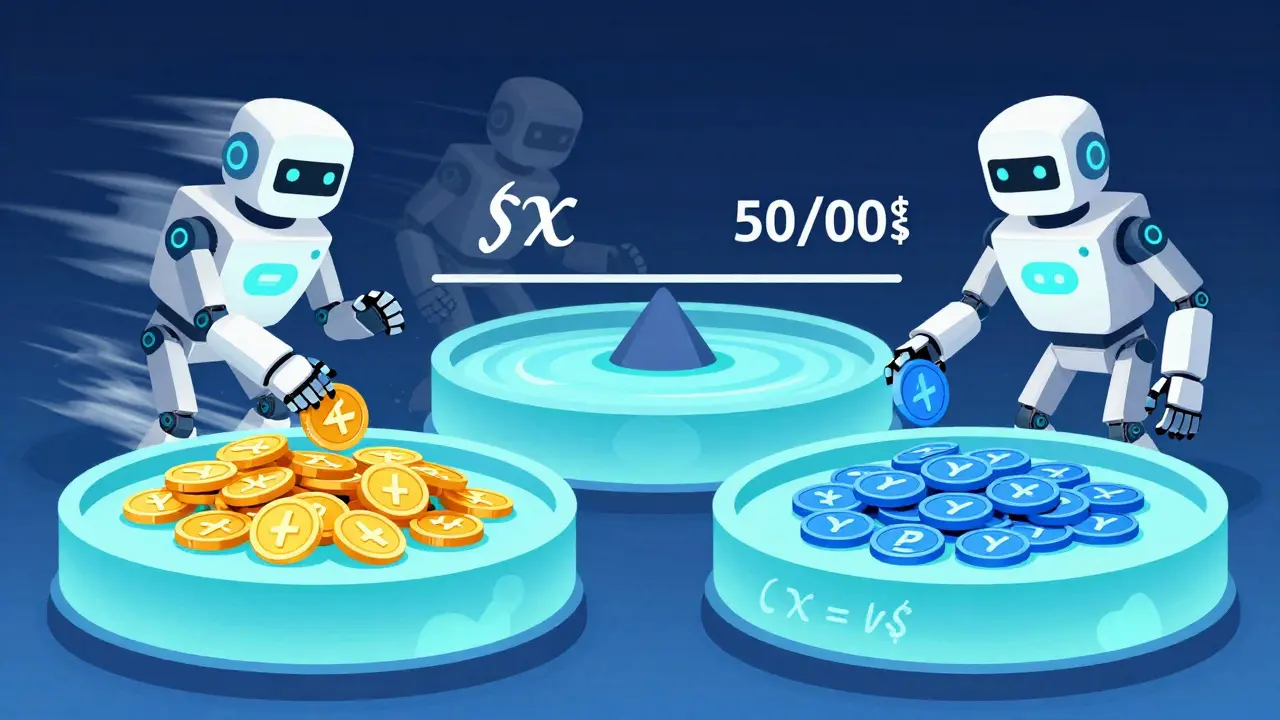
To understand when the loss becomes permanent, we first need to look at how it happens. Most AMMs use a constant product formula ($x \times y = k$). This means as one asset in the pair gets bought, the other gets sold to maintain balance. When the external market price of one token changes significantly compared to the other, arbitrage bots step in. They buy the cheaper token from the pool and sell the expensive one until the pool's internal price matches the market price.
This rebalancing changes the composition of your deposit. You started with a 50/50 split by value, but after a price surge in one asset, the pool now holds less of the rising asset and more of the stable one. While your funds are still in the pool, this is "impermanent." Why? Because if the price drops back down, the arbitrageurs will reverse the trade, rebalancing your holdings back toward the original state. The loss vanishes.
However, the moment you click "withdraw," you take that unbalanced portfolio off the hook. You accept the lower amount of the high-performing asset and the higher amount of the low-performing asset. You cannot get the optimal mix anymore. According to Dr. Georgios Konstantopoulos, Chief Scientist at Paradigm, this withdrawal is a "crystallization event." It is not a gradual process; it is an instant lock-in of the disparity between what you have in the pool versus what you would have had holding the assets separately.
Calculating the Damage: Real Numbers
Let’s look at concrete examples so you can see the math in action. Imagine you provide $1,000 worth of ETH and $1,000 worth of USDC to a pool when ETH is priced at $2,000. You deposit 0.5 ETH and 1,000 USDC.
Scenario A: ETH doubles to $4,000. Arbitrageurs buy ETH from the pool. Your position rebalances to roughly 0.35 ETH and 1,414 USDC. The total value of your pool position is now about $2,828. If you had just held the original 0.5 ETH and 1,000 USDC, your value would be $3,000 (0.5 ETH * $4,000 + $1,000). You are down $172, or about 5.7%. If you withdraw now, that 5.7% loss is permanent.
Scenario B: ETH crashes to $1,000. Your position rebalances to roughly 0.707 ETH and 707 USDC. Total value is $1,414. Holding would have yielded $1,500 (0.5 ETH * $1,000 + $1,000). You are down $86, or 5.7%. Again, withdrawing locks in this loss permanently.
The pain accelerates with volatility. At a 3x price increase, the loss jumps to 13.4%. At a 5x increase, it hits 25.5%. These aren't minor fluctuations; they are significant chunks of capital that vanish the second you exit the pool during a trend. Data from CoinGecko’s 2023 analysis shows that roughly 50% of liquidity providers on Uniswap V3 experience negative returns because these losses exceed the trading fees they earn.
| Price Change Multiplier | Impermanent Loss % | Status Upon Withdrawal |
|---|---|---|
| 1.5x (or 0.66x) | ~2.0% | Permanent Loss Locked |
| 2.0x (or 0.5x) | ~5.7% | Permanent Loss Locked |
| 3.0x (or 0.33x) | ~13.4% | Permanent Loss Locked |
| 5.0x (or 0.2x) | ~25.5% | Permanent Loss Locked |
Uniswap V3 vs. V2: The Concentration Risk
The rules change slightly depending on which protocol version you use. Uniswap V2 uses standard 50/50 pools where liquidity is spread across all possible prices. Uniswap V3 introduced "concentrated liquidity," allowing you to set a specific price range for your funds. This sounds efficient, but it drastically changes the risk profile of permanent loss.
In V3, if you set a narrow range around the current price, you earn much higher fees because your capital is working harder. However, if the price moves outside your range, your position effectively converts entirely into the less valuable asset. For example, if you set a range for ETH between $3,000 and $3,500, and ETH shoots up to $4,000, your entire position becomes USDC. You miss out on the ETH gains completely. When you withdraw, you realize a massive permanent loss relative to holding, often far exceeding the fee income you collected.
A study by Gauntlet Network found that in volatile markets, over 62% of Uniswap V3 positions in the 0.05% fee tier experienced permanent losses that wiped out their fee earnings. Narrow ranges mean faster fee accumulation but also a much higher probability of crystallizing severe permanent loss if the market trends strongly in one direction.
Strategies to Avoid Permanent Loss
You cannot eliminate impermanent loss in standard AMMs-it is baked into the math. But you can manage when it becomes permanent. Here are four practical strategies used by experienced providers.
- Stick to Correlated Assets: Provide liquidity for pairs that move together, like ETH/stETH or BTC/WBTC. Since their prices track closely, the divergence is minimal. Stablecoin pairs (USDC/USDT) have near-zero impermanent loss unless one stablecoin depegs significantly.
- Withdraw During Convergence: Monitor the price ratio. If ETH spiked and then dropped back to your entry price, the impermanent loss has vanished. Withdrawing at this point means you keep the trading fees without locking in a principal loss. This requires active monitoring, often taking 8-12 hours per week according to ConsenSys surveys.
- Choose Higher Fee Tiers: Only provide liquidity in pools with fee tiers high enough to offset potential divergence. For volatile tokens, the 0.3% or 1% fee tiers on Uniswap V3 are safer bets than the 0.05% tier. You need the fees to act as insurance against the loss.
- Use Protection Tools: Some protocols offer insurance or hedging mechanisms. Bancor v3, for instance, introduced a model that protects liquidity providers from impermanent loss up to a certain threshold. Additionally, tools like ILmentors.app allow you to simulate outcomes before you deposit.

The Human Factor: Common Mistakes
Data from user reviews on platforms like CoinGecko reveals a painful pattern. About 68% of negative reviews from liquidity providers cite "not realizing withdrawing would lock in losses" as their main regret. Users often see a red number on their dashboard representing unrealized impermanent loss and panic-sell to stop the bleeding. This is counterproductive. Selling during a divergence guarantees the loss. Waiting for price reversion offers a chance to recover.
Consider the case of a Solana liquidity provider in late 2021. They deposited funds when SOL was at $260. As the bear market hit and SOL dropped to $45, they withdrew in fear. They crystallized a 62.8% permanent loss. Had they waited for the next cycle where SOL recovered partially, the loss would have been smaller, and the accumulated fees might have offset some of the damage. Patience is a rare but profitable trait in DeFi.
Future Outlook: Can We Fix This?
The DeFi space is evolving to address this inherent flaw. Newer models like Dynamic Automated Market Makers (DAMMs) aim to adjust fees dynamically based on volatility, potentially reducing the impact of permanent loss. Balancer’s Linear Pools have shown a 62% reduction in permanent loss incidence for certain asset types. Machine learning models are also emerging; research by Flashbots suggests AI can predict price reversions with over 80% accuracy, helping users time their withdrawals better.
However, for now, the constant product formula remains king. Until alternative designs become mainstream, liquidity providers must treat impermanent loss as a real cost of doing business. It only stays "impermanent" if you have the discipline to wait for the market to return to your entry point.
Is impermanent loss actually permanent?
It becomes permanent only when you withdraw your assets from the liquidity pool while a price divergence exists. If you leave the assets in the pool and the prices eventually return to their original ratio, the loss disappears. However, if you exit early, the loss is locked in forever.
How do I calculate my impermanent loss?
You can use online calculators like CoinGecko’s Impermanent Loss Calculator. Mathematically, it is calculated using the formula: IL = (2 * sqrt(price_ratio)) / (1 + price_ratio) - 1. Most dashboards now show this value in real-time as "unrealized loss" or "divergence loss".
Does Uniswap V3 have less impermanent loss?
Not necessarily. Uniswap V3 allows for concentrated liquidity, which increases fee earnings but also increases the risk of permanent loss if the price moves out of your selected range. Narrow ranges can lead to faster and larger crystallized losses compared to broad-range V2 pools.
Can trading fees cover impermanent loss?
Yes, but it depends on volume and volatility. In highly volatile pairs with low trading volume, fees rarely cover the loss. In high-volume pairs with moderate volatility, fees can offset the impermanent loss, resulting in a net profit even if the price diverges.
What is the best way to avoid permanent loss?
The safest method is providing liquidity for correlated assets (like ETH/stETH) or stablecoins. Alternatively, actively monitor your positions and only withdraw when the price ratio has reverted to near your entry point, ensuring you keep the fees without locking in a principal loss.